wayground logo

Free Printable Worksheets

Font size

S
M
L
XL
Worksheets

Particle model revision

Total questions: 136

Worksheet time: 2hrs 37mins

Name
Class
Date
1.
How do gases behave in a container?
a)
Cluster together
b)
form a solid
c)
They take the shape of their container
d)
leak out 
2.
How do materials change from one state of matter to another?
a)
They gain or lose energy
b)
They break appart
c)
The particles get stickyer
d)
They are magnetised to themselves
3.
What sorts of things are made of particles?
a)
Everything in the universe
b)
Anything solid
c)
Water 
d)
Most solids, liquids and gases. 
4.
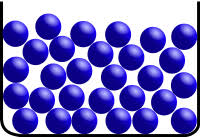
Which description best matches this particle model?
a)
Closely packed and can't move a lot. 
b)
Particles are close together but can move a little. 
c)
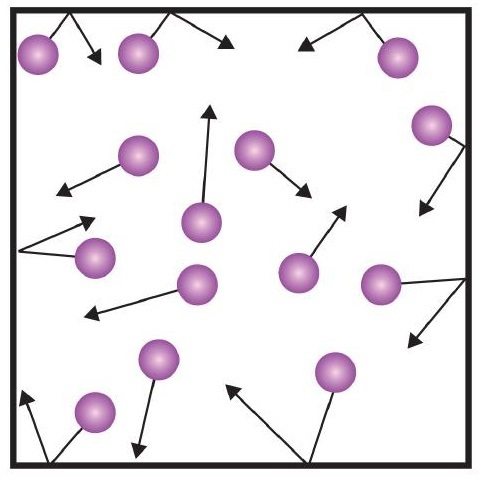
Particles have lots of energy and can move around. 
5.
Which description best matches this particle model?
a)
Closely packed and can't move a lot. 
b)
Particles are close together but can move a little. 
c)
Particles have lots of energy and can move around. 
6.

Gas to liquid is

a)

Condensation

b)

sublimation

c)

deposition

d)

evaporation

7.

Liquid to solid is

a)

freezing

b)

Melting

c)

Boiling

d)

Steaming

8.

Solid to a liquid is

a)

freezing

b)

boiling

c)

steaming

d)

melting

9.

Liquid to a Gas is

a)

Melting

b)

Vaporisation (evaporation or boiling)

c)

Condensation

d)

Sublimation

10.

How close together particles are is called?

a)

Mass

b)

Weight

c)

Vibrate

d)

Density

11.
Which states allow easy flow of particles
a)
Gas and Solid
b)
Gas and Liquid
c)
Solid and Liquid
d)
Gas only
12.
Which of the following is a property of a liquid
a)
Can't be compressed
b)
Can be compressed
c)
Particles are far appart
d)
Particles hold the object's shape 
13.
Can Solids be compressed?
a)
No
b)
Yes
c)
Sometimes (it depends what it's made of)
d)
Generally no
14.

Solids have...

a)

a fixed shape and a fixed volume

b)

a fixed shape but can change volume

c)

No fixed shape but a fixed volume

d)

no fixed shape or volume

15.

Which state of matter can be compressed easily?

a)

solid

b)

liquid

c)

gas

d)

all of them

16.

Which TWO things will not increase the pressure of a gas?

a)

adding more particles

b)

cooling particles

c)

heating the particles up

d)

Making a stretchy container

17.
What am I? I have a fixed mass, a fixed volume, I cannot be squashed and I have a shape that changes to fit the bottom of my container?
a)
solid
b)
liquid
c)
gas
d)
plasma
18.

When particles move from areas of high concentration to areas less concentrated, this has taken place.

a)

diffusion

b)

expansion

c)

contraction

d)

condensation

19.
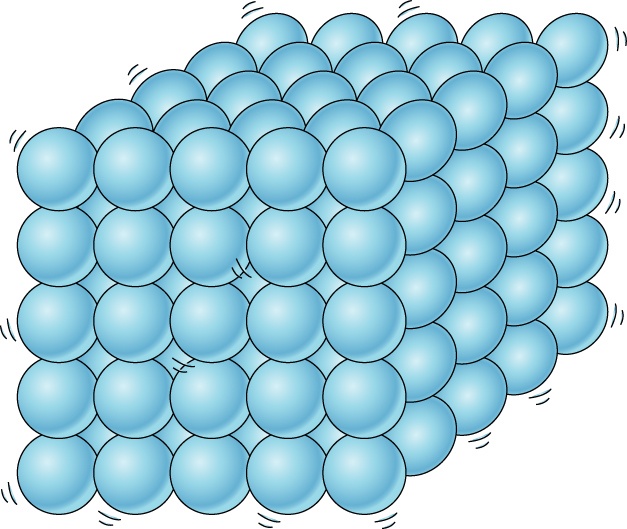
The molecules in the picture are tightly held together with little movement. They have shape and energy.  Therefore, the picture represents _________.
a)
solid
b)
liquid
c)
gas
d)
plasma
20.
What is the formula for density?
a)
density = mass x volume
b)
density = mass / volume
c)
density = mass + volume
d)
density = mass - volume
21.

If a hairspray can is heated, what can be expected of the pressure of the gas inside the can?

a)

The pressure will increase

b)

The pressure will decrease

c)

The pressure will remain constant

d)

The pressure will equalize

22.

The reason gases can be compressed is because:

a)

The particles are very close together.

b)

The particles are merely vibrating.

c)

The particles are unable to move.

d)

The particles are very far apart.

23.
Adding HEAT to matter causes its particles to:
a)
move faster and farther apart
b)
Move slower and farther apart
c)
Move faster and closer together
d)
Move slower and closer together
24.

Which of the following is not a state of matter

a)

Ice

b)

Gas

c)

Liquid

d)

Solid

25.

Latent Heat of Fusion: The amount of energy required to change the state of 1kg a substance from solid to liquid at fixed _____________

a)

Quantity

b)

Heat Energy

c)

Temperature

d)

Pressure

26.

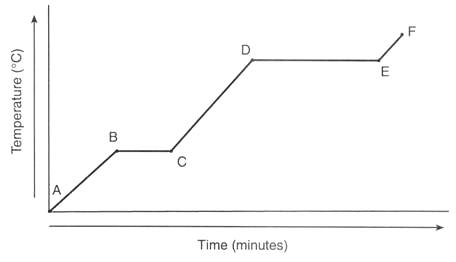
What is the graph called?

a)

Melting and Boiling graph

b)

Temperature Graph

c)

Heating Curve of a substance

d)

Graph of Temperature and heating up

27.

At which point does the substance finish boiling

a)

B

b)

C

c)

E

d)

F

e)

D

28.

At Which point is the Kinetic Energy Store increasing?

a)

B-C

b)

C-D

c)

D-E

d)

All of the above

29.

At stage is the Potential Energy Store increasing?

a)

A-B

b)

B-D

c)

C-D

d)

D-E

30.

Which stage is a gas heating up?

a)

F

b)

A

c)

D

d)

B

31.

Which is true of liquids?

a)

Particles arranged in an ordered manner

b)

Particles are not touching one another.

c)

Particles are quite closely packed

d)

Particles can vibrate but not move around

32.

A cube of metal has side 2 cm. It weighs 10g. Find its density.

a)

5 g / cm3

b)

20 g / cm3

c)

0.2 g / cm3

d)

1.25 g / cm3

33.
What two types of measurements make up DENSITY
a)
Mass and Volume
b)
Temperature and Mass
c)
Grams and Centimeters
d)
Volume and Weight
34.

It's the amount of heat required to change the state (gas,liquid, solid) of a unit of material

a)

Latent Heat

b)

Specific Heat

c)

Temperature

d)

Q

35.

Which state of matter has particles that move the least/slowest?

a)

solid

b)

water

c)

gas

36.
Which of the following is not a property of a solid?
a)
It expands a little when heated compared to a liquid
b)
It takes any shape of a container
c)
It is not easy to be compressed
d)
It usually has a higher density than a gas
37.
Which of the following occurs when a liquid becomes a gas?
a)
the particles slow down
b)
the particles beak away from one another
c)
the particles move closer together
38.
How do the particles of matter move as the matter changes state in the diagram?
a)
The particles released energy and move as matter changed state?
b)
The particles released energy and moved more quickly.
c)
The particles gained energy and moved more slowly.
d)
The particles gained energy and moved more quickly.
39.

Which two states of matter can flow?

a)

solid and gas

b)

liquid and solid

c)

liquid and gas

40.

Which state of matter has tightly packed particle in fixed positions?

a)

solid

b)

liquid

c)

gas

41.
Which container will have lower pressure?
a)
left
b)
right
c)
they both have the same pressure
42.

Which will heat up faster?

a)

copper

b)

granite

c)

iron

d)

basalt

43.

Which will heat up slower?

a)

water

b)

lead

c)

granite

d)

iron

44.
If I heat up 2 pans of water one has 100 mL in it and one has 1000mL. Which one heats up the fastest?
a)
100 mL
b)
1000 mL
c)
They both heat up at the same speed
d)
They cool down.
45.

Which of the following best explains why the sand at the beach is hotter than the water?

a)

Sand has a higher specific heat than water.

b)

Sand has a lower specific heat than water.

c)

There is more water than sand at the beach.

d)

There is more sand than water at the beach.

46.
When a  piece of aluminum foil is taken out of the oven and cools from 100° to 50°, What is the change in temperature?
a)
50°
b)
c)
100°
d)
150°
47.
What would be the effect on the particles if more heat is supplied to the system?
a)
They would slow down
b)
They would stop moving
c)
They would speed up
d)
There would be no effect
48.
Copper, Stainless Steel, Carbon Steel, and Zinc were all heated using the same thermal energy.  What material would be the coolest after being heated?
a)
Copper
b)
Carbon Steel
c)
Zinc
d)
Stainless Steel
49.
Specific heat of water is  4.18 J/g°C. Specific heat of wood is 1.760 J/g°What material needs more heat energy to raise the temperature?
a)
Water
b)
Wood
c)
Both are same
50.
What unit do you use to measure Thermal Energy?
a)
J/Kg ºC
b)
Kg
c)
ºC
d)
J
51.

What letter is used to represent specific heat capacity?

a)

H

b)

P

c)

C

d)

T

52.

What is Specific Heat Capacity?

a)

The amount of thermal energy required to increase the temperature of 1kg of a material by 1°C.

b)

The amount of radiant energy required to increase the temperature of 1kgof a material by 1°C

c)

The amount of energy required to increase the temperature of 1kgof a material by 1°C.

d)

The amount of friction required to increase the temperature of 1kgof a material by 1°C.

53.

Water molecules have the greatest kinetic energy in

a)

Ice at 0 ⁰C

b)

Water at 90 ⁰C

c)

Water at 373 K

d)

Steam at 150 ⁰C

54.
The amount of energy required to raise the temperature 1ºC for every kilogram is called____?
a)
Thermal Energy
b)
Specific Heat
c)
Temperature
d)
Kinetic Energy
55.
A material was cooled from 100ºC to 40ºC.  What is the temperature change?
a)
60ºC
b)
40ºC
c)
-60ºC
d)
-40ºC
56.
How does heat flow?
a)
Always from cold to warm
b)
Always from warm to cold
c)
Both warm to cold & cold to warm
d)
It depends on the temperature
57.
There are four cups of hot cocoa. The cup sizes are shown. The temperature of the cocoa in each cup is 25 degrees celsius. Which cup has the MOST thermal energy?
a)
Large cup (Trenta)
b)
Small cup (Tall)
c)
Venti
d)
All three are the same temperature so they have same thermal energy
58.

The heat absorbed by melting a solid is known as

a)

latent heat of fusion

b)

latent heat of solid

c)

latent heat of liquid

d)

latent heat of vaporisation

59.

specific latent heat of vaporisation is

a)

the amount of heat required to change 1 kg of the substance from the solid to liquid phase without change in temperature

b)

the amount of heat required to change 1 kg of the substance from the liquid to gaseous phase without change in temperature

c)

the amount of heat required to change the temperature 1 kg of the substance by 1 degree Celcius

60.

Name the process at QR

a)

melting

b)

boiling

c)

condensation

d)

freezing

61.

Solid starts to melt at

a)

P

b)

Q

c)

R

d)

S

62.

Use the picture to select the correct statement.

a)

Oil is denser than water

b)

Pasta is less dense then crayon

c)

The paper clip is denser than every thing else

63.

Which liquid is the least dense?

a)

Oil

b)

Water

c)

Syrup

d)

Plastic bottle

64.

Put the liquids in order from most dense to least dense?

a)

4,3,2,1

b)

1,2,3,4

c)

3,4,2,1

d)

4,3,1,2

65.

What causes an object to sink in a water?

a)

if the object's density is less than the water's density.

b)

if the object's density is the same as water's density.

c)

if the object's density is greater than water's density.

d)

if the object's density is zero

66.

You are given a mystery object in science class. Your teacher asks you to determine if your object is more or less dense than water. You place the object in the water and it sinks. What statement would best describe this situation?

a)

The mystery substance is denser than water.

b)

Water is denser than the mystery substance.

c)

They both have the same mass.

d)

The mystery substance must be hollow.

67.

An object will float in a liquid if it is

a)

cooled to the same temperature.

b)

heated to the same temperature.

c)

less dense than the liquid.

d)

more dense than the liquid.

68.

When two materials that have different densities, like oil and water, encounter one another, they will?

a)

exchange densities.

b)

mix uniformly.

c)

repel one another.

d)

separate according to their densities.

69.

Two cubes of the same size were measured. Cube A was 52 grams and cube B was 130 grams. Which cube has the greatest density?

a)

A

b)

B

70.

What is the independent variable

a)

Anything that can change

b)

The thing you change

c)

The thing you measure at the end

d)

The thing you keep the same

71.

What is the dependent variable

a)

Anything that can change

b)

The thing you change

c)

The thing you measure at the end

d)

The thing you keep the same

72.

What is a control variable

a)

Anything that can change

b)

The thing you change

c)

The thing you measure at the end

d)

The thing you keep the same

73.
Molecules have energy and _________ stop moving
a)
rarely
b)
always
c)
never
d)
sometimes
74.
Matter changes state when...
a)
energy is added or removed
b)
energy is added
c)
energy is removed
d)
there is no energy
75.
As molecules gain energy, they move _____ and spread apart, and vise versa.
a)
faster
b)
slower
c)
less
d)
inside
76.
Energy(heat) is added in order to go from ...
a)
solid to gas
b)
liquid to solid
c)
gas to liquid
d)
gas to solid
77.
Energy(heat) is removed in order to go from ....
a)
gas to solid
b)
solid to liquid
c)
solid to gas
d)
liquid to gas
78.
Suppose you pour a glass of ice water and set it on the kitchen table. After a few minutes, the outside of the glass will be covered with drops of water. Why did this happen?
a)
Oxygen in the air cooled and condensed onto the cold glass.
b)
Water vapor in the air cooled and condensed onto the cold glass.
c)
Water vapor in the air cooled and evaporated onto the cold glass.
d)
Water seeped through pores in the glass.
79.
What happens to a substance when it changes from a liquid to a solid?
a)
it gains mass
b)
it gains energy
c)
it loses mass
d)
it loses energy
80.

What type of energy does a substance lose when it cools?

a)

thermal

b)

gravitational

c)

nuclear

d)

potential

81.
Which is needed for both boiling and melting to occur?
a)
solids
b)
gases
c)
heat
d)
pressure
82.
 The process where water vapor changes from a gas to a liquid is called:
a)
sublimation
b)
precipitation
c)
evaporation
d)
condensation
83.
What happens when my glass of water is sitting in the sun and disappears into a gas?
a)
evaporation
b)
burning
c)
melting
d)
freezing
84.

The average kinetic energy of the particles in a substance

a)

internal energy

b)

temperature

c)

heat

d)

thermodynamics

85.

The transfer of internal energy

a)

temperature

b)

kinetic energy

c)

thermodynamics

d)

heat

86.
Which of these is not a state of matter?
a)
Solid
b)
Liquid
c)
Gas
d)
Atom
87.
Which state of matter cannot flow
a)
Solid
b)
Liquid
c)
Gas
88.
In which state of matter do the particles move the fastest?
a)
Solid
b)
Liquid
c)
Gas
89.
In which state of matter are the particles in a fixed position?
a)
Solid
b)
Liquid
c)
Gas
90.
In which state of matter are the forces/bonds the strongest?
a)
Solid
b)
Liquid
c)
Gas
91.
In which state of matter are the forces/bonds the weakest?
a)
Solid
b)
Liquid
c)
Gas
92.
How do particles move in a gas?
a)
Randomly
b)
Slowely
c)
Organised
93.
How do particles move in a gas?
a)
Fast
b)
Slow
94.
Are substances freezing points always cold?
a)
Yes
b)
No
95.
Are substances melting points always hot?
a)
Yes
b)
No
96.
What happens to the pressure a gas exerts as its heated?
a)
Increases
b)
Decreases
c)
Stays the same
97.
What type of energy do gas particles gain more of when heated?
a)
Gravitational potential
b)
Kinetic
c)
Elastic
d)
Nuclear
98.
How do you work out the mass of an object?
a)
weigh it on a balance
b)
work outs its volume
c)
find out its density
99.
What are the units for mass if density needs to be calculated in kg/m3?
a)
kg
b)
g
c)
dm3
d)
cm3
100.
What are the units for density if mass is kg and volume is m3?
a)
kg/cm3
b)
cm3/kg
c)
kgcm3
d)
kg/m3
101.
What are the units for volume if density needs to be calculated in g/cm3?
a)
kg
b)
g
c)
dm3
d)
cm3
102.
How do you calculate the volume of a cuboid?
a)
width x length x height
b)
height x length
c)
height x length / width
d)
width / mass x length
103.
How do you calculate the volume of an irregular shaped object?
a)
submerge the object in a eureka can and measure the water displaced using a measuring cylinder
b)
submerge the object in a eureka can
c)
measure it
d)
width x length x height
104.
What happens to the internal energy of a substance as it is heated?
a)
increases
b)
decreases
c)
doesn't change
105.
What happens to the number of particles as you heat them up and change its state?
a)
Increases
b)
decreases
c)
doesn’t change
106.
What happens to the number of particles as you cool them down and change its state?
a)
Increases
b)
decreases
c)
doesn’t change
107.
What can happen to substances when their internal energy increases?
a)
change state
b)
increase in temperature
c)
decrease in temperature
108.
What can happen to substances when their internal energy decreases?
a)
change state
b)
increase in temperature
c)
decrease in temperature
109.
The energy needed to change 1kg of a solid into a liquid (melt all of it)?
a)
specific latent heat
b)
specific latent heat of vaporisation
c)
specific latent heat of fusion
110.
The energy needed to change 1kg of a liquid into a gas (evaporate all of it)?
a)
specific latent heat
b)
specific latent heat of vaporisation
c)
specific latent heat of fusion
111.
What is happening when a substance is melting?
a)
Bonds are forming
b)
Bonds are breaking
c)
Bonds are weakening
112.
What is happening when a substance is evaporating?
a)
Bonds are forming
b)
Bonds are breaking
c)
Bonds are weakening
113.
What is happening when a substance is condensing?
a)
Bonds are forming
b)
Bonds are breaking
c)
Bonds are weakening
114.
How do you calculate the energy needed to melt something?
a)
specific latent heat x mass
b)
specific latent heat / mass
c)
mass / specific latent heat
115.
How do you calculate the energy needed to evaporate something?
a)
specific latent heat x mass
b)
specific latent heat / mass
c)
mass / specific latent heat
116.

In which section of the graph is melting happening?

a)

Between A and B

b)

Between B and C

c)

Between D and E

d)

Between E and F

117.
Which of these is not a state of matter?
a)
Solid
b)
Liquid
c)
Gas
d)
Atom
118.
In which state of matter are the particles in a fixed position?
a)
Solid
b)
Liquid
c)
Gas
119.

What is density?

a)

The mass of a substance compared to it's volume

b)

How heavy an object is

c)

The size of an object

d)

The volume of the object divided by mass

120.

Which equation links density, mass and volume?

a)

Density = mass ÷ volume

b)

Density = volume ÷ mass

c)

Density = mass2 ÷ volume

d)

Density = volume2 ÷ mass

121.

Which change is state takes place when a liquid turns to a gas at the fastest rate possible?

a)

Melting

b)

Freezing

c)

Boiling

d)

Evaporating

122.

Which type of change are changes in state?

a)

Chemical change

b)

Physical change

123.

What is internal energy?

a)

The total potential and kinetic energy in a system

b)

The total kinetic energy in a system

c)

The total potential energy in a system

d)

The total potential and chemical energy in a system

124.

Which state of matter has the greatest internal energy?

a)

Solid

b)

Liquid

c)

Gas

125.

Which state of matter has the lowest internal energy?

a)

Solid

b)

Liquid

c)

Gas

126.

What is potential energy?

a)

The energy stored in particles because of their position

b)

The energy stored in particles because of their motion

c)

The energy stored in particles because of their temperature

127.

State the equation that links specific heat capacity, energy, mass and temperature

a)

Energy = mass x specific heat capacity x change in temperature

b)

Specific heat capacity = energy x mass x temperature

c)

Change in temperature = energy x mass x specific heat capacity

d)

Mass = change in temperature x specific heat capacity x energy

128.

What is the relationship between pressure in a gas and volume?

a)

Pressure in a gas is inversely proportional to volume

b)

Pressure in a gas is directly proportional to volume

c)

Pressure in a gas and volume show a positive correlation

d)

There is no relationship between pressure in a gas and volume

129.

What is gas pressure?

a)

The force exerted by a gas when particles collide with a surface

b)

How often gas particles collide with a surface

c)

How easily gas particles collide with a surface

d)

The speed of gas particles colliding with a surface

130.

Why doesn't temperature change during melting?

a)

Energy is transferred to weaken the forces between particles

b)

Energy is transferred the strengthen the forces between particles

c)

Energy is dissipated to the surroundings

d)

Energy is dissipated, heating up the object holding the solid material
131.

Why doesn't temperature change during evaporation?

a)

Energy is transferred to weaken the forces between particles

b)

Energy is transferred the strengthen the forces between particles

c)

Energy is dissipated to the surroundings

d)

Energy is dissipated, heating up the object holding the solid material

132.
Which description best matches this particle model?
a)
Particles are closely packed, vibrate fixed position, strong intermolecular forces.
b)
Particles are closely packed, no movement, strong intermolecular forces
c)
Particles are closely packed, move around each other, medium intermolecular forces
133.

Which description best matches this particle model?

a)

Particles are closely packed, move around each other, strong/medium intermolecular forces

b)

Particles are loosely packed, move around each other, strong/medium intermolecular forces

c)

Particles are closely packed, move randomly around each other and have weak intermolecular forces.

134.
The mass after a physical change in a closed system, such as ice melting into water, stays the same
a)
True
b)
False
135.
Between which points is the substance changing state?
a)
A-B only. 
b)
A-B, C-D, E-F
c)
B-C only. 
d)
B-C, D-E
136.
If a gas is heated the pressure increases because ...
a)
the particles increase in speed
b)
the particles hit the sides more often
c)
the particles hit with more force
d)
the particles increase in speed, hit more frequently and with more force