
 Worksheets
kassim Hafiz Hope Quiz on Transamination, Deamination, and Urea Cycle
Total questions: 21
Worksheet time: 54mins
Which enzyme catalyzes transamination reactions?
Aspartate transaminase (AST)
Glutamate dehydrogenase
Carbamoyl phosphate synthetase
Urease
What coenzyme is required for transamination reactions?
FAD
NAD+
Pyridoxal phosphate (PLP)
Coenzyme Q
In which organ do most transamination reactions occur?
Brain
Liver
Heart
Lungs
In which part of the cell do transamination reactions occur?
Nucleus
Cytosol
Mitochondria
Ribosome
Which amino acid does not undergo transamination?
Lysine
Alanine
Glutamate
Aspartate
What is the most commonly transaminated amino acid?
Glutamate
Glycine
Valine
Leucine
What are the two types of deamination?
Oxidative and Non-oxidative
Hydrolytic and Transaminative
Reductive and Oxidative
None of the above
Which enzyme is involved in oxidative deamination?
Glutamate dehydrogenase
Aspartate transaminase
Urease
Pyruvate kinase
Which enzyme is involved in non-oxidative deamination?
Serine dehydratase
Glutamate dehydrogenase
Carbamoyl phosphate synthetase
Urease
Which amino acid does not undergo deamination?
Serine
Proline
Alanine
Glutamate
Which enzyme catalyzes the first reaction of the urea cycle?
Aspartate transaminase
Carbamoyl phosphate synthetase I (CPS-I)
Argininosuccinate synthetase
Ornithine transcarbamoylase
What is the end product of the urea cycle?
Ammonia
Urea
Glutamate
Aspartate
How many steps are involved in the urea cycle?
3
4
5
6
Where do the first two steps (step 1 ,2) of the urea cycle occur?
Cytosol
Mitochondria
Endoplasmic reticulum
Golgi apparatus
Where do the remaining steps (3,4,5) of the urea cycle occur?
Cytosol
Mitochondria
Endoplasmic reticulum
Nucleus
What is hyperammonemia?
Excess urea in the blood
Excess ammonia in the blood
Excess glucose in the blood
None of the above
What is the transportable form of ammonia?
Fructose
Glutamine
Glucose
Non of the above
Why is ammonia not transported in free form in the blood?
It is highly soluble in blood.
It is toxic to the body.
It is poorly reactive in blood.
It is too large to travel freely.
What is the significance of carbamoyl phosphate in the urea cycle?
It is an end product of the urea cycle.
It initiates the cycle by combining with ornithine.
It transports ammonia in the blood.
It converts ammonia to glutamine.
Which enzyme move ornithine from cytosol into mitochondria ?
Ornithine translocase
Argininosuccinate lyase
Citrulline translocase
Urease
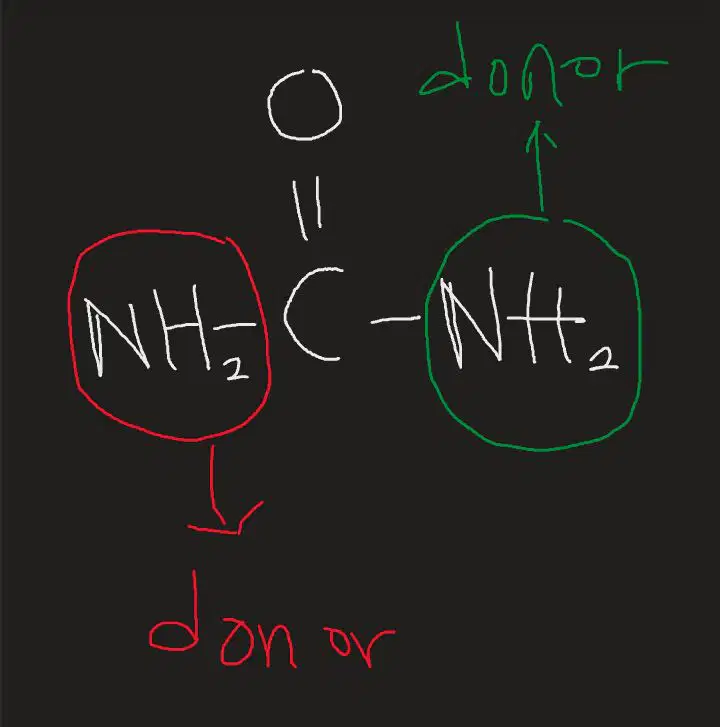
Who are the donors of the nitrogen atom represented in red and green in urea structure shown above?
Ammonia and amino acid(aspartate)
Lysine and benzene
Glucose and fructose
All of the above

