
NEW
Font size
S
M
L
XL
 Worksheets
Bio-Semester 1 Exam Review (2025)
Total questions: 64
Worksheet time: 32mins
Name
Class
Date
1.
Which defines energy?
a)
ability to do work
b)
creation of heat
c)
increase of disorder
d)
power to change
2.
Which occurs during the Krebs cycle?
a)
breaking down pyruvate
b)
caputuring light energy
c)
creating glucose molecules
d)
producing ethyl alcohol
3.
What process: One molecule of glucose is broken down into two pyruvate molecules.
a)
cellular respiration
b)
glycolysis
c)
photosynthesis
4.
Which identifies the relationship between photosynthesis and cellular respiration?
a)
Both processes generate energy for cell use
b)
Both processes release energy for cell use
c)
the products of one process are used as reactants by the other process.
d)
The reactants of one process are also the reactants fo the other process
5.
Where in the cell does the Krebs cycle occur?
a)
chloroplast
b)
cytoplasm
c)
mitochondrion
d)
nucleus
6.
What process includes the Calvin cycle?
a)
cellular respiration
b)
photosynthesis
7.
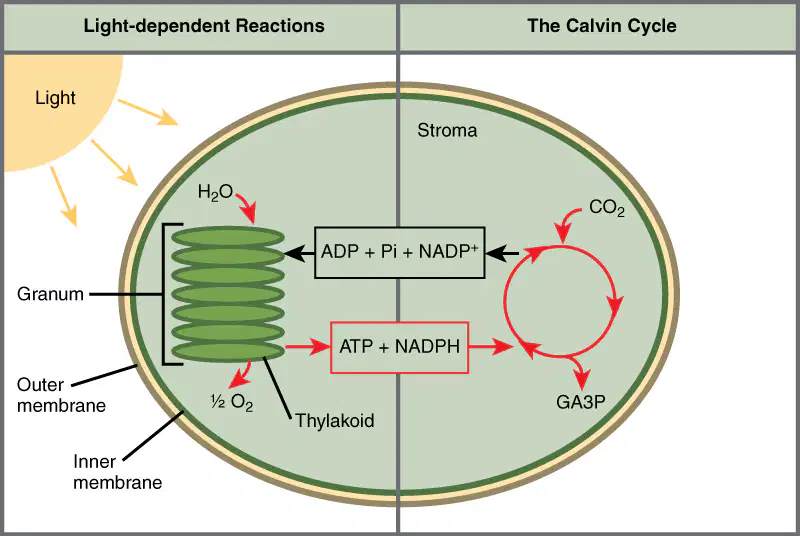
Which is formed during the light-dependent phase of photosynthesis?
a)
ATP
b)
glucose molecules
c)
NADP
d)
ADP
8.

Which describes the process of fermentation?
a)
Aerobic process the manufacturers pyruvate
b)
aerobic process that restores NAD supply
c)
anaerobic process that manufactures pyruvate
d)
anaerobic process that restores NAD supply
9.
Photosynthesis and cellular respiration are functional opposites of each other.
a)
true
b)
false
10.
Only animals undergo cellular respiration.
a)
true
b)
false
11.
The chemical equation for photosynthesis is 6CO2 + 6H2O → C6H12O6 + 6O2
a)
true
b)
false
12.
Which is a product of photosynthesis?
a)
water
b)
ATP
c)
carbon dioxide
d)
glucose
13.
Chlorophyll is the primary pigment in plant chloroplasts. It absorbs all wavelengths of light except...
a)
green
b)
yellow
c)
blue
d)
red
14.
ATP is a compound that is synthesized when which occurs?
a)
Chemical bonds between carbon atoms are formed in photosynthesis
b)
Digestive enzymes break amino acids into smaller parts
c)
energy stored in chemical bonds is released during cellular respiration
d)
energy stored in nitrogen is released forming amino acids
15.
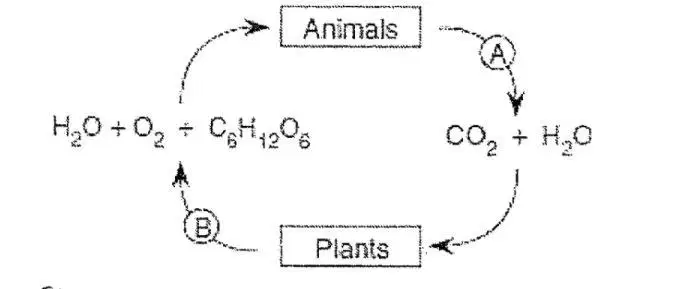
In the material cycle shown below, which processes are represented by A and B?
a)
A- respiration b- photosynthesis
b)
a- excretion b- respiration
c)
a- transcription b- excretion
d)
a- photosynthesis b- transpiration
16.
Which of the following is a reactant used in cellular respiration?
a)
the product of photosynthesis
b)
rubsico
c)
carbon dioxide
d)
ion channels
17.
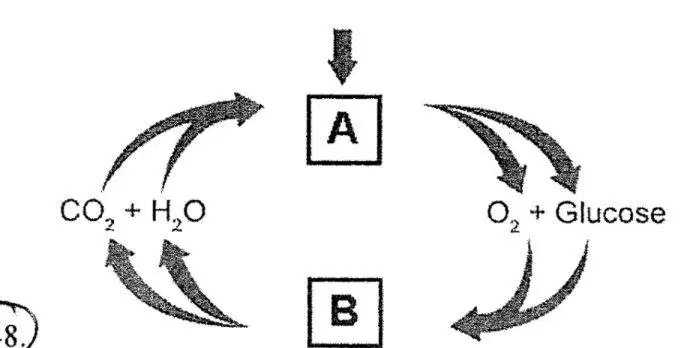
Which metabolic process is photosynthesis?
a)
A
b)
B
18.
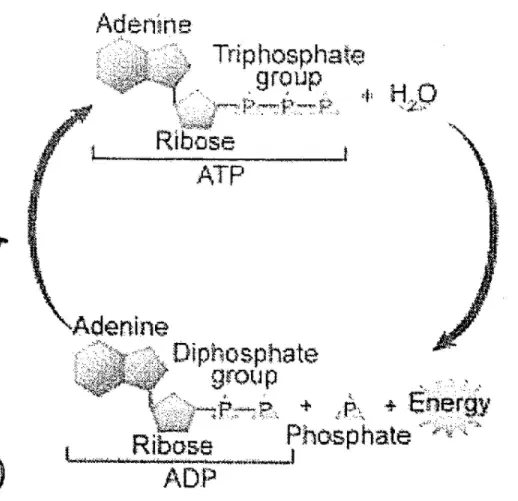
Which molecule is released when ATP becomes ADP?
a)
phosphate group
b)
water
c)
ribose
d)
adensine
19.
A metabolic process that does not require oxygen is ____
a)
anaerobic
b)
aerobic
c)
anabolic
d)
entropy
20.
A cougar's role as a predator often involves eating weakened or diseased animals. This is a description of the ___ of cougars.
a)
habitat
b)
community
c)
niche
d)
none of these
21.
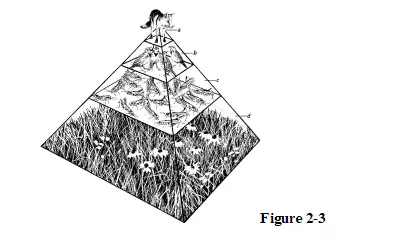
Which of the following is the ultimate source of energy for the pyramid in Figure 2-3?
a)
grass
b)
heat
c)
sunlight
d)
water
22.
Which process describes nitrogen fixation?
a)
animals eat plants containing nitrogen and return it to the soil through urination
b)
bacteria take nitrogen from the air and convert it to a form useable by plants
c)
organisms die and are decomposed into ammonia in the soil
d)
plants take nitrogen from the air and store it in their roots
23.

In Figure 3-1, which section would account for a lower number of organisms near the bottom of a pond due to a short supply of oxygen and sunlight?
a)
A
b)
B
c)
C
d)
D
24.
Which of these species might be classified as a pioneer species?
a)
ponderosa pine
b)
choke cherry
c)
aspen
d)
lichen
25.
A flowering plant has seeds that are carried by the wind. Infer the most likely dispersion pattern of the plants that grow from these seeds.
a)
uniform
b)
clumped groups
c)
random
d)
spatial
26.
A fruit fly that has a short life span and produces many offspring can be classified into which reproductive strategy?
a)
r-strategist
b)
k-strategist
c)
a carrying-capacity strategist
d)
a logistic strategist
27.

Which area in Table 5-1 has the greatest biodiversity?
a)
Area A
b)
Area B
c)
Area C
d)
Area D
28.
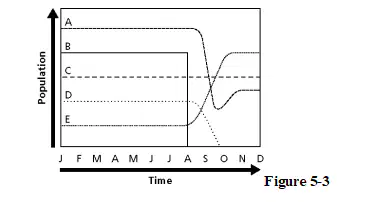
Examine the graph in Figure 5-3. Which species were NOT affected by the loss of species B?
a)
species A, C, and E
b)
species C and E
c)
species C only
d)
species E only
29.
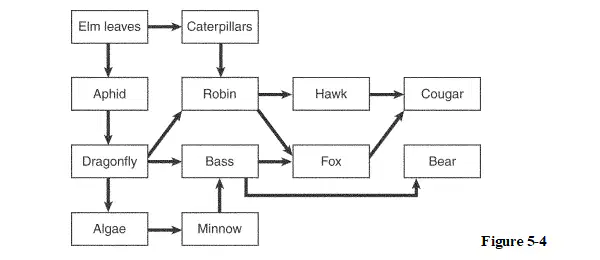
Examine the food web shown in Figure 5-4. Suppose a herbicide is used to kill some of the algae in this ecosystem. The herbicide does not break down in the environment. Inside the cells of which organisms would you expect to find the highest amount of herbicide?
a)
algae
b)
cougar
c)
elm tree
d)
minnow
30.
Which of the following practices can help conserve an area's biodiversity?
a)
biological magnificaiton
b)
habitat fragmentation
c)
species introduction
d)
sustainable usage
31.
Which is the negatively charged particle located outside the nucleus of an atom?
a)
electron
b)
neutron
c)
silicon
d)
proton
32.
A single covalent bond forms when two atoms do which of these?
a)
when they share one electron
b)
when they share two electrons
c)
when one gives an electron to the other
d)
when one gives two electrons to the other
33.
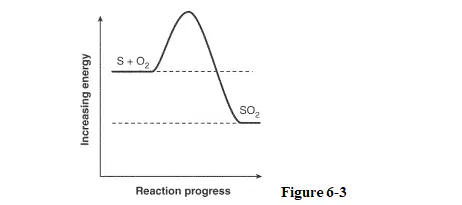
Consider the energy diagram for a chemical reaction in Figure 6-3. Overall, is energy released or absorbed?
a)
absorbed, because the energy level increases during the reaction
b)
absorbed, because the energy level of the products is greater than that of the reactants
c)
released, because the reaction is initiated by the addition of heat
d)
released, because the energy level of the reactants is greater than that of the products
34.
Which property is responsible for the fact that water and oil do not mix?
a)
density
b)
mass
c)
phase
d)
polarity
35.
An organism's genetic information is stored in which type of macromolecule?
a)
DNA
b)
carbohydrate
c)
lipid
d)
protein
36.
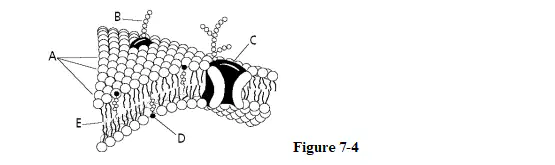
Where are you least likely to find water in the structure shown in Figure 7-4?
a)
A
b)
B
c)
C
d)
E
37.
Which statement is true about bacterial cells
a)
The cells are very large.
b)
The cells have no nucleus.
c)
They are eukaryotes.
d)
They have organelles.
38.
Chloroplasts are organelles that convert light energy to sugars. These organelles are found only in plants. Which organelles are found only in animals?
a)
golgi apparatus
b)
lysosomes
c)
mitochondria
d)
ribosomes
39.
What is a major difference between facilitated diffusion and active transport
a)
Active transport moves substances against the concentration gradient.
b)
Active transport uses proteins in the process.
c)
Facilitated diffusion moves molecules through the plasma membrane.
d)
Facilitated diffusion requires large amounts of energy.
40.
Which of the following is an example of passive transport?
a)
endocytosis
b)
exocytosis
c)
facilitated diffusion
d)
Na+/K+ ATPase pump
41.
Which activity is an example of the human body striving to maintain homeostasis?
a)
creating thoughts to solve a difficult problem
b)
digesting foods to reduce their particle size
c)
producing sweat to reduce body temperature
d)
sprinting across a street to avoid oncoming traffic
42.
Which is an autotroph?
a)
alga
b)
mushroom
c)
sparrow
d)
wolf
43.
Which is an example of mutualism?
a)
a fish protecting a shrimp, who build a burrow for the pair to share
b)
a peacock courting and mating with a peahen
c)
crayfish and minnows resting under the same rock
d)
two snake species with similar markings advertising their toxic venom
44.
Demography is the study of ____
a)
available resources.
b)
biosphere health.
c)
human population.
d)
organism competition.
45.
Which defines extinction?
a)
A species disappears.
b)
An ecosystem vanishes.
c)
Biodiversity decreases.
d)
Genetic diversity drops.
46.
Which defines an atom?
a)
building block of energy
b)
building block of matter
c)
charged particle
d)
smallest particle
47.
Which substance would be extensively studied during a college organic chemistry course?
a)
glucose
b)
oxygen
c)
sodium
d)
water
48.
Which macromolecule is involved in nearly every function in the human body?
a)
carbohydrate
b)
lipid
c)
nucleotide
d)
protein
49.
Which defines a cell?
a)
microscopic organisms in water
b)
protein molecules in animals
c)
the basic unit of living things
d)
the smallest type of animal
50.
Which is a protein fiber that forms the cell's supporting network?
a)
cytoskeleton
b)
cell wall
c)
endoplasmic reticulum
d)
plasma membrane
51.
Which manufactures ribosomes?
a)
nucleolus
b)
nucleus
c)
endoplasmic reticulum
d)
plasma membrane
52.
Which organelle is large in plant cells but small or absent in animal cells?
a)
centriole
b)
chloroplast
c)
nucleolus
d)
vacuole
53.
The portion of Earth that supports the existence of living things is the _____.
a)
ecosystem
b)
habitat
c)
biosphere
d)
niche
54.
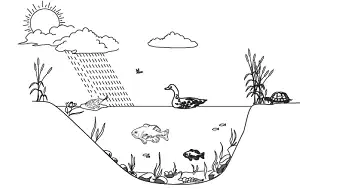
The illustration below shows living and nonliving factors that interact in a certain area. Which term best describes the interactions shown in the diagram?
a)
biome
b)
food chain
c)
ecosystem
d)
population
55.
What event is most likely to initiate primary succession?
a)
forest fire
b)
heavy rain
c)
logging
d)
volcanic eruption
56.

What does the line graph below show?
a)
The population increased at a constant rate.
b)
The population increased at a rapid rate and then leveled off.
c)
The population increased at an exponential rate.
d)
Ecosystems are able to support any number of species.
57.
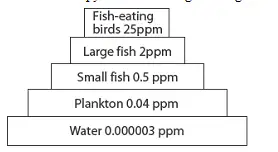
What does the pyramid of biological magnification shown below illustrate?
a)
Higher trophic carnivores eat very little food.
b)
Toxic substances increase as trophic levels increase in a food chain.
c)
Acid precipitation destroys underwater habitats.
d)
The process of eutrophication destroys underwater habitats.
58.
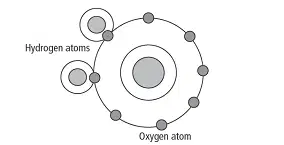
What makes a water molecule polar?
a)
Water has the ability to be frozen.
b)
The pH of pure water varies with the temperature.
c)
A water molecule has a slight charge on each end.
d)
A water molecule is made up of three atoms.
59.
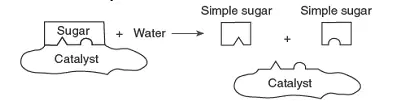
The diagram below illustrates a biochemical process that occurs in organisms. The substance labeled "catalyst" is also known by what other name?
a)
antibody
b)
enzyme
c)
ion
d)
inorganic compound
60.
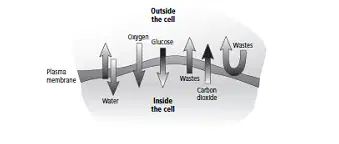
What characteristic of the plasma membrane is illustrated in this drawing?
a)
selective permeability
b)
phospholipid bilayer
c)
fluid mosaic construction
d)
impermeability to water
61.
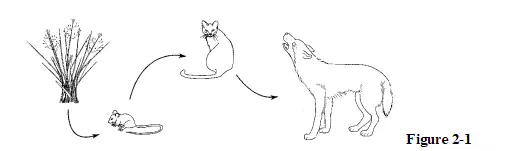
Referring to Figure 2-1, suppose 10,000 units of energy are available at the level of the grasses. What is the total number of energy units lost by the time energy reaches the mouse?
a)
9000 units
b)
990 units
c)
9900 units
d)
9990 units
62.
Sugar dissolves in or mixes completely with water. The solubility of a substance in water is determined by measuring the maximum amount of the substance that dissolves in a given amount of water at a given temperature. Hypothesis: The solubility of sugar in water decreases as the temperature of the water decreases. Identify the independent variable and the dependent variable that you would use to test this hypothesis.
a)
dependent variable -- volume of water; independent variable -- water temperature
b)
dependent variable -- water temperature; independent variable -- amount of sugar that dissolves
c)
dependent variable -- amount of sugar that dissolves; independent variable -- water temperature
d)
dependent variable -- amount of sugar that dissolves; independent variable -- mineral content of the water
63.
A scientist performs a series of experiments to confirm an idea regarding cellular metabolism. The results of the experiments support the scientist's initial idea, and after conferring with colleagues, the scientist discovers that evidence from many experiments has supported the same idea. This idea could now be considered a(n) _______.
a)
theory
b)
hypothesis
c)
observation
d)
control
64.
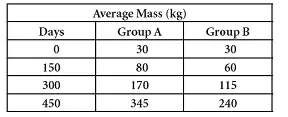
Some cattle were given bovine growth hormone (BGH) to see if they would produce more meat. The animals were studied over a period of two years. Animals in Group A were injected with BGH. Animals in group B were not injected with BGH. The table shows the results of the investigation. Which is a valid conclusion from this data?
a)
BGH does not bring about an increase in mass.
b)
The more BGH injected into the animal, the faster its mass will increase.
c)
Animals injected with the hormone will increase in mass faster than those who are not injected.
d)
Animals injected with BGH will not increase mass as fast as animals that are not injected.
Reset

