Wayground logo

Free Printable Worksheets

Font size

S
M
L
XL
Worksheets

Fall Semester Review

Total questions: 67

Worksheet time: 2hrs 35mins

Name
Class
Date
1.
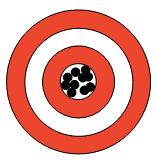
This bullseye demonstrates...
a)
High Accuracy & High Precision
b)
High Accuracy & Low Precision
c)
Low Accuracy & High Precision
d)
Low Accuracy & Low Precision
2.
?
a)
High Accuracy & High Precision
b)
High Accuracy & Low Precision
c)
Low Accuracy & High Precision
d)
Low Accuracy & Low Precision
3.
A set of data are all close to each other, but they are not close to the actual value.  This set of data can be described as...
a)
accurate
b)
precise
c)
both precise and accurate
4.

Measurements: 24.9, 25.2, 25.1, 24.8

True Value: 25.0

These measurements are…

a)

Accurate, but not precise

b)

Precise, but not accurate

c)

Both precise and accurate

d)

Neither precise nor accurate

5.

WHAT IS THE VOLUME?

a)

36

b)

36.5

c)

37.0

d)

36.0

6.

An atom of iodine has 7 valence electrons. What will an atom of iodine MOST likely do to be stable?

a)

Lose 1 electron

b)

Lost 7 electrons

c)

Gain 1 electron

d)

Neither gain nor lose any valence electrons

7.

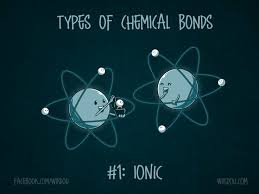
What type of bond is formed when atoms share electrons?

a)

Covalent

b)

Ionic

c)

Hydrogen

d)

Polyatomic

8.
How is carbon-12 different from carbon-14?
a)
They have a different number of protons
b)
they have a different number of electrons
c)
they have a different number of neutrons
9.

What is the mass number for the isotope shown?

a)

29

b)

34

c)

63

d)

92

10.

How many neutrons are in the nucleus of copper-63?

a)

29

b)

34

c)

63

d)

92

11.

How close a measurement or a set of data is to the true value is called..

a)

Accuracy

b)

Precision

c)

Significant

d)

Estimate

12.

Which of the choices is the best measurement to write for the blue line pictured when using proper metric measurement technique?

a)

3.57

b)

30.57

c)

30.7

d)

35.7

13.
Which of the following is a chemical property?
a)
odor
b)
flammability
c)
boiling point
d)
conductivity
14.
Which of the following is a physical property?
a)
Ability to react with oxygen
b)
Ability to rust
c)
Ability to burn
d)
Ability to conduct electricity
15.

Which of the following is an example of a physical change?

a)
rusting iron
b)
burning wood
c)
melting ice
d)
cooking an egg
16.
Which of the following is an example of a physical change?
a)
Burning wood
b)
Cooking an egg
c)
Melting ice
d)
Rusting iron
17.

Match the following

a)

Physical property

1.

Color

b)

Physical property

2.

Melts at 145 °C

c)

Physical property

3.

Good conductor of heat

d)

Chemical property

4.

Burns easily (flammable)

e)

Chemical property

5.

Reacts violently with chlorine

18.
Flammability (burns)
a)
Physical Property
b)
Chemical Property
19.
Melting point
a)
Physical Property
b)
Chemical Property
20.

Has definite volume

Takes the shape of its container

particles slide past each other at medium speed

a)

solid

b)

liquid

c)

gas

21.

Has no definite shape

Has no definite volume

fast moving particles that are far apart

a)

solid

b)

liquid

c)

gas

22.

Has no definite shape

Has no definite volume

fast moving particles that are far apart

a)

solid

b)

liquid

c)

gas

23.
An ionic bond forms when 
a)
Valence electrons are shared
b)
a sea of mobile electrons surround the cations
c)
valence electrons are transferred between atoms
d)
none of the above
24.

What is the ion formed from Sulfur? If it has 6 valence electrons.

a)

S+2

b)

S-2

c)

S+6

d)

S-6

25.

A Bromine ion gains 1 electron, which of the following is the correct symbol for a Bromine ion?

a)

Br-1

b)

Br+1

c)

Br+7

d)

Br-7

26.

When an atom loses a valence electron, it becomes a _____________ ion.

a)

positive

b)

negative

c)

neutral

d)

polyatomic

27.
What electron configuration matches an oxygen atom?
a)
1s22s22p63s2, 3p64s23d104p5
b)
1s22s22p4
c)
1s22s22p6
d)
1s22s22p63s23p64s23d1
28.
The electron configuration of an atom is 1s22s22p6.  The number of electrons in the atom is 
a)
3
b)
6
c)
8
d)
10
29.
Which electron configuration belongs to Chlorine (Cl)?
a)
1s2 2s2 2p6 3s2 3p5
b)
1s2 2s2 2p6 3s2 3p6
c)
1s2 2s2 2p6 3s2 3p7
30.
Anions are _______ that form ____________ ions and __________ electrons.
a)
nonmetals, positive, lose
b)
nonmetals, negative, gain
c)
metals, positive, gain
d)
metals, positive, lose
31.
What is the electron configuration for F?
a)

1s2 2s2 3p5

b)

1s2 2s2 3d5

c)

1s2 2s2 2p5

d)

1s2 2p5

32.

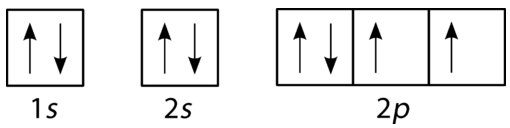
This orbital diagram represents the electron configuration for:  

a)
C
b)
B
c)
N
d)
O
33.
This is the correct dot diagram for sodium (Na)
a)
true
b)
false
34.

By replacing the element symbol, this could be a diagram of which element?

a)

Li

b)

Al

c)

C

d)

Be

35.

What is the noble gas configuration for Cobalt?

a)

[Kr] 4s2 3d7

b)

[Kr] 4s2 4d7

c)

[Ar] 4s2 3d7

d)

[Ar] 4s2 4d7

36.
This orbital diagram represents:  
a)
C
b)
B
c)
N
d)
O
37.
What is incorrect about this orbital diagram?
a)
Both arrows in the 2p box should be pointing up
b)
There is nothing incorrect with this diagram
c)
In the 2p box there should only be 1 electron in the first 2p box and one in the 2nd 2p box
d)
All the arrows should be pointing up.
38.

Which of the following particles are located in the nucleus of the atom? (You may select more than one answer.)

a)

proton

b)

neutron

c)

electron

39.

Name this group: These metals are the second most reactive.

a)
b)
c)
d)
40.

Name this group: These metals are the most reactive.

a)
b)
c)
d)
41.

What is the most reactive nonmetal?

a)

Iodine

b)

Fluorine

c)

Chlorine

d)

Bromine

42.

Which color on the image of the periodic table corresponds with the noble gases?

a)

Black

b)

Red

c)

Blue

d)

Orange

43.
Which has the greater Electronegativity: 
N or C?
a)
C
b)
N
44.

Which of the following has the greatest Atomic Radii?

a)

Rb

b)

In

c)

Sb

d)

Xe

45.

Which of the following elements will most likely form cations?

a)

Oxygen

b)

Iodine

c)

Magnesium

d)

Sulfur

46.

Which element's atom is larger? Nitrogen or Phosphorus?

a)

Nitrogen

b)

Phosphorus

47.

Which element's atom is the smallest?

a)

Rhodium

b)

Silver

c)

Cadmium

d)

Tin

48.

Name the following compound: NaCl

(a)  

49.

Write the name of the following compound: CaSO4

(a)  

50.

Octanitrogen tetroxide

a)
N8O3
b)
N7O3
c)

N2O

d)
N8O4
51.

CS2

a)

monocarbon disulfide

b)

carbon bisulfide

c)

carbon disulfide

d)

carbon disulfer

e)

monocarbon sulfide

52.

SCl6

a)

sulfur hexachloride

b)

monosulfur hexachloride

c)

sulfide hexachloride

d)

sulfur heptachloride

e)

sulfur chloride

53.

P4H7

a)

tetraphosphorus heptahydrogide

b)

phosphorus heptahydride

c)

tetraphosphorus heptahydride

d)

tetraphosphorus hexahydride

e)

tetraphosphorus heptahydrogen

54.
Name the following ionic compound: Cs2S
a)
cesium sulfide
b)
cesium sulfate
c)
cesium (II) sulfate
d)
cesium (II) sulfide
55.
Name the following compound: SnO2
a)
tin(II) oxide
b)
tin(IV)oxide
c)
tin(II)oxygen 
d)
tin oxide
56.
Zn3P2
a)
Zinc Phosphide
b)
Zinc (II) Phosphide
c)
Trizinc Diphosphide
d)
Zinc Phosphate
57.
What is the formula for Potassium Fluoride? 
a)
KF
b)
K2F
c)
KF2
d)
none of the above
58.
Name the compound CaF2
a)
calcium difluoride
b)
calcium (II) fluoride
c)
calcium fluorite
d)
calcium fluoride
59.
Name the following ionic compound: FeCl3
a)
iron chloride
b)
iron (III) chloride
c)
iron chlorate
d)
iron (III) chlorate
60.

The name for Al(OH)3 is

a)

aluminum(III) hydroxide

b)

aluminum trihydroxide

c)

aluminum hydroxide

d)

monaluminum trihydroxide

e)

aluminum(I) hydroxide

61.

How would you name the compound CuSO4?

a)

copper(II) sulfate

b)

copper sulfate

c)

copper(III) sulfate

d)

copper(II) sulfide

62.
When naming ionic compounds with transition metals you need to include roman numerals to show the _____ of the metal..
a)
atomic number
b)
mass number
c)
charge
d)
ionization energy
63.

Name the compound CuO

a)

copper (II) oxide

b)

copper oxide

c)

copper (I) oxide

d)

carbon uranium oxide

64.
The chemical compound for sodium phosphate would be:
a)
NaPO4
b)
Na2PO4
c)
Na3PO4
d)
Na(PO4)3
65.

Select the correct Lewis structure for Li2O:

a)
b)
c)
d)
66.

Electrons located on the outermost shell are called _________ electrons

a)

Hybrid

b)

Atomic

c)

Neutral

d)

Valence

67.

What do we call electrons that move freely in a metallic bond?

a)

sea of electrons

b)

lone electrons

c)

unpaired electrons

d)

covalent electrons