
Font size
 Worksheets
Review 1st semester
Total questions: 86
Worksheet time: 1hrs 6mins

What is pictured in the illustration?
Mitochondria
Protein channels
Protein layer
Phospholipid bilayer

The purple regions of the image represent:
Phospholipid
Protein channel
Cholesterol
Carbohydrates
When water uses a channel protein called AQUAPORIN. What type of transport is this?
Osmosis
Diffusion
Active Transport
Facilitated Diffusion

The concentration of red molecules outside the cell is higher than the concentration inside the cell. The red molecules cannot penetrate the cell. What will happen to the cell?
Water will leave the cell, and the cell will shrink. The solution is isotonic.
Water will enter the cell, and the cell will expand. The cell is isotonic.
Water will enter the cell, and the cell will expand. The cell is hypertonic.
Water will leave the cell, and the cell will shrink. The solution is hypertonic.

Which cell is in a hypertonic solution?
A
B
C
What protects carrot cells (plant) from swelling too much when it rains?
They have cell walls that keep them from swelling too much.
They don't swell because rain is absorbed by the roots.
They have pores in their cell membranes that keep them from swelling.
The rain water is hypertonic to the cells so the cells lose water.
The variable you are measuring.
independent
dependent
constant
bio- means
study
eco-
life
Homeostasis is
keeping a stable internal environment
eating food
sweating
keeping your balance
Cells can be
multi-celluar
unicelluar
both
What YOU change as the experimenter
independent variable
constant variable
dependent variable
How many level in our taxonomy system?
5
4
7
All living things:
reproduce
grow & develop
use energy (eat)
all of these
Auto=self A living thing that is an autotroph can:
grow & develop
make food by itself
watch Stars Wars movies ;-)
di= two Using a dichotomous key means that you read ____ questions and then make a choice.
4
3
2
A cell´s structure refers to:
specific parts of the cell
plant cells
multi-cellular animals
A cell´s function refers to:
what the cell is made of
what the cell does (hair cell, root cell etc.)
how the cell interacts with other cells
Tissues in your body are groups of cells that:
less organized than cells
work together to form blood clots
work together to perform a specific function
Level of classification that has the MOST living things.
class
domain
phylum
A dichotomous key helps you to classify:
all living things
some living things
just plants
When you write the name of a living thing it should be:
Genus-species Canis lupus
Species-genus Lupus Canis
Class-order Mammalia Carnivora

How long is the paper clip?
3 cm
4cm
5cm
Which is true when using a digital balance?
You should leave the cover on.
You should press down on it to make sure it works.
You should hold it level in the air when using.
You should make sure it says 0.00 before you place anything on the scale.


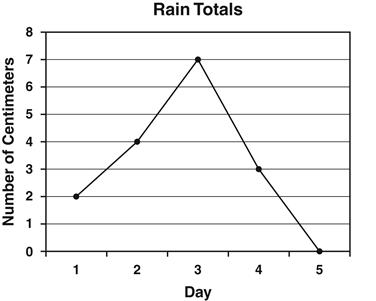
Annie recorded the amount of rain that fell each day. The results are shown in the line graph below. How many centimeters of rain fell on the third day?
2
3
4
7

What type of graph is this?
line plot
line graph
bar graph
frequency table
The X axis represents the _________ variable.
Independent
Dependent
The Y axis represents the ____________ variable.
Independent
Dependent

What units does the item above measure in?
kilograms (Kg)
pounds (lbs)
grams (g)
inches (in)

Which objective lens should you start on to locate an image?
scanning power
low power
high power
What is a claim?
Answers a question or problem
long and detailed paragraph
Explains why something happened
What is evidence ?
Answers a question
Anything you see, hear or read or experience that causes you to believe something is true.
Long and detailed paragraph
What is an example of reasoning?
Honey is stored in hives.
Honeybees store their honey in hives.
Honeybees use hexagons to store the honey and pollen they bring to the hive.
What is an example of evidence?
Football players are 33% more likely to get injured than baseball players.
Football is more dangerous than baseball.
Baseball is a fun sport.

50 ml of water was added to the graduated cylinder. After we drop in the object, the new water level goes up to 60 ml. What is the volume of the blocks?
8 ml
10 ml
60 ml
5 ml
How many characteristics of life must an organism exhibit to be considered a living thing?
All of them
Some of them
At least three
At least one.
_______ are the smallest units of life because they grow, reproduce, respond, and use energy.
atoms
elements
cells
all of the above
Cells come from______.
other preexisting cells
cytoplasm
organelles
prokaryotes
The cell theory states that_________
cells come from cells
all organisms are made of cells
cells are the basic unit of structure and function for life
all of the above
________ is the scientist who saw small chambers when looking at cork, and named them “cells”.
Newton
Hooke
Carson
Manning
The size of an organism is determined -
by the size of the cells that make up the organism.
by the number of cells that the organism has.
The cell theory is a result of the work of one very important scientist name Hooke.
True
False
A multicellular organism is made of
one cell
multiple cells
unicellular cells
there is no such thing as a "multicellular" organism
One common feature of all cells is their ability to -
work with other cells in a "unicellular" organism.
reproduce themselves.
be formed by spontaneous generation.
exist without needing a cell membrane
When a cell is ready to reproduce, it duplicates its contents, then divides into two similar (and sometimes exact duplicate) cells.
True
False
Regardless of type, all cells
have a cell membrane
have cytoplasm
can duplicate themselves by undergoing cell division
all of the above
Cell Membrane
maintains homeostasis by controlling what enters and leaves the cell
suspends the organelles and provides an environment for chemical reactions within the cell
makes proteins
provides structure for cells and movement of organelles
Cytoplasm
maintains homeostasis by controlling what enters and leaves the cell
suspends the organelles and provides an environment for chemical reactions within the cell
makes proteins
provides structure for cells and movement of organelles
Ribosome
maintains homeostasis by controlling what enters and leaves the cell
suspends the organelles and provides an environment for chemical reactions within the cell
makes proteins
provides structure for cells and movement of organelles
Cytoskeleton
maintains homeostasis by controlling what enters and leaves the cell
suspends the organelles and provides an environment for chemical reactions within the cell
makes proteins
provides structure for cells and movement of organelles
Nucleus
stores genetic information (DNA)
makes and transports proteins
makes lipids and membranes (also detoxifies and stores calcium)
modifies, sorts, and ships proteins
Rough Endoplasmic Reticulum
stores genetic information (DNA)
makes and transports proteins
makes lipids and membranes (also detoxifies and stores calcium)
modifies, sorts, and ships proteins
Smooth Endoplasmic Reticulum
stores genetic information (DNA)
makes and transports proteins
makes lipids and membranes (also detoxifies and stores calcium)
modifies, sorts, and ships proteins
Golgi Bodies
stores genetic information (DNA)
makes and transports proteins
makes lipids and membranes (also detoxifies and stores calcium)
modifies, sorts, and ships proteins
Mitochondria
creates energy (ATP) from food; site of cellular respiration
stores food, water, or wastes with the cell; plant cells have a special vacuole
uses enzymes to digest bacteria, viruses, and old organelles (old cell parts are recycled)
create special structures called spindle fibers that are used in cell division
Vacuole
creates energy (ATP) from food; site of cellular respiration
stores food, water, or wastes with the cell; plant cells have a special vacuole
uses enzymes to digest bacteria, viruses, and old organelles (old cell parts are recycled)
create special structures called spindle fibers that are used in cell division
Lysosome
creates energy (ATP) from food; site of cellular respiration
stores food, water, or wastes with the cell; plant cells have a special vacuole
uses enzymes to digest bacteria, viruses, and old organelles (old cell parts are recycled)
create special structures called spindle fibers that are used in cell division
Centrosome/Centrioles
creates energy (ATP) from food; site of cellular respiration
stores food, water, or wastes with the cell; plant cells have a special vacuole
uses enzymes to digest bacteria, viruses, and old organelles (old cell parts are recycled)
create special structures called spindle fibers that are used in cell division
Cell Wall
provides shape, structure, and protection for the cell
site of photosynthesis; uses the sun's energy to produce food
stores water in order to maintain plant shape (if a plant needs water, it wilts)
site of cellular respiration
Chloroplast
provides shape, structure, and protection for the cell
site of photosynthesis; uses the sun's energy to produce food
stores water in order to maintain plant shape (if a plant needs water, it wilts)
site of cellular respiration
Central Vacuole
provides shape, structure, and protection for the cell
site of photosynthesis; uses the sun's energy to produce food
stores water in order to maintain plant shape (if a plant needs water, it wilts)
site of cellular respiration
What is the key role (function) of carbohydrates?
energy storage
immunity, muscles, structure for tissues, cell metabolism
instant energy for cells and body functions
genetic information (heredity)
How how carbohydrates and lipids similar?
both contain C, H, O, N, P and store energy
both contain C, H, O, N and give energy
both contain C, H, O, N, S and store energy
both contain C, H, O and give energy
The monomer for carbohydrates is a monosaccharide.
True
False
Lipids key role (function ) is:
immunity, chemical reactions in the body, cell metabolism, contract muscles, regulate other proteins
store energy
instant energy for cells/body
heredity/genetic information
What elements (monomers) make up a protein?
C, H, O
C, H, O, N
C, H, O, N, P
What is the smallest unit of a macromolecule?
micromolecule
glucose
monomer
polymer
What elements (monomers) make up nucleic acids?
C, H, O
C, H, O, N, (S)
C, H, O, N, P
Carbohydrates are necessary for chemical reactions in our body.
true
false
Sugars (saccharides) are not carbohydrates.
false
true
Match the protein with the correct picture.


What is the key role (function) of a protein?
instant energy for the cell/body
hormones, buoyancy, forms cell membranes, insulation, energy storage
growth, repair, and energy, immune system, enzymes
store and transmit genetic information/heredity
Identify the monosaccharide:


Identify the lipid:


Identify the nucleic acid:


Identify the key role of nucleic acids:
instant energy
hormone, buoyancy, forms cell membranes, insulation, energy storage
transport hemoglobin, immunity,chemical reactions, regulate proteins, tissue structure
store and transmit heredity, genetic information
Carbohydrates have C, H, O. What is the ratio of elements?
2:1:2
1:3:1
1:2:1
3:1:3
The monomer for a lipid is:
monosaccharide
fatty acid
nucleotide
amino acid
The monomer for a nucleic acid is:
fatty acid
monosaccharide
nucleotide
amino acid
The monomer for a protein is:
amino acid
fatty acid
monosaccharide
nucleotide
Which macromolecule contains C, H, O, and has hydrogen and oxygen in a 2:1 ratio?
carbs
lipids
proteins
nucleic acid

