
NEW
Font size
 Worksheets
Exam Review Modules 2-3
Total questions: 72
Worksheet time: 37mins
The distance between an object and a reference point is the object's _____.
displacement
neutral point
position
velocity
At 8:00 AM you leave home and walk 1.0 km to a friend's house. At 11:00 AM you return home, then travel by car to the mall, which is 20 km away, and arrive at 11:45 AM. What is the total distance traveled?
2.8 km/h
22 km
10.5 km
10 km
What is the equation for momentum?
p = mv
f = ma
p = m/v
f = m/a
Earth's _____ causes projectiles to follow a curved path.
circumference
acceleration
mass
gravity
Average speed is found by _____.
multiplying total distance traveled by the total time
dividing total distance traveled by the total time
multiplying the displacement by the total time spent
dividing the displacement by the total time spent
_____ is the speed of an object at any instant of time.
Acceleration
Velocity
Average speed
Instantaneous speed
The direction and speed of an object is described by its _____.
average displacement
velocity
average speed
displacement
If a runner maintains a constant speed of 10 km/h, how long will it take to complete a marathon race of 26.2 miles? (1 km = 0.62 mi)
2.18 h
3.14 h
3.52 h
4.2 h
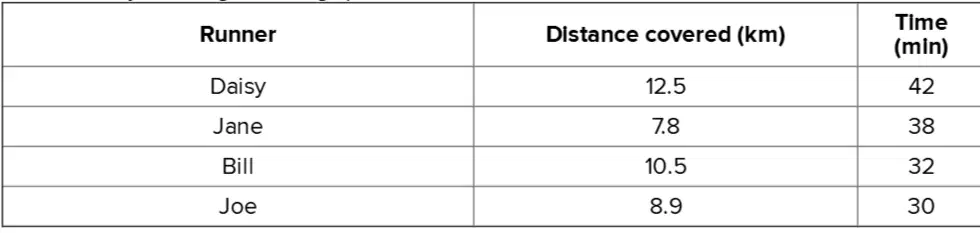
What is Daisy's average running speed?
3.0 km/min
30 km/min
0.30 km/min
330 km/min
If an object has a constant velocity, then it _____.
has a negative acceleration
has a positive acceleration
is not moving
has an acceleration of zero
The speed of light in a vacuum is 300,000.0 km/s. How long does it take light to travel 150,000,000 km from the Sun to Earth?
2100 seconds
0.25 hour
8.3 minutes
4500 seconds
A change in velocity means a change in ______.
speed, direction, or both
direction only
speed only
always both speed and direction
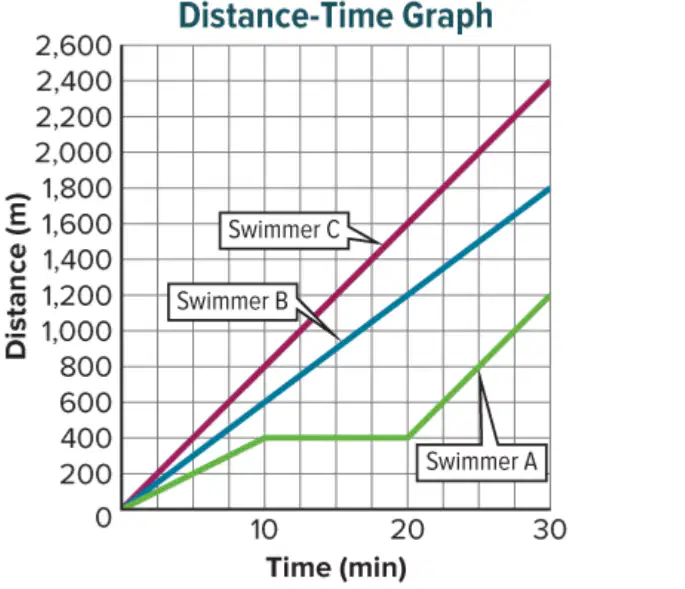
What was Swimmer B's average speed?
3600 km/h
2.4 km/h
2400 km/h
3.6 km/h
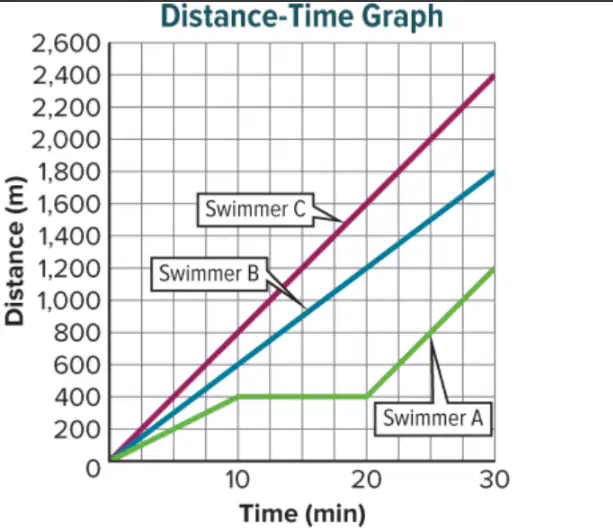
What was Swimmer B's average speed during the period 0 min to 10 min?
60 m/min
0 m/min
600 m/min
6000 m/min
As you brake your bicycle, your velocity changes from 20 east m/s to 10 east m/s in 5 seconds. What is your acceleration?
2 m/s² west
10 m/s² west
2 m/s² east
10 m/s² east
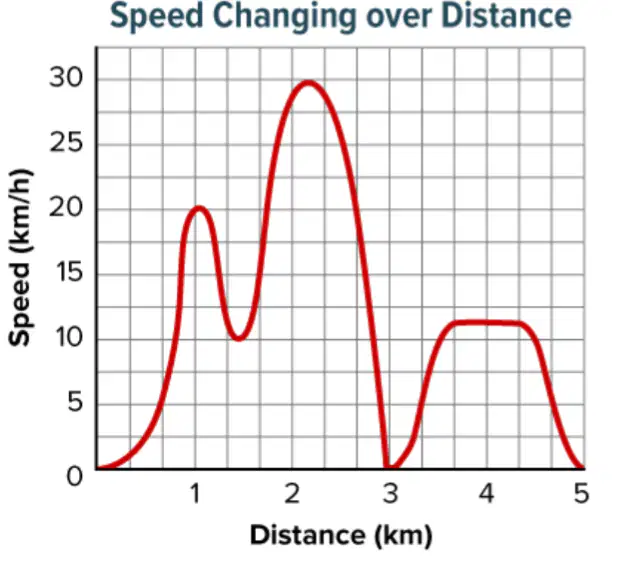
The graph shows how a cyclist’s speed changed over a 0.25-h trip. What is the cyclist’s average speed?
20 km/h
30 km/h
8 km/h
2 km/h
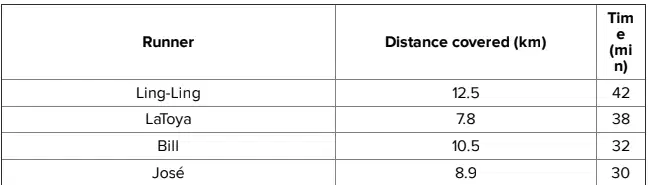
What is Ling-Ling's average speed?
530 km/min
0.3 km/min
3.0 km/min
3.4 km/min
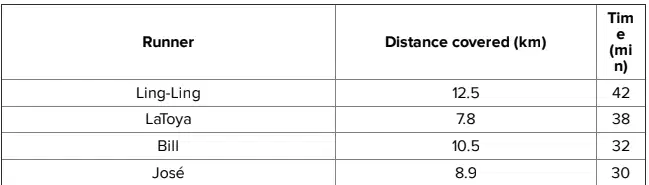
Which runner has the fastest average speed?
Bill
LaToya
José
Ling-Ling
Which best describes why projectiles move in a curved path?
They have horizontal acceleration and constant vertical velocity.
They have horizontal momentum and constant vertical velocity.
They have horizontal acceleration and vertical momentum.
They have constant horizontal velocity and vertical acceleration.
The direction and speed of an object is described by its ______.
velocity
mass
temperature
density
_____ is the change in velocity divided by the time needed for the change to occur.
Average velocity
Speed
Acceleration
Displacement
Any change of distance over time is called _____.
Speed
Acceleration
Rate
Displacement
The distance and direction between the final position and the starting position is the _____.
Acceleration
Displacement
Velocity
Position
The _____ of an object is the product of its mass and velocity.
Average speed
Constant speed
Momentum
Displacement
Acceleration toward the center of a curved or circular path is called _____.
Motion
Centripetal acceleration
Velocity
Momentum
_____ is a change in an object's position relative to a reference point.
Motion
Speed
Acceleration
Velocity
The speed you read on a speedometer is ______.
average speed
constant speed
instantaneous speed
velocity
3 m/s north is an example of a(n) ______.
time
velocity
speed
acceleration
A car moves around a wide turn going 45 mi/hr the whole time. The car has a constant ______.
acceleration
velocity
direction
speed
If you ride your bicycle down a straight road for 500m then turn around and ride back to your starting point, your distance is ______ your displacement.
less than
equal to
greater than
can't determine
Motion is a change in ______.
speed
time
position
velocity
An indicator that orients you when describing motion is called the ______.
speed
point of motion
time
reference point
How long will it take an object traveling at 25 m/s to reach a distance of 125 meters?
5 s
0.2 min
0.2 s
5 m
A high-speed train travels with an average speed of 227 km/hr. The train travels for 2 hours. How far does the train travel?
0.0088 km
113.5 km
454 km
225 km
A cross-country runner runs 10 km in 40 minutes. What is his average speed?
0.0088 km
0.25 km/min
30 km/min
454 km
What does the slope of a distance vs. time graph tell you?
the time it took for the object to travel
the acceleration
the speed of the object
the total distance traveled
A horizontal (flat) line on a velocity vs. time graph shows ________ acceleration.
positive
negative
changing
zero
Acceleration is rate of change of ______.
velocity
time
speed
position
Find the acceleration of a car that goes from 32 m/s to 96 m/s in 8.0 seconds.
8.0 m/s²
4.0 m/s
12 m/s
-8.0 m/s²
If a car on cruise control moves at a speed of 50 mi/hr for 3 hours, how far does the car travel?
0 miles
1,500 miles
15 miles
150 miles
Suppose two balls are rolled off the edge of a table. Ball A rolls off the edge at a speed of 2 m/s, and Ball B rolls off the edge at 1 m/s. Which will hit the ground closer to the base of the table?
A
B
Neither. They will both hit the ground at the same time.
Acceleration occurs when an object changes its speed or _______.
direction
force
mass
inertia
A car is driven for 3 hours. What else do you need to know to describe this car's speed?
the road the car is driven on
the number of passengers in the car
the time of day
the distance the car is driven
What is speed?
how far an object moves in a certain amount of time
how long an object moves
how far an object moves
how much an object's position changes
Which information is needed to determine how fast a truck is traveling?
time and weight
size and speed
distance and time
direction and mass
What is the definition of velocity?
uniform circular motion
the speed of an object in a particular direction
a force that opposes motion
An object traveling in a circular motion is always changing its ______ and ______.
rotation, velocity
direction, velocity
speed, mass
position, energy
acceleration, force
The correct equation for acceleration is...
p=mv
a=td
a=tΔv
a=vfs
If an object decreases its speed each second it moves before stopping, it is...
conserving energy
insane
conserving momentum
accelerating
A car travels a distance of 98 meters in 10 seconds. What is the average speed of the car?
49 m/s
9.8 m/s
98 m/s
4.9 m/s
A group of bike riders took a 4 hour trip. During the first 3 hours, they traveled a total of 50 km, but during the last hour they traveled only 10 km. What was the group's average speed for the entire trip?
40 km/hr
60 km/hr
30 km/hr
15 km/hr
Which statement about the movement of an object with zero acceleration could be true?
the object is moving at a constant speed
the object is speeding up
the object is changing direction
the object is slowing down
The position of a runner in a race changes as time passes. What could be a reference point to describe the change in position?
the runner's speed
the starting line
another runner
the runner's right foot
How is velocity different than speed?
speed opposes velocity
velocity is speed with a direction
none of the answers are correct
Which term best describes the forces on an object with a net force of zero?
balanced forces
unbalanced forces
inertia
acceleration
How does the gravitational force change as two objects move farther apart?
It increases.
It decreases.
It remains constant.
It is zero.
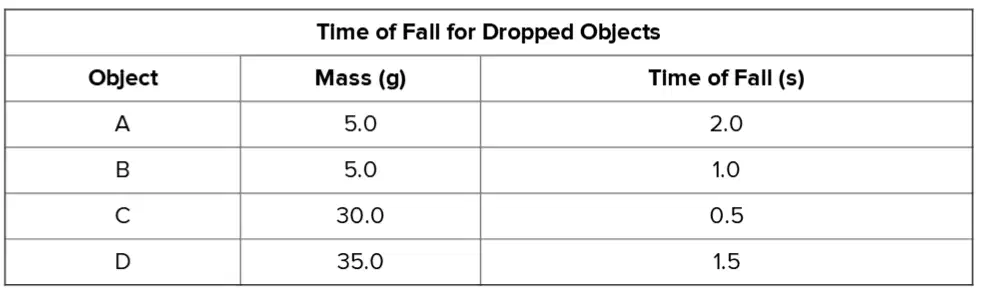
If the objects in the data table above all fell the same distance, which object fell with the greatest average speed?
Object A
Object B
Object C
Object D
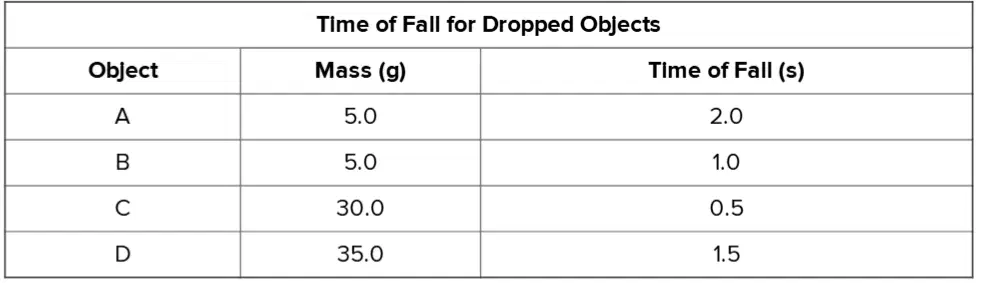
Which object was affected the most by air resistance?
Object A
Object B
Object C
Object D
According to Newton's first law of motion, a moving object _____.
gradually slows and then stops
has a constant positive acceleration
transfers energy to its environment
continues moving at the same velocity unless a force acts on it
_____ measures an object's tendency to resist changing its motion.
Acceleration
Gravity
Inertia
Mass
The _____ is the combination of all the forces acting on an object.
direction of motion
force pair
inertia
net force
A(n) ______ is a push or a pull that one body exerts on another.
force
mass
energy
velocity
In which direction is centripetal force?
upward
along the curve
toward the center of a circle
toward the edges of a circle
A fuel-filled rocket is at rest. It burns its fuel and expels hot gas. The gas has a momentum of 1,500 kg·m/s backward. What is the momentum of the rocket?
1,500 kg·m/s forward
1,500 kg·m/s backward
0 kg·m/s
3,000 kg·m/s forward
What is the gravitational force exerted on an object called?
centripetal force
friction
momentum
weight
Which explains why astronauts seem weightless in orbit?
Earth’s gravity is much less in orbit.
The spacecraft is in free fall.
The gravity of Earth and the Sun cancel.
The centripetal force on the shuttle balances Earth’s gravity.
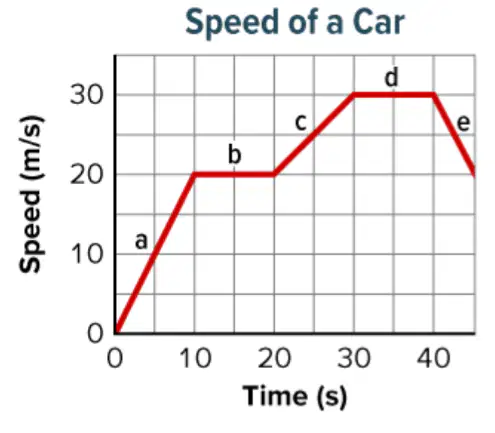
The graph shows the speed of a car moving in a straight line. Over which segments are the forces on the car balanced?
A and C
B and D
C and E
A, C, and E
Which of the following would cause the gravitational force between object A and object B to increase?
Increase the mass of object A.
Increase the distance between them.
Decrease the mass of object A.
Decrease the mass of both objects.
Which of the following is a force?
friction
acceleration
inertia
velocity
____ relates the net force exerted on an object to its mass and acceleration.
Newton's first law of motion
Newton's second law of motion
Newton's third law of motion
The law of conservation of energy
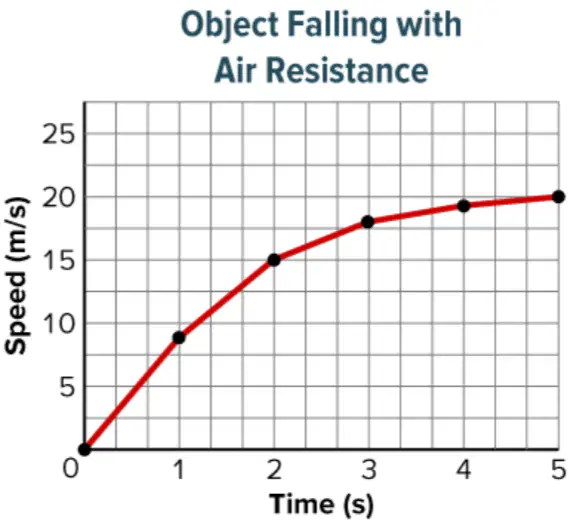
According to the trend in these data, which of the following values is most likely the speed of the object after falling for 6 s?
26.7 m/s
15.1 m/s
20.1 m/s
0 m/s
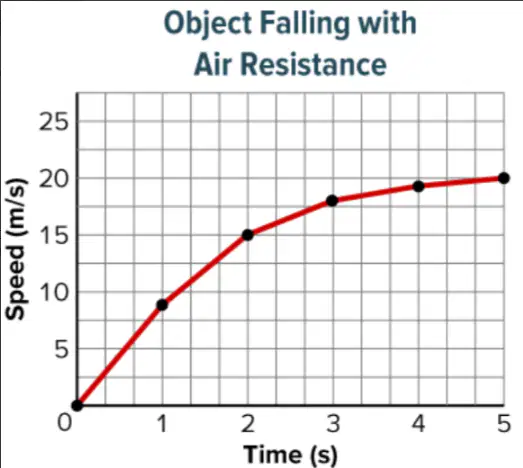
Over which of the following time intervals is the acceleration of the object the greatest?
0 s to 1 s
1 s to 2 s
2 s to 3 s
4 s to 5 s

