
NEW
Font size
 Worksheets
Physics Quiz 1 Quarter 2
Total questions: 39
Worksheet time: 20mins
Which of the following is an appropriate unit for area?
Square yards
Seconds
Yards
Inches
What is the reciprocal of 300?
30
.3
1/3
.03
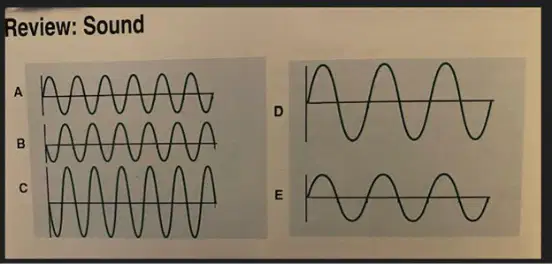
Which of the following best describes waves A and B?
In phase, will interfere destructively.
Out of phase, will interfere destructively.
In phase, will interfere constructively.
Out of phase, will interfere constructively.
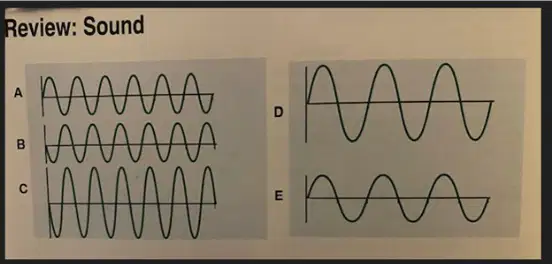
Which of the following best describes waves B and C?
Out of phase, will interfere constructively.
In phase, will interfere destructively.
In phase, will interfere constructively.
Out of phase, will interfere destructively.
All of the following are acoustic parameters EXCEPT:
Frequency
Amplitude
Wavelength
Temperature
Which of the following best describes sound waves?
Longitudinal, pressure waves
Transverse, pressure waves
Longitudinal, out-of-phase waves
Transverse, Longitudinal waves
Which of these waves is ultrasonic and most useful in diagnostic sonography?
400 mHz
200,000 Hz
2 kHz
4 Mhz
Using a particular ultrasound system and transducer, which of the following cannot be changed by the operator?
power
wavelength
amplitude
intensity
What determines the wavelength?
both the sound source and the medium
medium
neither
sound source
How many hertz is 3 MHz?
3,000
.003
3,000,000
333
The y-axis ______
is also the vertical axis
runs up and to the side
runs down and to the side
is also the horizontal axis
What is the reciprocal to 1/15?
15/1
15
15.1
.015
When 2 out-of-phase waves have equal amplitude what occurs?
They become in-phase waves
Complete destructive interference occurs
Period is determined by _____
sonographer
sound
all of the above
medium
Frequency is determined by
medium
source
sound
Amplitude is
adjustable
never changes
fixed
Wavelength is measured in units of
time
intensity
watts
distance
Which of the following does not describe "bigness" of a wave
sound
power
intensity
Which is not an acoustic variable?
distance
density
power
pressure
Deep images have shorter PRP.
True
False
Spatial pulse length is determined by
medium
both
source
Axial resolution identifies two structures that are perpendicular to the sound beam’s main axis.
True
False
Axial resolution is also called:
Longitudinal
Depth
All of these
Range
Which of the following offer an improved axial resolution?
Shorter pulses
Lower frequencies
Longer pulses
Longer duration
Which of the following is not associated with better axial resolution?
Shorter spatial pulse length
Higher frequencies
Fewer cycles per pulse
Longer pulse duration
Which of the following is a characteristic of higher frequency?
Longer pulse duration
Less ringing
Longer wavelength
Shorter wavelength
What is the ability to accurately distinguish two structures lying close together called?
Dual
Gain
Resolution
Imaging
Axial resolution is measured in units of ______.
Distance
Time
Frequency
Amplitude
Lateral resolution identifies two structures that are perpendicular to the sound beam’s axis.
True
False
Lateral resolution is measured in units of ______.
Time
Speed
Volume
Distance
Lateral resolution is determined by ______.
Width of sound beam
Volume of sound beam
Speed of sound beam
Length of sound beam
Where is lateral resolution the best?
Focus
Axis
Far field
Near field
Lateral resolution is equal to ______.
Focus
Axis
Far field
Near field
Axial resolution is determined by _____.
Pulse length
Beam width
Duration
Speed
Which of the following is NOT a method of focusing?
Internal focusing
External focusing
Phased array focusing
Spatial pulse focusing
Which method of focusing uses a lens?
Internal focusing
External focusing
Phased array focusing
Spatial pulse focusing
In which focusing method does the system’s electronics focus the sound beam?
Internal focusing
Phased array focusing
External focusing
Spatial pulse focusing
Which of the following is an effect of focusing?
Beam diameter
Axial resolution
Duration
Speed
Select one:
Beam diameter in far zone increases
Focal zone is increased
Beam diameter in near field increases
Focal depth is deeper

