
 Worksheets
Final Exam Review
Total questions: 75
Worksheet time: 38mins
A high-speed train travels with an average speed of 227 km/hr. The train travels for 2 hrs. How far does the train travel?
A cross-country runner runs 10 km in 40 minutes. What is his average speed?
30 km/min
0.25 km/min
4 km/min
400 km/min
What does the slope of a distance vs. time graph tell you?
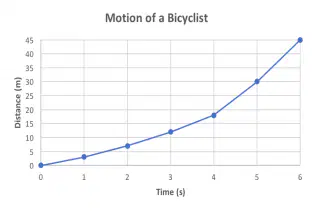
Which time interval has the greatest speed?
0-1 s
1-2 s
3-4 s
4-6 s
What is true about a car with constant velocity?
It has zero acceleration
It has positive acceleration
It has negative acceleration
The car is changing direction
A person walks 3 miles north, turns, and walks 2 miles east. Calculate the person’s distance traveled and their displacement.
Distance traveled: 3.6 miles, Displacement: 5 miles
Distance traveled: 5 miles, Displacement: 3.61 miles
Distance traveled: 5 miles, Displacement: 3.61 miles NE
The horses on a carousel or merry-go-round are accelerating because ____.
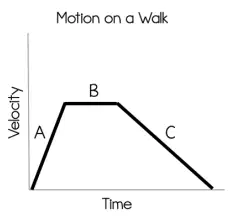
At what point is the rate of change of velocity the greatest?
Segment C
Segment D
Segment A
Segment B
Which of the laws of motion states, “To every action there is an equal but opposite reaction”?
When a car traveling at 30 m/s hits the gas pedal, it speeds up to 65 m/s in 3.5 sec. What is the car’s acceleration during that time?
A driver isn’t paying attention while he texts and drives, colliding with the parked car in front of him and transferring all of his car’s moving force into it. Which law is this describing?
How much does a 200 kg car weigh?
22.6 N
1780 N
1960 N
20.4 N
An object has 16 N of force being applied to the right, 16 N of force being applied to the left, and 4 N of force being applied downward. Assume the object is suspended in the air. What is the net force on the object?
The sum of kinetic energy and potential energy within a system is called
What is the potential energy of a 5 kg apple that is sitting on a 1.5 m high tree branch?
15.7 J
73.5 J
Which of the following is not a type of potential energy?
A box weighing 30 N is pushed a distance of 5 meters. How much work was done?
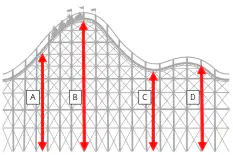
In the diagram to the right, a roller coaster car starts from rest and moves along the track. At which point does the roller coaster car have the greatest potential energy?
A
B
C
D
How much power is used if a machine does 28 J of work in 7 seconds?
Which requires more work?
pushing a box with a force of 115 N a distance of 15 m
lifting a 20 kg mass a distance of 10 m
An 8 kg toddler is running at a speed of 10 m/s. How much energy does he have?
The law of ____ states that energy in a system can change forms but can never be created or destroyed.

The diagram to the right shows four locations in a temperature field. The temperature of each location is given in degrees Celsius. Heat energy will normally flow from:
D to A
C to B
B to D
B to C
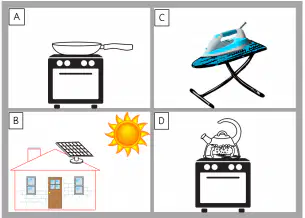
Thermal energy is transferred to the solar panel in picture B by
friction
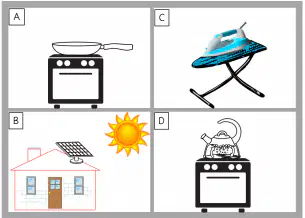
Which picture shows thermal energy transfer by convection?
Kinetic energy is
How much force is required to lift a rock a vertical distance of 8 m if 80 J of work were done?
80 J
10 J
80 N
What is the potential difference (voltage) if a resistance of 20 ohms produces a current of 10 amperes?
Which two areas of physical science are closely related to the development of electric motors and generators?
Electricity, Magnetism
Light, Magnetism
Sound, Light
Electricity, Sound
What is the resistance of a 15 ampere current with 8 volts of potential difference?
0.53 ohms
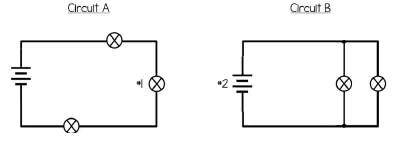
What does the symbol labeled #2 represent?
Which of these would make the best insulator?
Rubber

Michael is playing with two horseshoe magnets. He is trying to get them to touch, but they will not regardless of how hard he tries. Why will the magnets not come in contact?
The magnets are aligned with like poles together.
What is the SI unit for temperature?
Convert 25 °F to °C
-3.9 °C
The speed of light is approximately 3.0×10⁹ m/s. How would this be written in standard notation?
3,000,000,000 m/s
300,000,000 m/s
Lindy is going to New England to visit her brother for spring break and wants to know what the weather will be like. Her brother is a chemist, so naturally he tells her it is expected to be 272 Kelvin while she is in town. Can you help her find the temperature in °F so she can know if she should pack a jacket or not?
39.2°F
29.9°F
Convert 99 daL to dL.
The speed of light is 3 x 10⁸ m/s. If its frequency is 4.11 x 10⁴ Hz, what is its wavelength?
1.37 x 10⁻⁴ m
1.23 x 10¹³ m
7.299 x 10¹¹ m
7.299 x 10³ m
A piece of zinc was lying outside and had a temperature of 26°C. Later that day the sun came out and the temperature increased to 36°C. If the piece of zinc is only 0.15 kg, find the thermal energy. (Note: Zinc has a specific heat of 380 J/kg/°C.)
Conduction is the transfer of heat energy by
A 700 kg car is driving with an acceleration of 5 m/s2 down the interstate. What is the force required to accelerate?
Temperature measures the average ____ of the particles in a material.
Which law is also referred to as the Law of Inertia?
What is the weight (in Newtons) of a person with a mass of 95 kg?
932 N
If you ride your bicycle down a straight road for 500 m then turn around and ride back to your starting point, your distance is _____ your displacement.
Jumping on a trampoline causes you to fly up in the air. What law is this scenario describing?
Find the acceleration of a car that goes from 32 m/s to 96 m/s in 8.0 s.
What is the volume of 72 g of copper if copper has a density of 9 g/cm3
Matter in which the particles are free to move in all directions until they have spread evenly throughout their container is a
Which of the following is not an example of a physical change?
Letting a piece of food rot in the fridge
Hydrogen, gold, and iron are all examples of
What is the mass of a cube measuring 3 cm on each side that has a density of 8.1 g/cm
3.3 g
The Law of Conservation of Mass states
Mass is not lost or created in a chemical reaction.
An element with 15 protons, 16 neutrons, and 18 electrons has a mass number of
Atoms of elements in the same group of the periodic table share the same
Which of the following is a transition metal?
Aluminum
Sodium
Strontium
Iron
How many electrons will a neutral atom have if its nucleus has 10 protons and 11 neutrons?
Two different isotopes of an element have the same
What is found in the atom's nucleus?
electrons
protons
neutrons
All electromagnetic waves
travel at the speed of light in a vacuum which is 300,000,000 m/s

A ray of light falls on the mirror pictured to the right. Which ray best describes the path of the light reflected from the mirror?
A
B
C
D
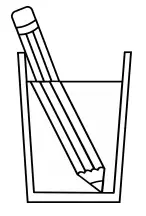
The picture to the right shows which wave behavior?
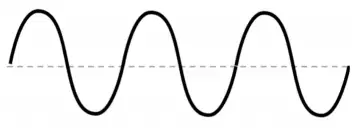
How many wavelengths are there in the picture to the right?
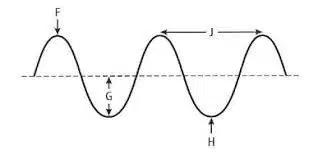
In this diagram, what letter represents a crest?
How many electrons are being shared in a triple bond?
Which of the following is a similarity between ionic and covalent bonds?
Which atoms are most likely to form covalent bonds?
Nonmetals that share protons
Nonmetals that share electrons
Metals that transfer electrons
Metals that share electrons
Which of the following is the correct name for a compound between Magnesium and Sulfur?
Anions are ions with a ______________ charge that are formed when an atom _______________ electrons.
Which pair of atoms will combine with each other and form an ionic bond?
Carbon (C) and Hydrogen (H)
Neon (Ne) and Oxygen (O)
Which statement is true regarding the chemical equation below?
2CH4 + 4O2 -> CO2 + 4H2O
The equation is balanced.
The 4 in front of the oxygen on the product side needs to be a 6 in order to be balanced.
The 2 in front of methane, CH4, needs to be changed to a 3 in order to be balanced.
The carbon dioxide on the product side needs a 2 in front of it in order for it to be balanced.
If something is burned, a ________________ reaction has occurred.
Substances that speed up chemical reactions are called
Which chemical reaction represents a double displacement reaction?
2Na + Cl2 → 2NaCl
H2 + O2 → H2O
Na2SO4 + BaCl2 → BaSO4 + 2NaCl
Zn + 2HCl → ZnCl2 + H2

