
 Worksheets
2024 Chemistry Semester Exam
Total questions: 64
Worksheet time: 35mins
Which process is an example of a chemical change?
Boiling water
Combustion of wood
Crystallization of sugar
Melting steel
A liquid is cooled during an investigation causing it to solidify. Which of the following most likely occurred?
Absorption of heat
A chemical change
A physical change
Formation of a new compound
Which of the following observations is usually not evidence of a chemical change?
Change of shape
Formation of a precipitate
Giving off of a gas
Giving off of heat and/or light
Which phase of matter is the least compressible?
Gases
Liquids
Solids
Plasma
Water (H₂O) is best described as a(n)
Atom
Compound
Element
Mixture
After a jar of muddy water is shaken vigorously, the dirt eventually sinks to the bottom. When a flashlight shines into the jar of muddy water, a beam of light reflects off the small particles of soil suspended in the water. How is the muddy water classified?
A compound
A homogeneous mixture
A heterogeneous mixture
An element
Dmitri Mendeleev was one of the first scientists to arrange the known elements into an organized table. His arrangement, which was by increasing atomic mass, had holes and some elements' chemical and physical behavior did not match with other elements in the same group. Many years later, Henry Moseley arranged the periodic table according to increasing atomic number. What happened to the problems and holes Mendeleev experienced when the elements were arranged by increasing atomic number?
The problems with chemical and physical behaviors were still present because many of the elements were in the same groups.
Arranging elements by atomic number fixed the holes and issues with the chemical and physical behavior among elements in the same group.
The elements in each group were less similar when arranged by increasing atomic number.
Elements arranged by increasing atomic number show properties that are similar among the periods, not groups.
Why is iodine found after tellurium on the Periodic Table even though its average atomic mass is lower for iodine?
Elements within a period have similar behaviors
Elements with a group have different chemical properties
Elements are arranged by atomic mass not atomic number
Elements are arranged by atomic number not atomic mass
On Mendeleev's Periodic Table, two spaces were left empty because those elements had not yet been discovered. He predicted that one of the elements would be found to have an atomic mass between that of zinc and arsenic and would behave chemically like silicon. He suggested it be called "ekasilicon". What is the current name of this element?
Carbon
Germanium
Mendelevium
Selenium
Elements that have been placed in the same group on the Periodic Table share what properties?
Color and density when in the solid phase
Electronegativity and atomic radii
Number of neutrons and radioactive isotopes
The number of valence electrons and chemical behavior
Alkali metals and elements in the halogen group bond well together. Which of the following conclusions can be drawn about these two groups of elements on the periodic table?
The alkali metals have one valence electron to give away and halogens need to gain one electron.
Both the halogens and alkali metals have the same properties and so they bond well together.
The halogens need to lose one valence electron and the alkali metals need to gain one valence electron.
The alkali metals will bond with the halogen group because they both have metallic properties.
Scientists have synthesized elements with atomic numbers as high as 118. If they succeed in synthesizing element number 119, what properties would this element be expected to have at room temperature?
Brittle solid with dull luster
Colorless, odorless gas
High density and melting point
Soft, highly reactive metal
Which elements are grouped together because they share these properties? - chemically inert - very low boiling point - full valence shell - very high ionization energy
Alkali metals
Metalloids
Noble gases
Transuranium elements
Soft silvery metal elements with 2 valence electrons would be called
Alkali metals
Alkaline earth metals
Noble gas
Halogens
With respect to physical and chemical properties, which element is most similar to oxygen?
Fluorine
Nitrogen
Oxygen
Sulfur
With respect to physical and chemical properties, which element is most similar to calcium?
Barium
Carbon
Oxygen
Sulfur
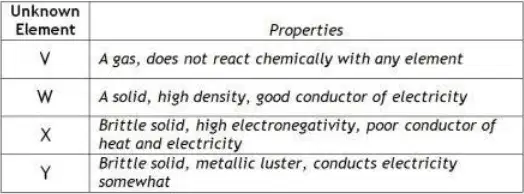
Based on the information in the chart below, which element is most likely a member of Group 18?
Element V
Element W
Element X
Element Y
Which of the following group of elements have the most similar chemical properties?
Argon, potassium, bromine
Beryllium, carbon, nitrogen
Oxygen, nitrogen, silicon
Potassium, rubidium, cesium
Atomic radius increases down a group because
The number of energy levels increases.
The atomic number increases.
The electronegativity decreases.
The ionization energy decreases.
When examining periodic trends of element families, the least electronegative elements are most likely found in the
Alkali metals
Halogens
Noble gases
Transition metals
On the Periodic Table, what are the group and period trends in ionization energy (IE)?
IE increases down a group and increases from left to right across a period.
IE increases down a group and decreases from left to right across a period.
IE decreases down a group and decreases from left to right across a period.
IE decreases down a group and increases from left to right across a period.
When examining the chemical nature of elements, which of the following has atoms with the highest electronegativity?
Fluorine
Gallium
Iodine
Sodium
When examining periodic trends, the elements with the largest atomic radii are most likely found in the
Lower left hand section of the table.
Lower right hand corner of the table.
Upper left hand section of the table.
Upper right hand section of the table.
Which of the following has the lowest ionization energy?
Beryllium
Carbon
Lithium
Nitrogen
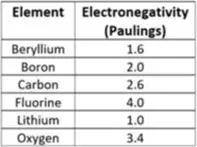
Using the table of Electronegativity below, determine which of the following trends, in a period of the periodic table, is best supported by the data?
Metals have a higher electronegativity.
Higher atomic numbers have a higher electronegativity.
Nonmetals have a higher electronegativity.
Higher atomic masses have a lower electronegativity.
Which of the following is the most reactive nonmetal?
F Carbon
G Fluorine
H Nitrogen
J Oxygen
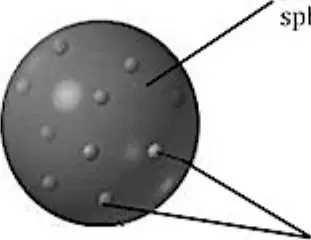
The discovery of subatomic particles in 1897 opened an exciting new era in science. Experiments conducted to determine atomic structure made it necessary to modify our model of how atoms are constructed. Who proposed the atomic model shown below?
A Ernest Rutherford
B J.J. Thomson
C John Dalton
D Neils Bohr
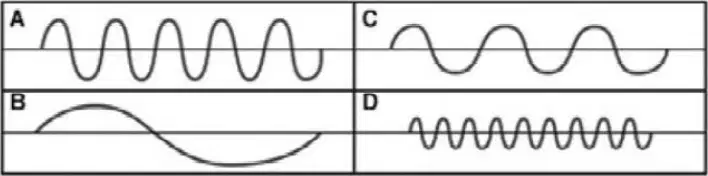
Based on the diagram below, rank these electromagnetic waves in order of increasing wavelength.
B, A, C, D
B, C, A, D
D, A, C, B
D, C, A, B
Chromium has four naturally abundant isotopes. Based on its average atomic mass, if 4.35% is Cr-50, 9.50% is Cr-53, and 2.36% is Cr-54, which isotope constitutes the majority 83.79%?
Chromium-51
Chromium-52
Chromium-55
Chromium-56
Chlorine has two naturally abundant isotopes. Based on its average atomic mass, if 75.77% is Cl-35, which isotope constitutes the other 24.23%?
Chlorine-17
Chlorine-30
Chlorine-37
Chlorine-39
Germanium has five naturally occurring isotopes. Based on its average atomic mass, if 20.5% is Ge-70, 27.4% is Ge-72, 7.8% is Ge-73 and 7.8% is Ge-76, which isotope constitutes the majority 36.5%?
Germanium-71
Germanium-74
Germanium-75
Germanium-77
Silver occurs as two isotopes. The most common isotope, silver -108, comprises 51.8% of a sample of silver. What is the atomic mass of the other isotope?
109 u
108 u
107.868 u
107.434 u
A certain element sample is analysed and found to consist of 11% of isotope X with a mass of 26 u, 10% of isotope Y with a mass of 25 u, and 79% of isotope Z with a mass of 24 u. What is the average atomic mass of the element?
75.0 u
25.0 u
24.32 u
24.00 u
Draw the electron dot diagram for Nitrogen (N)

What element has the electron configuration 1s² 2s² 2p⁶ 3s² 3p⁴?
Cl
O
S
Si
What element has the electron configuration [Ar] 3d⁵ 4s²?
Ca
Cl
Co
Mn
What is the maximum number of electrons found on an f orbital?
2
6
10
14
What is the maximum number of electrons that can be found on a p orbital?
2
6
10
14
What is the maximum number of electrons found on an s orbital?
2
6
10
14
A Lewis valence electron dot structure for potassium would contain (a) dots.
Which of the following is not a correct electron configuration for a noble gas?
1s²
[Ar]
1s²2s²2p⁶
[He]1s²
The electron configuration for boron is 1s² 2s² 2p¹. How many valence electrons do atoms of boron have?
1
2
3
5
Which of the following is the correct electron configuration for oxygen?
[He]2s⁶
[He]2s² 2p⁴
[He]2p⁶
[He]2s² 3p⁴
All of the halogens have the same number of valence electrons. Therefore, their electron configurations will be alike in that they all end in
p⁷
d⁴
s²
p⁵
What element would have the electron configuration 1s² 2s² 2p⁶ 3s²?
Calcium
Magnesium
Neon
Silicon
Which of the following electron configurations represents an alkali metal?
[Ar]4s²3p¹
[Ar]4s²
[Ar]4s²3p⁶
[Ar]4s¹
Which electron configuration represents an element with three valence electrons?
[He]2s¹
[Ne]3s²3p³
[Kr]5s²4d¹
[Ar]4s²3d¹4p¹
Which of the following electron configurations represents an alkaline earth metal?
[He]2s¹
[Ar]4s²3p⁶
[Ne]3s²2p⁴
[Ne]3s²
Which electron configuration represents an atom with six valence electrons?
[Xe]6s²4f¹
[Kr]5s²4d²5p²
[Ar]4s²3d¹4p⁴
[Ne]3s²3p⁶
Which electron configuration represents an element in the same family as oxygen?
[Ar]3s²3p⁴
[He]2s²2p¹
[Ne]2s²2p²
[Kr]5s²4d¹⁰
Which element is represented with an electron configuration of [Kr]5s²4d¹⁰5p²?
Krypton
Silicon
Tin
Zirconium
Emission of gamma radiation ____.
has no effect on the nucleus
increases the number of protons in the nucleus
decreases the number of neutrons in the nucleus
increases the mass of the nucleus
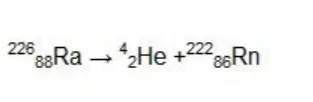
What type of radioactive particle is emitted as the product of the decay process below?
Alpha
Beta
Delta
Neutron
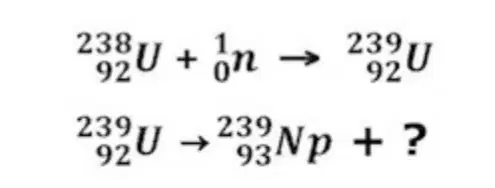
The first transuranium element, neptunium, was synthesized from uranium-238 in a 2-step process shown below. The first step in the process is neutron capture. The second step is —
Alpha decay
Beta decay

Radioactive uranium-238 undergoes spontaneous decay as shown in the following equation. What is the mass number of the thorium isotope produced in this decay process?
232
234
242
cannot be determined
A gamma ray is best described as having
A mass number of 2 and a positive charge.
A mass number of 4 and a positive charge.
No mass and a negative charge.
No mass and no electric charge.
One characteristic that fusion and fission share is that
Both reactions deal with electrons.
Fusion and fission both give off a large amount of energy.
Only fusion can be a contained reaction.
The fuel that fusion and fission use is the same.
Compared to nuclear fission, nuclear fusion
Produces more energy.
Occurs at much lower temperatures.
Produces more radioactive waste.
Is a more rapid chain reaction.
Which term describes the formation of a more massive nucleus by the combination of two lighter nuclei?
Alpha Decay
Beta Decay
Fission
Fusion
Which best describes the break-up of a nucleus into two nuclei of roughly similar masses?
Alpha Decay
Beta Decay
Fission
Fusion
From which of the following atoms would it be the most difficult to remove an electron?
Sodium
Aluminum
Sulfur
Chlorine
Rubidium has a lower ionization energy than sodium. One reason for this is that the —
number of protons is increasing
number of energy levels is decreasing
valence electrons are farther from the nucleus
number of neutrons is increasing
Scientists, including Ernest Rutherford, started testing atomic structure theory in the early 1800's. What was Rutherford's key contribution to the atomic theory of matter?
Elements can form compounds.
Atoms contain a central nucleus.
Electrons are negatively charged particles.
Matter cannot be divided infinitely and retain its properties.
What does the following hyphen notation of Helium-3 mean?
An atom of Helium-3 has two protons, two electrons, and one neutron.
An atom of Helium-3 has one proton, two electrons, and three neutrons.
An atom of Helium-3 has two protons, two electrons, and three neutrons.
An atom of Helium-3 has two protons, two electrons, and two neutrons.

