
 Worksheets
24 Q Biology Draft
Total questions: 50
Worksheet time: 25mins
Name
Class
Date
1.

In this pedigree, the dominant trait, curly hair is shaded while straight hair is not. The genotype of the non-shaded individuals would be...
a)
Both are homozygous dominant (CC).
b)
Both are homozygous recessive (cc).
c)
Both are heterozygous (Cc)
d)
The male is homozygous dominant; the female is homozygous recessive.
2.
In the F1 generation of a monohybrid cross (Ss x Ss), the phenotypic ratio would be:
a)
3:1
b)
2:2
c)
1:1
d)
1:1:2
3.
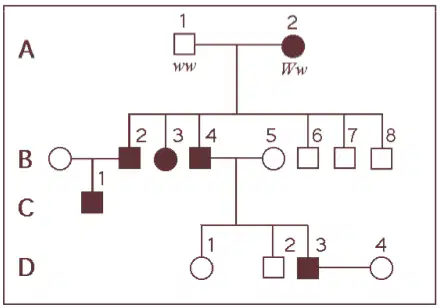
The pedigree chart below is for a family, some of whose members exhibit the recessive trait, wooly hair. Affected individuals are indicated by an open (non-shaded) square or circle. Use the chart to answer the following questions. What is the genotype of individual B-5?
a)
WW
b)
Ww
c)
ww
d)
WW or ww
e)
ww or Ww
4.
Tallness (T) is dominant to dwarfness (t), while red (R) flower color is dominant to white (r). The heterozygous condition (incomplete dominance) results in pink (Rr) flower color. A dwarf, red snapdragon is crossed with a plant homozygous for tallness and white flowers. What are the genotype and phenotype of the F1 individuals?
a)
ttRr - dwarf and pink
b)
ttrr - dwarf and white
c)
TtRr - tall and red
d)
TtRr - tall and pink
e)
TTRR - tall and red
5.
On a dihybrid cross, genetic traits of seeds are noted as follows: L = long, l = short W = wrinkled, w = smooth Which of the following is the genotype for a short, wrinkled?
a)
llWw
b)
LLWW
c)
LlWw
d)
llww
6.
Genetic disorders occur because of ________________ (changes) that can happen in DNA copying.
a)
mutation
b)
transcription
c)
translation
d)
conversion
7.
A type of mutation that doesn't result in problems with the protein...
a)
frameshift
b)
addition
c)
subtraction
d)
silent
8.
The following terms: gly, ser, thr, arg are examples of
a)
DNA
b)
RNA
c)
amino acids
d)
nucleotides
e)
proteins
9.
Proteins are important because...
a)
they form structural units of cells.
b)
they form functional enzymes that speed up reactions.
c)
both
d)
neither
10.
Why does the cell have to create an mRNA molecule in order for proteins to be produced?
a)
DNA can't produce proteins but mRNA can.
b)
mRNA is the building blocks of proteins.
c)
The DNA is in the nucleus and separated from the ribosomes.
d)
Ribosomes can only use amino acids to form the proteins.
11.
The process of creating an mRNA "text" message from the DNA template is
a)
transcription
b)
translation
c)
transportation
d)
transplantation
e)
transmembrane
12.
The process of creating an amino acid "protein" sequence that follows the mRNA recipe is
a)
translation
b)
transportation
c)
transplantation
d)
transcription
e)
transmembrane
13.
Proteins are made in the
a)
ribsomes
b)
nucleus
c)
chloroplast
d)
mitochondria
e)
vacuole
14.

The diagram below represents a small section of a DNA molecule. Which section of DNA represents the COMPLEMENTARY strand to the section of DNA above?
a)
A T T C G G G A T A T T
b)
T T A T A G G G C T T A
c)
T A A G C C C T A T A A
d)
A A T A T C C C G A A T
15.
The "rungs" of the DNA ladder are made of:
a)
phosphates and hydrogen
b)
glucose and sugars
c)
sugars and phosphates
d)
nitrogenous base pairs
16.
If a DNA molecule is found to be composed of 40% thymine, what percentage of adenine would be expected?
a)
10%
b)
20%
c)
40%
d)
80%
17.
Which of the following is NOT a requirement for an organism to be considered alive?
a)
Ability to reproduce
b)
Ability to grow and develop
c)
Ability to breathe
d)
Ability to respond to stimulus
18.
Which of the following is not an example of homeostasis?
a)
As a person’s body temperature rises, the person begins to sweat.
b)
As a person exercises, the person’s breathing rate decreases.
c)
As a person’s skin cells are shed, more skin cells are produced.
d)
As a person’s body loses water, the person becomes thirsty.
19.
Which is the correct order of the levels of Biological Organization? *Hint: Might not include all levels.
a)
Cells, Molecules, Organisms, Groups of Cells, Community, Population, Ecosystem, Biosphere
b)
Molecule, Cells, Groups of Cells, Organism, Population, Community, Ecosystem, Biosphere
c)
Organism, Community, Population, Ecosystem, Groups of Cells, Biosphere
d)
Molecule, Groups of Cells, Organism, Community, Ecosystem, Population, Biosphere
20.
A scientist believes that she has found a new life form. Which of the following conditions is not considered essential in determining whether the new life form is alive?
a)
The creature possesses purposeful anatomical structures that differ from one another.
b)
The creature’s body is bilaterally symmetrical.
c)
The creature seems to react to being touched.
d)
The creature is composed of cells.
21.
Cells in an organism indicate...
a)
the organism is abiotic
b)
all cells will have the same structure
c)
the organism is biotic
d)
the organism can move
22.
What is the independent variable in this experiment?
a)
the presence of fructose in their diet
b)
the mice that drank only water
c)
the weight gained by the mice
d)
the quantity of water provided
e)
the quantity of food eaten
23.
What is the dependent variable in this experiment?
a)
the presence of fructose in their diet
b)
the mice that drank only water
c)
the weight gained by the mice
d)
the quantity of water provided
e)
the quantity of food eaten
24.
What is the control used in this experiment?
a)
the presence of fructose in their diet
b)
the mice that drank only water
c)
the weight gained by the mice
d)
the quantity of water provided
e)
the quantity of food eaten
25.

What is the independent variable of Brian's experiment?
a)
days or time
b)
number of plants
c)
amount of fertilizer
d)
height of plants
26.

Based on the reading below, which hypothesis would be supported by the experiment?
a)
If I add baking soda to the acid, then nothing will happen.
b)
The mixture will fizz.
c)
If I add baking soda to the acid, then the balloon change color.
d)
If I add baking soda to the acid, then my balloon will inflate.
27.
What should Megan keep constant in this experiment? Check all that apply.
a)
the type of baking soda
b)
the type of acid
c)
the flask
d)
the environment
28.

The diagrams below show a bacterium. Why is it considered a prokaryote?
a)
it has in irregular shape.
b)
it doesn't have a nucleus
c)
it has a nucleus.
d)
it has DNA
29.

This diagram most likely represents which of the following phases of the cell cycle?
a)
metaphase
b)
prophase
c)
interphase
d)
cytokinesis
e)
telophase
30.
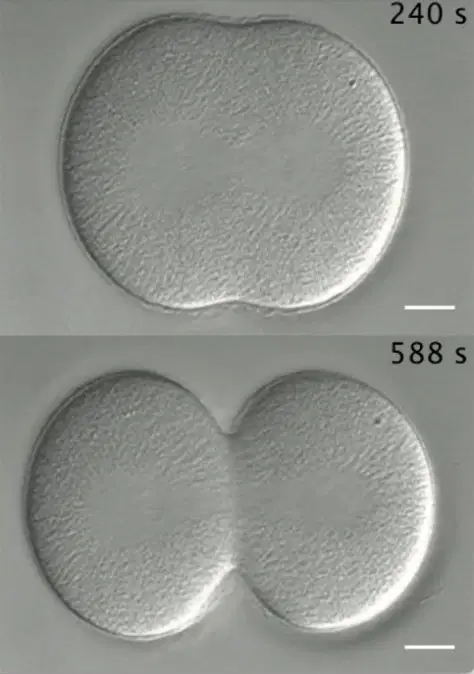
This diagram most likely represents which of the following phases of the cell cycle where the rest of the cell divides?
a)
cytokinesis
b)
prophase
c)
interphase
d)
metaphase
e)
telophase
31.

This diagram most likely represents which of the following phases of the cell cycle?
a)
anaphase
b)
prophase
c)
interphase
d)
metaphase
e)
cytokinesis
32.
Chromosomes getting copied prior to cell division ensures that...
a)
Each cell's chromosome number continually multiplies because having more chromosomes is better.
b)
Each cell only gets half of the chromosomes that they need to function.
c)
Each new cell contains a complete set of chromosomes so it can function properly.
33.
Which of the following statements is true?
a)
Single celled organisms use cell division to replace old cells.
b)
Single celled organisms use cell division to reproduce.
c)
Single celled organisms use cell division to grow.
d)
Single celled organisms use cell division to repair damaged cells.
34.
Improper cell division can lead to... Check all that apply.
a)
viral infection
b)
genetic disorders
c)
cell death
d)
cancer
e)
strep throat
35.

Only certain types of cells contain this organelle, which utilizes the energy of the sun to produce food for the organism.
a)
Ribosome
b)
Vacuole
c)
Cytoskeleton
d)
Chloroplast
36.

The cells below are most likely:
a)
animal cells because of their shape
b)
plant cells because of their shape
c)
bacteria because of their shape
37.
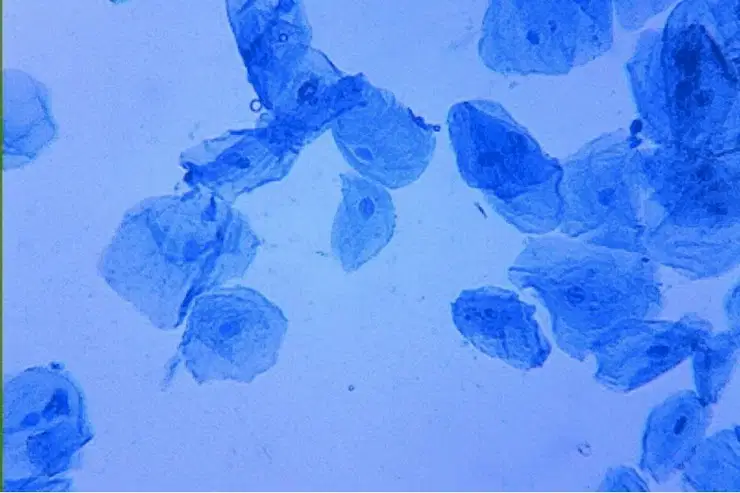
The cells below are most likely:
a)
eukaryotic, animal cell
b)
eukaryotic, plant cell
c)
prokaryotic, animal cell
d)
prokaryotic, plant cell
38.

The cells in this pic require the production of ATP for energy in the cell. Which organelle provides this energy?
a)
cell membrane
b)
mitochondrion
c)
nucleus
d)
nucleolus
39.
Which of the following is the best definition of homeostasis
a)
getting rid of waste
b)
maintenance of a constant internal environment
c)
taking in oxygen and getting rid of carbon dioxide
d)
keeping a constant temperature
40.
Which of the following is NOT an example of homeostasis?
a)
maintaining body temperature
b)
hair loss
c)
maintaining blood sugar levels
d)
getting thirsty after a workout
41.
Two systems that primarily work together to provide support and movement are:
a)
nervous & digestive
b)
excretory & digestive
c)
integumentary & nervous
d)
circulatory & endocrine
e)
skeletal & muscular
42.
Two systems that primarily work together to provide oxygen to the cells of the body:
a)
digestive & respiratory
b)
nervous & immune
c)
circulatory & respiratory
d)
circulatory & endocrine
e)
skeletal & muscular
43.
Which of the following best matches the organ system with its function?
a)
Nervous - transports materials
b)
Immune - breaks down food
c)
Circulatory - carries signals
d)
Skeletal - provides support
44.
Which of the following best matches the system with the organ?
a)
endocrine - pancreas
b)
nervous - veins
c)
circulatory - lungs
d)
respiratory - heart
45.
An example of an inherited trait is:
a)
language
b)
favorite food
c)
clothing style
d)
eye color
46.
Brown eyes are said to be "dominant" to blue eyes because:
a)
Brown eyes are darker in pigment.
b)
Genes for brown eyes occur most commonly in people.
c)
The gene for brown eyes is hidden or masked by the gene for blue eyes.
d)
The gene for blue eyes is hidden or masked by the gene for brown eyes.
47.
Hair color is a trait with several _____________ such as blonde, black, red, and brown. *
a)
genetics
b)
chromosomes
c)
variations
d)
environments
48.
Acquired (environmental traits) are not passed on to offspring because:
a)
they are associated with only certain organisms.
b)
they are not part of the genes of organisms.
c)
they are always harmful to an organism.
d)
they are always neutral to the organism.
49.
Alternate forms of the same gene such as dominant and recessive that affect the same trait are called ______. *
a)
phenotypes
b)
alleles
c)
mutations
d)
genotypes
50.
______ means that the alleles in the genotype are different. *
a)
heterozygous
b)
homozygous
c)
dominant
d)
recessive
100 %

