
 Worksheets
Environmental Science FINAL EXAM FALL 2024
Total questions: 50
Worksheet time: 32mins
Which layer of the earth is the thinnest?
Crust
Mantle
Outer core
Inner core
The exact underground location where an earthquake occurs is called the ____.
Epicenter
Thrust
Focus
Elastic rebound
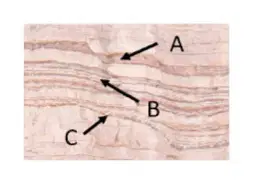
Look at the image to the right. Which of the layers is the oldest?
A
B
C
Which of the following is NOT true of mining?
It will likely become more costly to mine in the future.
We can reduce our need to mine by recycling mineral-containing materials.
Minerals are used to produce household items such as electronics and cosmetics.
The environmental impact of mining will likely remain the same in the future.
Which soil particle is the smallest?
sand
silt
clay
Which of the following are the three largest sources of energy for the United States?
petroleum, natural gas, and coal
solar, natural gas, and coal
petroleum, hydroelectric, and natural gas
solar, wind, and hydroelectric
nuclear, hydroelectric, and coal
Which of the following IS true of nuclear energy?
Nuclear meltdowns can affect large areas, but are easily cleaned up.
Nuclear power is a renewable energy source.
Nuclear power produces radioactive waste that must be disposed of properly.
Nuclear power produces more carbon dioxide and other greenhouse gases than oil or coal power.
The source of most irrigation water is:
flowing surface water such as streams and rivers
surface water reservoirs such as lakes and ponds
the ocean
groundwater
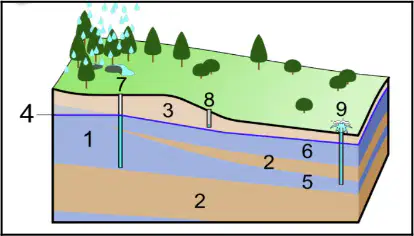
In the image to the right, which number is an example of a confined aquifer?
2
5
6
9
Which of these is NOT true about water?
water expands as a solid
water is a nonpolar molecule
water has a neutral pH
water has a high specific heat
The term “surface tension” is created by which property of water?
Capillary action
Condensation
Adhesion
Cohesion
Which process brings water into the ground?
transpiration
condensation
infiltration
evaporation
How does deforestation affect the local climate?
A lack of trees increases the humidity in the air.
Groundwater infiltration will decrease.
Precipitation will increase.
In terrestrial (on land) biomes, the factor limiting photosynthesis is __________, whereas in marine biomes, it is __________.
carbon dioxide, light
light, nutrients
nutrients, carbon dioxide
Which of the following is NOT a benefit that can be gained from aquaculture?
Stable income for fishermen
Fewer diseases for fish
Reduced fuel consumption for commercial fishing vessels
Requires less aquatic area to yield the same catch
A large plant near your house is contaminating the local stream by dumping water that contains POCs in the stream.
This pollution could be categorized as a...
point-source chemical pollution
nonpoint-source nutrient pollution
point-source sediment pollution
nonpoint-source thermal pollution
Many individuals of one species together in one place are called _____________________.
a niche
a community
a population
mutualism
A place where an organism lives is called its _____________________.
community
niche
trophic level
habitat
Which level of an energy pyramid is most likely to have the highest number of organisms?
Producers
Primary consumers
Secondary consumers
Tertiary consumers
Which of these is not an example of an abiotic factor?
soil
temperature
How much chemical energy is transferred from the producer level to the secondary consumer level in a food chain?
1/10
1/20
1/100
1/1000
Organisms that eat both plants and meat are called ______________.
omnivores
herbivores
autotrophs
carnivores
A biome is cold, treeless and permanently frozen. Which type of biome is it?
Tundra
Taiga
Alpine
Chaparral
Which of the following is an example of climate?
There is a cold front coming in this weekend
A snowstorm is forecasted to hit the northeast US this week
It is usually hot in Texas in July
It rained 4 inches last week in Seattle, WA
Because frogs absorb both oxygen and toxins through their skin, they are very sensitive to air and water quality. This makes them an excellent
keystone species
indicator species
pioneer species
primary species
Which of the following is not an example of secondary succession?
Vegetation growing after a hurricane has destroyed a patch of land
Trees regrowing after deforestation
The recolonization of an area that has been burned by forest fire
The growth of lichens on a newly created volcanic island
When drawing a food web, arrows represent ____.
which prey is being eaten by a specific predator.
the flow of energy from one organism to another.
the trophic level of a certain species.
the habitat in which an organism lives.
Which process takes carbon dioxide from the air and converts it into organic matter?
Respiration
Denitrification
Decomposition
Photosynthesis
The environment includes
the plants and animals in the natural world
the nonliving portion of an area
humans and man-made structures
plants, animals and their nonliving surroundings
all of these
Which of the following is never considered a renewable resource?
fresh water
natural gas
soil
sunlight
A natural resource that is used at the same rate that it is replenished is called a ________________ resource.
renewable
nonrenewable
ecological
sustainable
Which of the following best describes the idea behind the tragedy of the commons?
Resources are essentially limitless
The human population will eventually be controlled by starvation and disease.
Free access to resources leads to their degradation.
Self-interest always prevents habitat destruction.
Which of the following is an example of a solution to the tragedy of the commons?
Improving literacy among urban populations
Raising tax rates for large corporations
Inventing stronger antibiotics
Passing a law to set limits for fishermen
Sustainability
The process of maintaining resources so they are not depleted or permanently damaged.
The ability to read minds
The ability to save resources for years and years
Using scientific information from chemistry and biology to devise a plan to clean up a lake and make it healthy again describes
ecology
earth science
environmental science
social science
Which two events had the greatest impact on human population?
Agricultural Revolution and Industrial Revolution
Agricultural Revolution and The Baby Boom
Industrial Revolution and The Baby Boom
The 2018 Fortnite competition
The amount of resources that an individual or group of people are responsible for using is called
Ecological yield
Carbon yield
Ecological impact
Ecological footprint
Most of today’s environmental problems began during which period(s) in human history?
hunter-gatherer period
agricultural revolution
Industrial Revolution
plants and animals were domesticated, human populations grew
agricultural revolution
Industrial Revolution
hunter-gatherer period
What is the purpose of reducing fossil fuel use and increasing renewable energy?
To increase air pollution
To reduce emissions from vehicles
To promote the use of lead-free fuels
To manage and control atmospheric pollution
What is the Clean Air Act of 1970 aimed at?
Increasing air pollution and acid deposition
Reducing air pollution and acid deposition
Promoting the use of lead-free fuels
Implementing congestion charges
During a science class, Estfany asked, 'What is the source of energy for all food chains/food webs?'
plants
consumers
producers
the sun
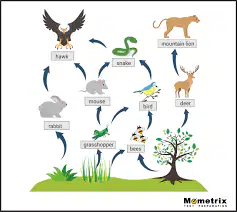
Aidan and Willa are studying a food chain diagram. Look at the image: Which item is a primary consumer?
snake
eagle
rabbit
bird
What are natural resources?
Man-made objects
Radioactive materials
Anything found in the environment that is useful for survival
Chemical compounds
What is the difference between renewable and nonrenewable resources?
Renewable resources are always nonliving, while nonrenewable resources are living
Renewable resources are always man-made, while nonrenewable resources are natural
Renewable resources can be replenished faster than the rate of use, while nonrenewable resources cannot be replenished fast enough to keep up with the rate of use
Renewable resources are always solid, while nonrenewable resources are liquid or gas
Which of the following is evidence for plate tectonics?
Which of the following is not a property of minerals?
Color
Luster
Hardness
Weight
Estuaries are areas where what types of water meet?
Freshwater and saltwater
Saltwater and brackish water
Freshwater and groundwater
Saltwater and rainwater
What is the productivity in the oceans related to nutrient availability and upwelling?
High productivity due to nutrient-rich waters
Low productivity due to lack of nutrients
No effect on productivity
Productivity is unrelated to nutrient availability


