
 Worksheets
Topics 2 - 6 Review
Total questions: 67
Worksheet time: 57mins
Air masses have properties from where they...
were formed
end up
Where do MARITIME air masses form?
Over water
Over land
Where do CONTINENTAL air masses form?
Over water
Over land
Global Winds are caused by
the unequal heating of the Earth
the movement of the air between the equator and the poles
the coriolis effect
all of the above
A large volume of air with the same temperature and moisture content.
weather front
air mass
air pressure
humidity
What are the characteristics of a maritime polar air mass?
Cold and dry
Cold and humid
Warm and dry
Warm and humid
When a warm air mass meets a cold air mass of equal strength, this usually forms.
cold front
warm front
stationary front
occluded front
The air mass is warm and dry, so it is
maritime polar
maritime tropical
continental polar
continental tropical
What causes wind?
differences in air pressure
differences in gravity
difference in oxygen
differences in the thermosphere
What causes differences in air pressure?
even heating of the Earth
Even cooling of the earth
uneven heating of the earth
global warming

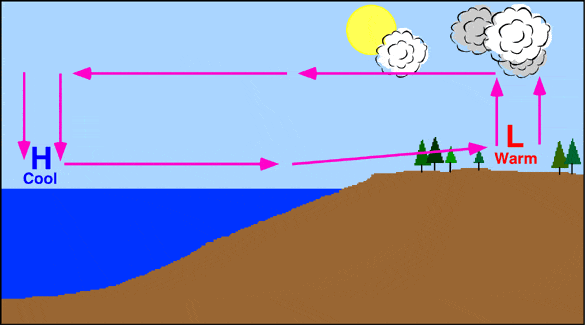
During the land breeze, what starts moving the cooler air out and warmer air in?
conduction
convection
radiation
Air at the poles is colder and denser so it_______________.
rises
circulates
stagnates
sinks
Air is warmer and less dense at the equator because the equator receives more____________________.
wind
solar radiation
air pressure
condensation


The lithosphere combines what two layers?
Athenosphere & Crust
Crust & Upper Mantle
Mantle & Athenosphere


The North American plate and Pacific plates meet at the San Andres Fault in California causing frequent earthquakes. This fault is located at a _____ boundary.
Ridge
Divergent
Convergent
Transform

Which oceanic plate in the above picture must be more dense? LEFT RIGHT
The plate on the left (the plate with the volcano on it)
The plate on the right (without the volcano)
Which TWO landforms occur when a continental plate and an oceanic plate hit each other?
Volcanoes on land and Volcanic Islands
Volcanoes on land and Deep Sea Trench
Volcanoes on land and Mountains
Rift Valley and Mid Ocean Ridge

What are these plates doing?
Diverging
Converging
Forming a transform boundary

Study this diagram carefully, noticing the direction of the arrows.The green bars are tectonic plates.What will happen at the place where the star is drawn on this diagram?
The plates will slide past each other (causing a major earthquake)
The plates will hit each other (one will subduct)
The plates will diverge (spread apart)

What are these plates doing?
Converging
Diverging
Forming a transform boundary

What are these plates doing?
Converging
Diverging
Forming a transform boundary

What type of event will occur at this boundary?
Earthquake
Volcano Eruption
Tornado
Mountain Building

What geologic process formed the Himalayas?
two continental plates converging
an earthquake in a subduction zone
a tectonic plate moving over a hot spot
movement at a transform fault boundary

the general terms for the MOVEMENT of sediment by wind, water, glaciers
weathering
erosion
deposition

the BREAKDOWN of rock into smaller pieces of the same rock without any change in its composition

the process of WEARING DOWN by friction - like sand blasting
exfoliation
abrasion
erosion
deposition

the process in which sediment particles are picked up and MOVED from one place to another

the part of the erosion process in which sediment travels to a new location and is laid down or DROPPED OFF


Beach waves dropping sand to create a beach is an example of...
weathering
erosion
deposition

What are the plates that form the Earth's crust called?
Teton plates
Technology plates
Temperature plates
Tectonic Plates
Which continents boarder the Ring of Fire? SELECT ALL THAT APPLY.
Asia
Austrailia
Africa
North America
South America
There are more volcanoes and earthquakes in the Ring of Fire than anywhere else in the world.
True
False
How do the people of Japan prepare for disaster?
fire drills with local fire fighters
organizations offer disaster management and preparedness classes
strict building codes/study how buildings respond to earthquakes
stay proactive
all of the above

This joke is referencing which kind of plate boundary?
Subduction Plate Boundary
Convergent Plate Boundary
Divergent Plate Boundary
Transform Fault Plate Boundary

How were seismic waves used as evidence that the Outer Core was liquid rock instead of solid rock?
S Waves cannot move through a liquid, and they don't move through the Outer Core.
S Waves speed up when they move through a liquid, and they sped up through the Outer Core.
S Waves slow down when they move into more dense material, and they do slow down when passing through the Outer Core.
None of these answers are correct.

When convection happens in the mantle...
the lithosphere moves.
the hotter, less dense fluid rises while the colder, more dense material sinks.
heat is transferred from the core up to the surface.
earthquakes, volcanoes, and tsunamis are generated on the surface.

This diagram is an example of what type of convergent boundary?
Ocean vs Ocean
Ocean vs Continent
Continent vs Continent
Divergent Boundary

What kind of plate boundary is this?
Divergent
Convergent
Transform-Fault
Subduction

What type of plate boundary is this?
Transform-Fault Boundary
Convergent Boundary
Divergent Boundary
Trivergent Boundary

How fast do the Earth's plates typically move?
Only a few cm per year.
As much as 1 km each year.
500 m/s
They don't move.

Are divergent boundaries constructive or destructive?
Destructive
Constructive

Are convergent boundaries constructive or destructive?
Destructive
Constructive

