

wayground logo

Free Printable Worksheets

NEW

Font size

S
M
L
XL
Worksheets

Mid Year Short Review

Total questions: 61

Worksheet time: 46mins
Name
Class
Date
1.
A process where one cell forms two identical daughter cells is called...
a)
cell cycle
b)
cell division (mitosis)
c)
interphase
d)
cytokinesis
2.
During interphase the cell ___________.
a)
divides into two cells
b)
divides its nucleus
c)
replicates its DNA
d)
replicates the organelles within the cell
3.
Replication is when __________.
a)
the cell makes a copy of its DNA in nucleus 
b)
the cell forms 2 identical cells
c)
the cell produces 2 sets of organelles
d)
the cell continues to complete the same function
4.
Mitosis is made up of how many phases?
a)
4
b)
5
c)
6
d)
7
5.
The following describes ________  during mitosis. The chromosomes line up along the center of the cell and the spindle fibers attach to each chromosome at the centromere.
a)
prophase
b)
metaphase
c)
anaphase
d)
telophase
6.
The following describes _________ during mitosis. The spindle fiber splits the centromere and the chromatids move to opposite sides of the cell.
a)
prophase
b)
metaphase
c)
anaphase
d)
telophase
7.
Which of the following best describes a DNA molecule?
a)
double helix
b)
contains ribose
c)
made of amino acids
d)
contains Uracil
8.
Guanine bonds with ______________.
a)
Adenine
b)
Guanine
c)
Cytosine
d)
Thymine
9.
What are the three components of a nucleotide?
a)
sugar, hydrogen, nitrogen base
b)
sugar, oxygen, nitrogen base
c)
sugar, phosphate, nitrogen base
d)
sugar, phosphate, protein
10.
What is the difference between DNA and RNA in terms of bases?
a)
RNA contains uracil in place of thymine
b)
RNA contains uracil in place of adenine
c)
RNA contains uracil in place of guanine
d)
RNA contains uracil in place of  cytosine
11.

What are the "messengers" from DNA to the rest of the cell?

a)

Nucleotides

b)

Ribose

c)

DNA

d)

mRNA

12.

Which organelle is the location where protein is made?

a)

Ribosome

b)

Nucleus

c)

Cytoplasm

d)

Nucleotide

13.

When these bond together, they form a protein

a)

Amino Acids

b)

Peptide Bonds

c)

Ribose

d)

Nucleotides

14.

mRNA occurs during this process

a)

Translation

b)

Transcription

c)

Replication

d)

Delivery

15.
The process to go from mRNA to a protein is called ____
a)
transcription
b)
rRNA
c)
replication
d)
translation
16.

Large molecules, such as glucose, that cannot cross the lipid bilayer can still move across the membrane through a type of PASSIVE transport called

a)

facilitated diffusion

b)

active transport

c)

osmosis

d)

diffusion

17.
Passive transport requires no
a)
concentration gradients
b)
osmosis
c)
motion
d)
energy
18.
What is the definition of  Selective Permeability?
a)
The movement of materials across the cell membrane that requires NO ENERGY from the cell.
b)
The movement of materials through (or across) the cell membrane
c)
The ability of the cell membrane to allow some things to pass through while preventing other things from passing through.
d)
The movement of molecules from an area of high concentration to a area of low concentration 
19.
 An animal cell placed in a hypertonic (salty) solution will
a)
Stay the same
b)
Shrink- get smaller
c)
Swell- get bigger
20.
During osmosis
a)
water moves from high to low concentration
b)
large or oddly shaped molecules move across a cell membrane
c)
water moves when energy is used
d)
proteins are built
21.

During diffusion, when the concentration of molecules on both sides of a membrane is THE SAME, the molecules will

a)

move across the membrane to outside of the cell

b)

stop moving across the membrane

c)

continue to move across the membrane in both directions

d)

move across the membrane to the inside of the cell
22.
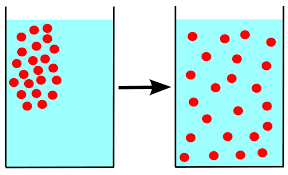
The picture below is an example of _________________.
a)
osmosis
b)
isotonic
c)
diffusion
d)
active transport
23.
What is diffusion?
a)
when molecules move 
b)
when molecules move from a high concentration to a low.
c)
no movement 
d)
molecules move everywhere
24.

What type of solution is this healthy looking red blood cell in?

a)

Isotonic

b)

Hypertonic

c)

Hypotonic

25.

In a HYPERtonic solution there is a ____ concentration of water.

a)

HIGH

b)

LOW

c)

EQUAL

d)

NO

26.
What are the raw materials of photosynthesis?
a)
oxygen and carbon dioxide
b)
oxygen and glucose
c)
carbon dioxide and water
d)
water and glucose
27.
What are the products of photosynthesis?
a)
oxygen and carbon dioxide
b)
oxygen and glucose
c)
carbon dioxide and water
d)
water and glucose
28.
What is the chemical formula for glucose?
a)
C6H12O6
b)
C6H6O12
c)
C12H6O12
d)
C6O2H6
29.

Why are plants usually green?

a)

Because the chlorophyll reflects green light

b)

Because the chlorophyll absorbs green light

c)

Because the accessory pigments combine to make green

d)

Because the accessory pigments only absorb green light

30.
Which of these conditions would decrease the rate of photosynthesis in a plant?
a)
Above average precipitation
b)
Changing the daylight hours from 14 hrs to 10 hrs
c)
Changing the CO2 concentration from 380 ppm to 410 ppm
d)
All of these choices
31.
After photosynthesis, plants store their energy as _________ .
a)
chlorophyll
b)
pigment
c)
glucose (sugar)
d)
Oxygen
32.

Why does the rate of photosynthesis decrease at high temperatures?

a)

Enzymes are denatured

b)

Enzymes do not have enough kinetic energy

33.

Cellular Respiration occurs in what cell organelle?

a)

chloroplast

b)

cytoplasm

c)

mitochondria

d)

animal

34.

Which organism go through cellular respiration?

a)

animals

b)

plants

c)

both animals and plants

d)

none

35.

What type of organism makes it's own food?

a)

Autotroph

b)

Heterotroph

c)

Consumer

d)

Omnivore

36.

Which organelle controls what goes in and out of the cell?

a)

nucleus

b)

nucleolus

c)

cell membrane

d)

nuclear membrane

37.
The ____________ packages and processes material before it exports out of the cell.
a)
Vacuoles
b)
mitochondria
c)
Golgi apparatus 
d)
nucleus 
38.
Which of the following is an enzyme filled organelle that breaks down waste in the cell?
a)
lysosomes
b)
chloroplast
c)
mitochondria 
d)
Golgi apparatus 
39.

Both Eukaryotic and Prokaryotic cells have __________.

a)

ribosomes

b)

nucleus

c)

ribosomes and a nucleus.

40.

Prokaryotic cells do not have…….

a)

membrane bound organelles

b)

cell membrane

c)

DNA

d)

genetic material

41.
What are abiotic factors?
a)
All of the living things in an ecosystem
b)
All of the non living things in an ecosystem
c)
All of the living and nonliving things combined
d)
A piece of a living thing
42.
What are biotic factors?
a)
All of the living things in an ecosystem
b)
All of the non living things in an ecosystem
c)
All of the living and nonliving things combined
d)
A piece of a living thing
43.
Large bodies of water do not quickly fluctuate in temperature. Why?
a)
Water is a solvent.
b)
Water has a high heat capacity.
c)
Water acts as a buffer.
d)
Water is non-polar.
44.
What word describes when water is attracted to other substances?
a)
cohesion
b)
adhesion
c)
capillary action
d)
surface tension
45.
Why does ice float?
a)
As water freezes, it expands and its density decreases.
b)
As water freezes, it takes up more hydrogen from the atmosphere, causing it to have a greater buoyancy.
c)
As water freezes, air becomes trapped between the hydrogen bonds of water molecules.
d)
As water freezes, it takes up more oxygen from the atmosphere, causing it to have a greater buoyancy.
46.

What is the monomer of Carbohydrates?

a)

Amino Acid

b)

Monosacharrides

c)

Fatty Acids

d)

DNA/RNA

47.

What is the monomer of lipids?

a)

Amino Acids

b)

Monosaccharides

c)

Fatty Acids

d)

DNA/RNA

48.

What is the monomer of proteins?

a)

Amino Acids

b)

Monosaccharides

c)

Fatty Acids

d)

DNA/RNA

49.

What is the monomer of nucleic acids?

a)

Amino Acids

b)

Monosaccharides

c)

Fatty Acids

d)

Nucleotides

50.

What is an example of a carbohydrate?

a)

b)

c)

d)

51.

What is an example of a protein?

a)

b)

c)

d)

52.

What does an enzyme do for reactions?

a)

Act as catalysts to speed up reactions.

b)

Act as catalysts to slow down reactions.

c)

Act as catalysts to keep reactions stable.

53.

What are examples of carbohydrates?

a)

triglycerides, waxes, fat, and oils

b)

form polypeptides such as antibodies, enzymes, and hormones

c)

glucose, fructose, cellulose, and lactose

d)

DNA and RNA

54.

What are examples of lipids?

a)

triglycerides, waxes, fats, and oils

b)

form polypeptides such as antibodies, enzymes, and hormones

c)

glucose, fructose, cellulose, and lactose

d)

DNA and RNA

55.
Genotype refers to the ...
a)
physical expression of the genes
b)
the possible combination of alleles in a gene
c)
whether an allele is dominant or recessive
d)
how an organism will appear
56.
Which of the following is a phenotype?
a)
BB
b)
Bb
c)
bb
d)
Blue eyes
57.
having two of the same genes for the trait (sometimes called purebred).
a)
homozygous
b)
hetrozygous
c)
protein
d)
chromosome
58.
having two different genes for a trait (sometimes called hybrid).
a)
protein
b)
homozygous
c)
heterozygous
d)
genotype
59.
G = green, g = yellow
The genotype for a yellow plant is...
a)
GG
b)
Gg
c)
gg
d)
all of the choices result in yellow
60.

CROSSING OVER INCREASES

a)

LIFE SPAN

b)

GENETIC VARIATION

c)

THE NUMBER OF OFF-SPRING

d)

ALL ARE TRUE

61.
The correct order of the phases of mitosis and meiosis could be abbreviated as:
a)
MAPT
b)
PAMT
c)
TPAM
d)
PMAT
