
 Worksheets
Earth's Interior, Continental Drift, and Plate Tectonics Review
Total questions: 65
Worksheet time: 33mins


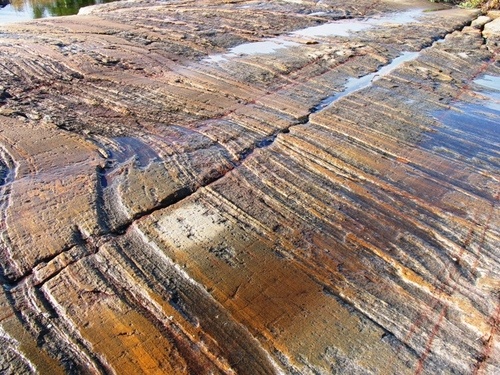
What is this a picture of?
plate tectonics
continental drift
Pangaea
glacier scaring
The theory of continental drift focus largely on the idea of Pangaea. What is Pangaea?
He couldn't explain how or why the continents were moving
He was not a geologist, only a meteorologist

What evidence did Wegener use to support his theory?
Continents and fossils fitting together/matching-up like puzzle pieces
glacier scars and other climate evidence from temperature
mountain ranges and rocks line up across continents
all of the above

What type of evidence was NOT used by Alfred Wegener to support his continental drift hypothesis?
evidence from landforms
evidence from fossils
evidence from human remains
evidence from climate

According to the continental drift hypothesis, the presence of similar fossils in South America and Africa supports which scientific idea?
Animals easily and frequently travel from Africa to South America.
Species of animals probably traveled between continents on natural rafts (such as trees destroyed in tsunamis).
Land bridges once existed that connected the continents.
South America and Africa were once connected together.
geometric fit of continents
Another piece of evidence in the theory of Continental Drift is __________ evidence of a giant fern named Glossopteris.
geologic
fit/shape
glacial
fossil/climate
What does the theory of continental drift state?
The continents were once joined in a super-continent and have moved over time
The Earth is broken into lithospheric plates that move due to convection currents
Continents are stationary and do not move
None of the above
Wegener used matching mountain ranges across different continents as evidence to support his hypothesis of Continental Drift.
true
false
Wegener used matching matching fossils of the same organisms on different continents as evidence to support his hypothesis of Continental Drift.
true
false
Wegener used seafloor spreading and magnetic striping as evidence to support his hypothesis of Continental Drift.
true
false
Are the continents still moving today?
Yes
No
Scientists are not sure.
Was Wegener's theory of continental drift accepted when he proposed it?
Yes
No
True or false: The layers of Earth separated by their physical properties and states of matter are the crust, mantle, and core.
True
False
True or false: The layers of Earth separated by their chemical composition are the crust, mantle, and core.
True
False
True or false: The layers of Earth separated by their chemical composition are the lithosphere, asthenosphere, mesosphere, outer core, and inner core.
True
False
True or false: The layers of Earth separated by their physical properties and states of matter are the lithosphere, asthenosphere, mesosphere, outer core, and inner core.
True
False
What is the state of matter of the lithosphere?
Solid
Semi-solid, like hot plastic
Fluid, semi-solid, like molasses or hot toothpaste
Liquid
What is the state of matter of the asthenosphere?
Solid
Semi-solid, like hot plastic
Fluid, semi-solid, like molasses or hot toothpaste
Liquid
What is the state of matter of the mesosphere?
Solid
Semi-solid, like hot plastic
Fluid, semi-solid, like molasses or hot toothpaste
Liquid
What is the state of matter of the outer core?
Solid
Semi-solid, like hot plastic
Fluid, semi-solid, like molasses or hot toothpaste
Liquid
What is the state of matter of the inner core?
Solid
Semi-solid, like hot plastic
Fluid, semi-solid, like molasses or hot toothpaste
Liquid
What is the chemical composition of the crust?
Mostly silica
Silica, iron, and magnesium
Iron and nickel
What is the chemical composition of the mantle?
Mostly silica
Silica, iron, and magnesium
Iron and nickel
What is the chemical composition of the core?
Mostly silica
Silica, iron, and magnesium
Iron and nickel
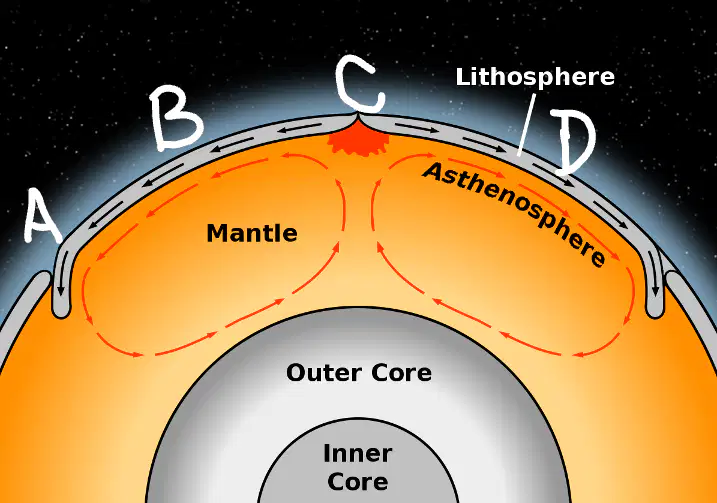
Which letter represents a mid-ocean ridge?
A
B
C
D
Which letter represents a trench?
A
B
C
D
At which letter would crust be the hottest?
A
B
C
D
At which letter would crust be the coldest?
A
B
C
D
At which letter would crust be the oldest?
A
B
C
D
At which letter would crust be the youngest?
A
B
C
D
At which letter would crust be the thickest?
A
B
C
D
What is the main driving force of plate tectonics?
Convection currents in the mantle
Earth's rotation on its axis
Earth's revolution around the sun
The moon's gravity
At which boundary do mid-ocean ridges, rift valleys, and volcanoes occur?
Divergent
Transform
Convergent
At which boundary do island arcs, trenches, volcanoes, and folded mountains occur?
Divergent
Transform
Convergent
At which boundary do earthquakes occur?
Divergent
Transform
Convergent
All of the plate boundaries have earthquakes
Earthquakes are the MAIN feature of which boundary?
Divergent
Convergent
Transform
Japan is an example of which type of plate boundary?
Oceanic-oceanic convergent
Continental-continental convergent
Oceanic-continental convergent
Divergent
The Andes Mountains are an example of which type of plate boundary?
Oceanic-oceanic convergent
Continental-continental convergent
Oceanic-continental convergent
Divergent
The Himalayan Mountains are an example of which type of plate boundary?
Oceanic-oceanic convergent
Continental-continental convergent
Oceanic-continental convergent
Divergent
The East African Rift Zone is an example of which type of boundary?
Continental-continental convergent
Oceanic-continental convergent
Oceanic-oceanic convergent
Divergent


Sea-floor spreading explains how.....
new crust is created at a divergent boundary
volcanoes are formed on continents
deep sea trenches are formed


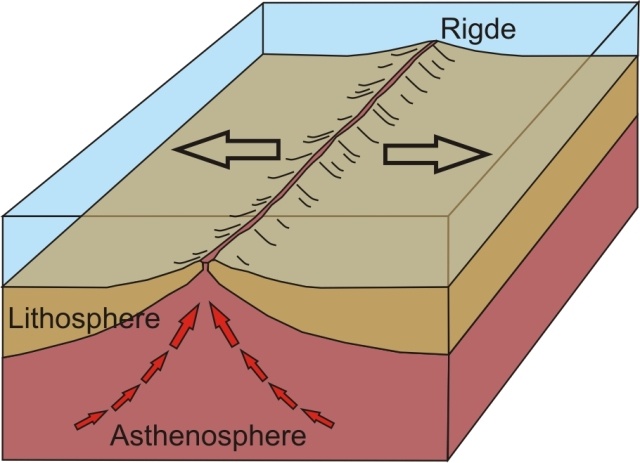

Is there a pattern to the locations of earthquakes and volcanoes around the globe?
No, earthquakes and volcanoes are random.
Yes, earthquakes and volcanoes usually occur near the boundaries of tectonic plates.
yes, earthquakes and volcanoes usually occur in the middle of tectonic plates.
No, earthquakes and volcanoes usually occur under water.

Mirror images of stripes on either side of mid-ocean ridges show
how old the crust is.
how new the crust is.
evidence of normal and reversed polarity.
the direction of plate motion.
Which of the following is NOT a piece of evidence used to support the modern theory of plate tectonics?
Seafloor spreading
Magnetic striping
Mid-ocean ridges
Trenches
Geometric fit of the continents
What are the TWO types of crust?
oceanic
continental
lithosphere
geologic

