
Font size
 Worksheets
Chapter 4 Practice
Total questions: 80
Worksheet time: 3hrs 16mins


Which of these is incorrect?


All atoms are most stable with (or would "prefer") how many electrons in their valence shell?
1
2
8
18
All atoms are most stable with (or would "prefer") how many electrons in their valence shell?
1
2
8
18
How would you draw a Lewis dot diagram for Magnesium?


All of the elements in column 18 or group 8A have 8 electrons EXCEPT ______, which is actually stable with only 2 electrons.
Hydrogen
Helium
Neon
Fluorine
When the element is heated, the electrons jump to higher energy level and this is called the ___ state.
ground
excited
When electrons change energy levels, when is light emitted?
When the electrons jumps to a higher energy level.
When an electron falls back to the ground state.
When the electrons jump to the excited state.
When electrons are resting.
When examining Bohr diagram, the energy level with the greatest amount of energy is the one
farthest from the nucleus
closest to the nucleus
they all have the same energy levels
If electrons gain energy they
move up one or more level to an excited state.
more down one or more shells to a ground state.
move up one or more level to a ground state.
more down one or more shells to an excited state.
When an atom _______________ _____________, its electrons can use this energy to move to a higher energy level.
releases energy
absorbs energy
emits radiation
gets rid
Explain what was occuring during the flame test that caused the flame change colors.
The electrons gained energy and moved to an excited state.
The electrons gained energy and moved to an ground state.
The electrons released energy and moved to a ground state.
The electrons released energy and moved to an excited state.
What particles in the heated compounds are responsible for the production of the colored light?
proton
neutron
electron
proton and neutron

What element is in the unknown?
He
O2
Ne
Ar
Xe

In the picture, Which of these represents electrons?
A
B
C
D
What evidence did you observe that proves that elements give off their own unique color spectrum?
All of the gas tubes produced a full spectrum. (A rainbow.)
When we looked at white light through a prism, we saw the rainbow.
Each gas tube gave off its own unique color and color spectrum when we looked at the light through the spectroscope. None of them were the exact same.
Each gas tube gave off the same color and color spectrum when we looked at the light through a spectroscope.
Regardless of how hot the flame is, when a metal ion is placed in a flame, it always give off the same color light. Why?
The number of protons is still the same, so the same number of electrons get excited and fall back to the ground state the same way and give off the same color every time.
The number of electrons is still the same, so the same number of electrons get excited and fall back to the ground state the same way and give off the same color every time.
The number of neutrons is still the same, so the same number of electrons get excited and fall back to the ground state the same way and give off the same color every time.
The number of ions is still the same, so the same number of electrons get excited and fall back to the ground state the same way and give off the same color every time.
What evidence indicates that electrons move around the nucleus in definite pathways?
None of the elements emitted a full color spectrum, but rather only certain frequencies of the spectrum were given off. Since some of the spectrum is missing, this means the electrons can only emit frequencies at the fixed energy levels and not in between.
None of the elements emitted a full color spectrum, but rather only certain frequencies of the spectrum were given off. Since some of the spectrum is missing, this means the electrons can emit frequencies of light in between the energy levels.
All of the elements emitted a full color spectrum. (The Rainbow.)
How can scientists use the color spectrum of individual elements to help determine the composition of stars in our galaxy?
Since each element has its own unique line spectra, it is possible to use a spectrometer to examine the light being emitted by the stars to determine what elements are present?
Since each element does not have its own unique color spectrum, it is impossible to determine what elements make up our start.
Since the stars are so far away, the light we would be studying can not be trusted to determine their composition.
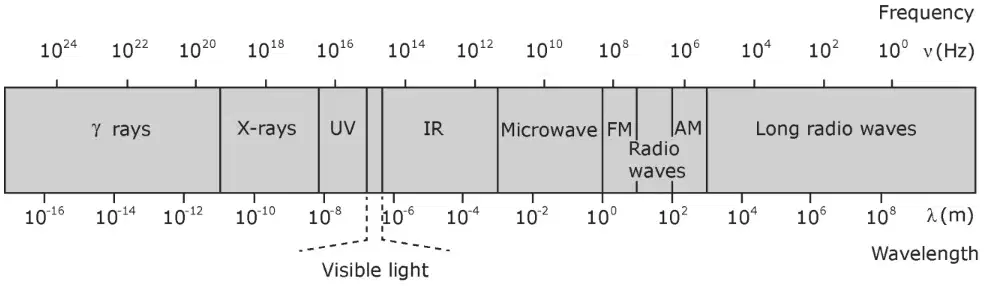
Which radiation on the electromagnetic spectrum has the highest energy?
radio
microwave
gamma
x-rays
If frequency increases, what happens to energy?
decreases
increases
stays the same
impossible to determine this
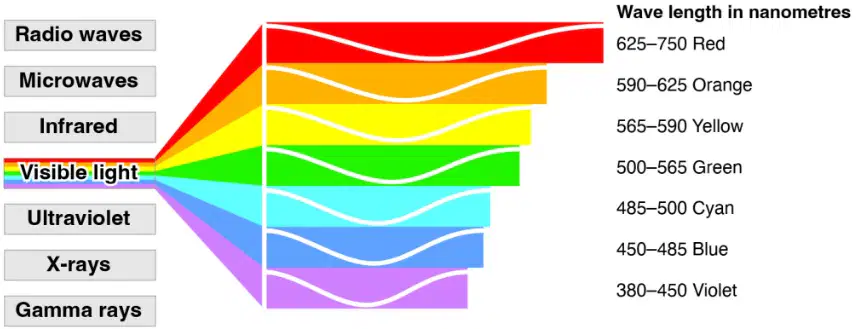
What color has the lowest energy?
violet
green
yellow
red
A wave with a large wavelength will have a ______ frequency and _____ energy
high, low
high, high
low, high
low, low
What is the speed of light?
3.0x10⁸ ms
3.0x10⁸ m/s
6.626x10⁻³⁴ Js
6.626x10⁻³⁴ J/s
The frequency of violet light is 7.5x10¹⁴ Hz. What is its wavelength?
4.0x10⁻⁷ m
4.0x10⁷ m
2.25x10²³m
2.25x10²³ Hz

If short wavelength has more ENERGY than long wavelength, which color Lightsaber is the most dangerous, or powerful?
Red
Orange
Blue
Green
The number of waves that pass a fixed point in a given amount of time is...
frequency
wave speed
amplitude
wavelength
4.10 x 10⁻¹² m. What is the frequency?
Energy is measured in........
Wavelength
Meters
Joules
Frequency
The symbol for wavelength Is?
nu
lambda
vi
meters

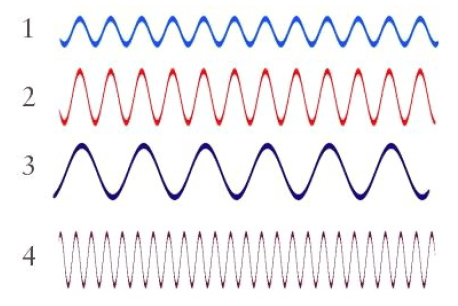
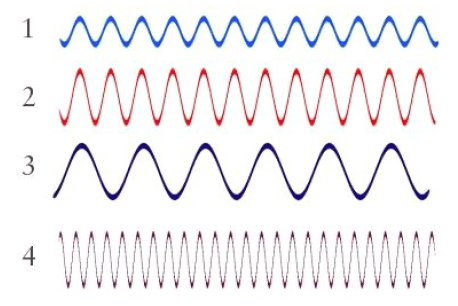
A wave of red light travels at:
6.02 x 10²³ m/s
5.30 x 10⁹ m/s
8.00 x 10³ m/s
3.00 x 10⁸ m/s
λ and ν are:
inversely proportional
directly proportional
they are proportional in 10 different ways
they are proportional in 20 differentways
When we looked at element tubes through glasses with diffraction gratings, we saw spectra from elements as:
continuous spectra just like the sun
dark line spectra
bright line spectra
were not able to show us spectra at all
A ______________ is the minimum amount of energy that can be gained or lost by an atom.
wavelength
frequency
quantum
electron
What are line spectra, and how are they used?
Line spectra are observed when pure samples of individual elements are heated. They can be used to identify elements.
Line spectra are observed when atoms interact with visible light. They can be used to determine the energy levels of atoms.
Line spectra are observed when atoms interact with visible light. They can be used to infer important information about atoms.
Line spectra are observed when pure samples of individual elements are heated. They can be used to determine the wavelengths of light.

True or False: The ground state is the highest energy state of an atom.
True
False

What is the light that you can see called?
observatory light
ultraviolet light
visible light
infrared light

The unknown emissions spectra belongs to the element
Hydrogen
Mercury
Neon
Sodium


How many electrons can fit on the 1st energy level (orbital) for any Bohr Model?
2
6
8
10

This is a correct dot diagram for oxygen (O)?
true
false

Why do carbon, silicon, and tin all react similarly?
They are located in the same period
They have an even atomic number
They have the same number of energy levels
They are located in the same group
What occurs when potassium reacts with chlorine to form potassium chloride?
Electrons are shared and the bonding is ionic.
Electrons are shared and the bonding is covalent.
Electrons are transferred and the bonding is ionic.
Electrons are transferred and the bonding is covalent.
Ions are ________
atoms with an electric charge
atoms with different number of protons
atoms with different number of neutrons
Metals form positive ions which are also known as (a)
Non-metals form negative ions which are also known as (a)
Which of the following ions have a +1 charge?
Hydrogen (H)
Helium (He)
Calcium (Ca)
Lithium (Li)
Ions have the same number of protons but different number of _________________
neutrons
electrons
protons
toes
How many valence electrons are needed to fulfill the octet rule?
2
4
6
8
What is a Lewis Dot Structure?
It shows all of the particles in the atom.
Contains protons and neutrons
Only shows the element symbol and it's outer most electron shell
Contains protons and electrons
Which of these cations have the correct charge? Pick all that apply.
Li+
Na2+
Al4+
Ca2+
Ga3+
Which of the following anions have the correct charge? Pick all that apply.
Cl2-
O2-
F-
N3-
Ne-
Which ions have the same number of electrons as Neon, Ne?
N3-
Mg2+
Ca2+
P3-
O2-
Which ions have the same number of electrons as argon, Ar?
N3-
O2-
Ca2+
Mg2+
P3-
What is the element symbol of an atom that has 33 protons, 42 neutrons, and forms a -3 ion?
(a)
What does the period number tell you about an atom's electron arrangement?
number of electrons
number of valence electrons
number of electron shells
number of possible isotopes
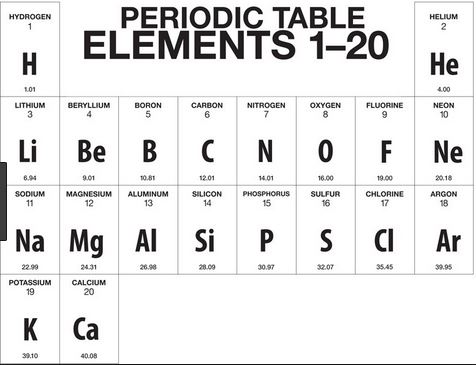
How many valence electrons does Nitrogen Have?
1 Valence electron
2 Valence electron
3 Valence electron
4 Valence electron
5 Valence electron
Electron live in something called __________.
nucleus
orbits
Shells or Energy levels
Valences
What is the electron configuration of sodium?
2-8
2-8-2
2-8-1
11
What is the electron configuration of calcium?
2-8-8-2
2-8-10
20
2-18-2
Which of the following shows an excited state electron configuration?
2-7-1
2-4
2-8-4
2-8-1
What is the electron configuration of sodium ion (Na+1)?
2-8
2-8-2
2-8-1
11
What is the electron configuration of Oxygen ion (O-2)?
2-8
2-6
8
10
Which of these answer choices does not show ground state?
2-2
2-7-1
2-8-18-9-2
2-8-18-18-8-1
Which particle has a mass so small, it is considered to be 0 amu?
proton
hydrogen nucleus
neutron
electron
During a flame test, sodium chloride produces an intense yellow flame. This yellow color is produced when electrons in excited atoms
are gained by the atoms
are lost by the atoms
move to higher energy states within the atoms
move to lower energy states within the atoms
Which elements have the most similar chemical properties?
Ge, As, and Sb
Mn, Fe, and Co
S, Se, and Te
P, S, and Cl
What is the overall charge of an ion that has 9 protons, 11 neutrons, and 10 electrons?
+1
-1
+2
-2

