wayground logo

Free Printable Worksheets

Font size

S
M
L
XL
Worksheets

Bio30 - Unit 4 Review

Total questions: 122

Worksheet time: 4hrs 0mins

Name
Class
Date
1.

The basic concept that, in nature, genetic information generally can flow only from DNA to RNA to PROTEIN.

a)
central dogma (of protein synthesis/molecular biology)
b)
nonsense mutation
c)
UUA
d)
It is the wrong order, and should be RNA -> DNA -> Protein
2.

Which of the following is the correct order of the central dogma of molecular biology?

a)
a . RNA -> protein -> DNA
b)
b . RNA -> DNA -> protein
c)
c . protein -> RNA -> DNA
d)
d . DNA -> RNA -> protein
3.

Who was the first to demonstrate the process of transformation with lab mice and virulent/non-virulent strains of bacteria?

a)
a. Frederick Griffith
b)
b . Alfred Hershey and Martha Chase
c)
c . James Watson and Francis Crick (and Rosalind Franklin)
d)
d . Oswald Avery, Colin MacLeod, and Maclyn McCarty
4.

Who is attributed the discovery of DNA as a double helix shape?

a)
a. Frederick Griffith
b)
b . Alfred Hershey and Martha Chase
c)
c . James Watson and Francis Crick (and Rosalind Franklin now-a-days)
d)
d . Oswald Avery, Colin MacLeod, and Maclyn McCarty
5.

Which enzyme synthesizes new stands of DNA?

a)
helicase
b)
DNA polymerase
c)
DNA photonase
d)
DNA lipase
6.

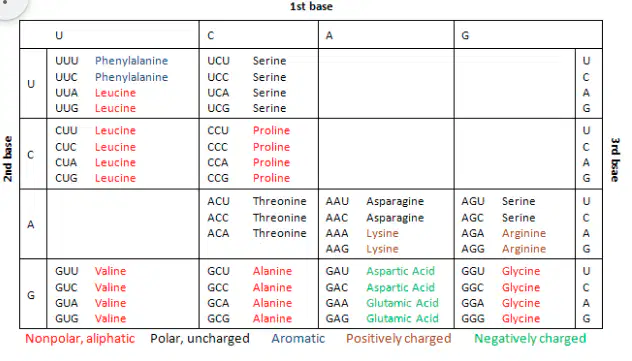
Which RNA brings the genetic code from the nucleus to the cytoplasm?
a)
transfer RNA (tRNA)
b)
messenger RNA (mRNA)
c)
DNA
d)
ribosomal RNA (rRNA)
7.

If the sequence within a gene is GGUGGGCCAGGGCCC, what is the amino acid sequence of the corresponding protein?

a)
a . Glycine, Glycine, Proline, Glycine, Proline
b)
b . Proline, Proline, Glycine, Glycine, Proline
c)
c . Proline, Proline, Glycine, Proline, Glycine
d)
d . Glycine, Glycine. Proline, Proline, Glycine
8.

This adds a "tail" to the mRNA

a)
splicing
b)
editing
c)

polyadenylation

d)
termination
9.

If the codon is CGA, what is the anticodon?
a)
TCC
b)
GCU
c)
GCT
d)
AGG
10.

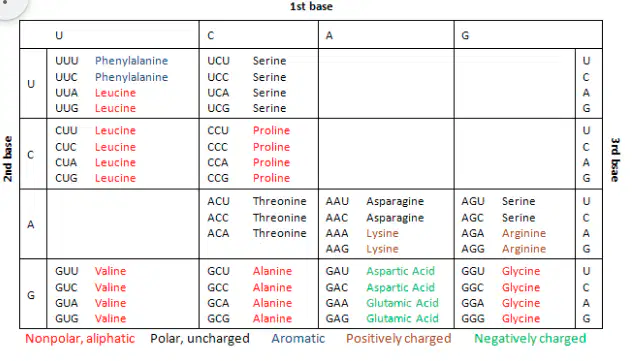
Which amino acids would this sequence of codons, AUGGUUUACCGAUGA, code for?

a)
Methionine, Valine, Tyrosine, Arginine, Stop
b)
Phenylalanine, Tyrosine, Arginine
c)
Methionine, Valine, Tyrosine, Arginine
d)
Methionine, Leucine, Tyrosine, Alanine, Stop
11.

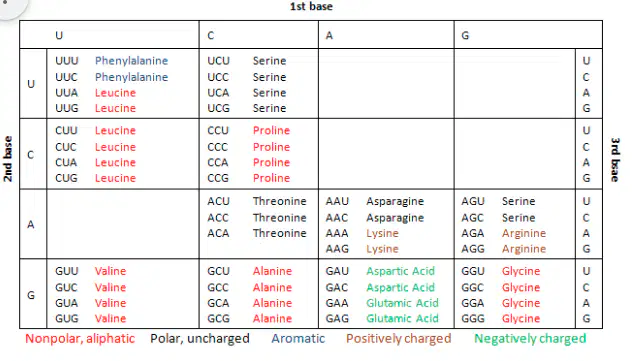
Which of the following types of mutations would most likely result in a serious genetic disorder?
a)
somatic mutation
b)
silent mutation
c)
frameshift mutation
d)
they are all equally likely
12.

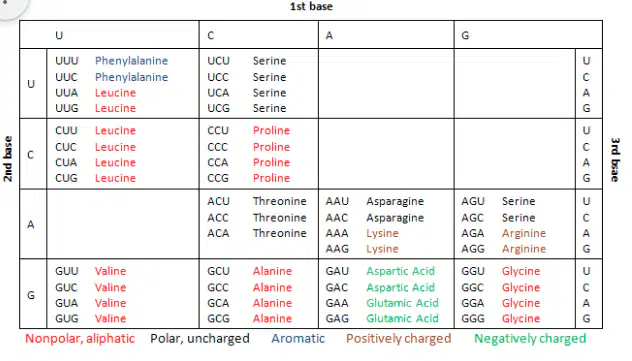
Assume that a point mutation changes the codon AGU to AGC. Is this a silent mutation?
a)
Yes
b)
No
c)
It can be, but not necessarily
13.

Change of UGC to UGA is an example of:

a)
nonsense mutations
b)
missense mutations
c)
frameshift mutations
d)
silent mutations
14.

Human Papillomavirus (HPV), cigarette smoke, and nitrate preservatives are all:

a)
causes of mutations
b)
nonsense mutations
c)
treatments against radiation contamination
d)
used in barbecuing and lead to cancer
15.

What is a mutagen?

a)
cancer-causing agent
b)
factor that immediately kills the organism
c)
inherited mutations
d)
environmental factors that cause mutations
16.

Types of mutagens include:

a)
radiation
b)
chemicals
c)
infectious agents
d)
all of the above
17.

____________________ mutations occur in cells of the body, and are confined to one cell and its daughter cells.

a)
somatic
b)
germline
c)
sololic
d)
gremlin
18.

If one helix of DNA in an individual normally reads AUGGCGCCGUGA, but when replicated becomes AUGGCGGCGCCGUGA, this is an example of

a)
Deletion
b)
Duplication
c)
Inversion
d)
Insertion
e)
Translocation
19.

Mutations having positive effects on the organism in which they occur are called beneficial mutations.

a)
True
b)
False
20.

Gene regulation allows: (choose the best answer)

a)
enhancers to speed up protein synthesis
b)
formation of enzymes
c)
cells to express proteins when needed
d)
formation of proteins
21.

Which process is normally regulated by tumor-suppressor genes?

a)
DNA synthesis
b)
transcription
c)
mitosis
d)
cell division
22.

The process which allows cells to make proteins when needed is known as the regulation of gene expression.

a)
True
b)
False
23.

To initiate transcription of a gene, RNA polymerase binds to a(n) _____.

a)
Lac Z
b)
operator
c)
Lac A
d)
promoter
24.

Prokaryotic gene regulation is _____ than eukaryotic gene regulation.

a)
simpler
b)
more complicated
c)
more artificial
d)
none of the above
25.

____________________ is a region of DNA that consists of one or more genes that encode the proteins needed for a specific function.

a)
operon
b)
promoter
c)
Lac A gene
d)
Lac Z gene
26.

_____ are important for transcription.

a)
Tumor-suppressor genes
b)
Homeobox genes
c)
Promoters
d)
DNA polymerases
27.

Which type of gene is NOT specifically involved in regulating the cell cycle?

a)
Tumor-suppressor genes
b)
Homeobox genes
c)
Promoters
d)
DNA polymerases
28.

The ____________________ is a sequence of 180 nucleotides in the DNA that codes for a polypeptide consisting of 60 amino acids.
a)
Tumor-suppressor
b)
Homeobox
c)
Promoters
d)
DNA polymerases
29.

If a mutation occurs where an A or G is missing it is called

a)
tautomerism
b)
depurination
c)
deamination
d)
transition
30.

This is an illustration of ________.

a)
deletion
b)
duplication
c)
inversion
d)
insertion
e)
translocation
31.

What is the role of tRNA in protein synthesis?

a)

It catalyzes peptide bond formation

b)

It forms the ribosome structure

c)

It synthesizes mRNA

d)

It carries amino acids to the ribosome

32.

Which enzyme is responsible for unwinding the DNA helix during replication?

a)

DNA polymerase

b)

Helicase

c)

Ligase

d)

Topoisomerase

33.

Which of the following is a stop codon in mRNA?

a)

UAA

b)

GCU

c)

UGG

d)

AUG

34.

What is the function of ribosomal RNA (rRNA) in protein synthesis?

a)

It forms the ribosome structure

b)

It catalyzes peptide bond formation

c)

It synthesizes mRNA

d)

It carries amino acids to the ribosome

35.

Which of the following processes involves the removal of introns from pre-mRNA?

a)

Translation

b)

Replication

c)

Transcription

d)

Splicing

36.
RNA is read in sections called:
a)
Triplets
b)
Genes
c)
Codons
d)
Genes
37.
Transcription is a process that in eukaryotic cells takes place in the:
a)
Nucleus
b)
Cytoplasm
c)
Golgi Apparatus
d)
Rough E.R.
38.
Transcription begins at sequences called
a)
Start Codons
b)
Promoters
c)
Origins
d)
Introns
39.
Transcription produces RNA by copying the:
a)
Coding Strand
b)
Template Strand
40.
RNA polymerase creates RNA in the _________ direction
a)
5' to 3'
b)
3' to 5'
41.
What is the RNA synthesized from a section of DNA with the code: GATTACA ?
a)
CUAAUGU
b)
GATTACA
c)
GAUUCA
d)
CTAATGA
42.
The enzyme that produces RNA in Transcription is called
a)
RNA Polymerase
b)
DNA Polymerase
c)
Transcriptase
d)
RNA Intrase
43.
Splicing is accomplished by:
a)
Spliceosomes
b)
DNA Ligase
c)
RNA Polymerase I
d)
SSBPs
44.
What is not done after Transcription?
a)
Chunking of mRNA into codons
b)
Intron Splicing
c)
5' Cap addition
d)
Poly A-tail added
45.
Translation is a process in eurkaryotic cells takes place in the:
a)
Cytoplasm
b)
Nucleus
c)
Nucleolus
d)
Golgi Bodies
46.
tRNA molecules move through the ribosome in the order:
a)
A-P-E
b)
E-P-A
c)
E-A-P
d)
P-E-A
47.
tRNA molecules match the mRNA codons with a(n):
a)
Codon
b)
Anti-Codon
c)
Intron
d)
Methylated Cap
48.
Translation begins with a(n):
a)
Start Codon
b)
Intron
c)
Promoter
d)
Origin
49.
The codon 5'-UAC-3' would have an anti-codon match:
a)
3'-AUG-5'
b)
3'-TAC-5'
c)
5'-AUG-3'
d)
5'-CAU-3'
50.
When the Ribosome reaches ________________ the process of translation stops
a)
Stop Codon
b)
Okazaki Fragment
c)
Terminator
d)
taq Polymerase
51.
Translation is a process that produces
a)
mRNA
b)
Protein
c)
Polypeptide Chains
d)
tRNA
52.
The amino acid sequence of a polypeptide chain comprises the ____ structure of the protein.
a)
Primary
b)
Secondary
c)
Tertiary
d)
Quaternary
53.
RNA contains which bases?
a)
adenine, guanine, uracil, cytosine
b)
thymine, guanine, cytosine, uracil
c)
thymine, uracil, cytosine, guanines
d)
adenine, uracil, guanine, thymine
54.

How many nucleotides equal 1 amino acid?

a)

1

b)

2

c)

3

d)

4

55.

TRANSCRIBE this DNA sequence: TACGTTACT

(a)  

56.

Which organelle makes proteins?

(a)  

57.
What is the term for a three-nucleotide sequence that codes for an amino acid?
a)

base

b)

codon

c)

amine

d)

serine

58.

This process to go from DNA to mRNA is
(a)  

Choose from the below words
transcription
translation
replication
synthesis
59.
The process to go from mRNA to a protein is called
(a)  
Choose from the below words
translation
transcription
rRNA
replication
60.
What amino acid is represented by the codon UUA?
a)

Phenylalanine

b)

Tyrosine

c)

Leucine

d)

Stop codon

61.
Which of the following molecules is made during transcription?
a)

DNA

b)

tRNA

c)

protein

d)

mRNA

62.
Which of the following bases is found only in RNA?
a)

Adenine

b)

Guanine

c)

Thymine

d)

Uracil

63.
Which form of RNA carries amino acids from the cytoplasm to the ribosome?
a)

amino RNA

b)

ribosomal RNA

c)

transfer RNA

d)

messenger RNA

64.

What would be the complementary DNA strand for the following nucleotide sequence?
TCG ATA CGA

(a)  

65.
Which of the following terms means that in each molecule of DNA made during replication there is one original strand and one new strand?
a)

Antiparallel

b)

Semi-conservative

c)

Complementary base-pairing

66.

Proteins are chains of amino acids bonded together. Which is the correct sequence for making proteins?

a)

Information in DNA is transcribed into mRNA and then translated into protein

b)

Information in DNA is formed into protein directly.

c)

Information in DNA is translated into mRNA then Transcribed into proteins

d)

Information in RNA uses thermal energy to make protein

67.

A change in a DNA sequence(order) that affects genetic information.

a)

Recessive trait

b)

Mutation

c)

Allele

68.
How many amino acids are coded for by this sequence of nucleotides:
ATG GGA ACT CCA
a)

4

b)

2

c)

6

d)

12

69.

What amino acid would be added to the protein being formed during translation if the DNA codon reads "GGA?"

a)

Isoleucine

b)

Stop

c)

Methionine

d)

Proline

70.
DNA polymerase is a(n)
a)

lipid

b)

enzyme

c)

sugar

d)

starch

71.

What mutation has occurred here?

T-G-A-C-C-A

T-G-A-G-C-A

a)

Substitution

b)

Deletion

c)

Insertion

d)

Frameshift

72.

Which of the following would result in a frameshift mutation?

a)

Insertions only

b)

Substitution only

c)

Deletion only

d)

Insertions and Deletions

73.

DNA molecule segment is : TTACGCAAG

The mutated DNA segment is TTCGCAAG. This is an example of ___ mutation.

a)

Substitution

b)

Deletion

c)

Insertion

d)

Inversion

74.

What type of mutation happens to just one base.

a)

Chromosome mutation

b)

Point mutation

c)

DNA mutation

d)

Deletion mutation

75.

What is it called when a mutation has no effect on the amino acid sequence in the final polypeptide?

a)

Substitution mutation

b)

No mutation

c)

Silent mutation

d)

Replication mutation

76.

What is a mutation?

a)

A change in a chromosomal region.

b)

A negative change in the nucleotide sequence of DNA.

c)

A change in one base pair in DNA.

d)

Any change in the nucleotide sequence of DNA.

77.

What type of chromosomal mutation loses genes?

a)

Duplication

b)

Inversion

c)

Deletion

d)

Translocation

78.

What type of chromosomal mutation gains a copy of the same genes it already has?

a)

Duplication

b)

Inversion

c)

Deletion

d)

Translocation

79.

What type of chromosomal mutation removes genes and then re-attaches the genes backwards?

a)

Duplication

b)

Inversion

c)

Deletion

d)

Translocation

80.

What type of chromosomal mutation gains extra genes that it did not have before?

a)

Duplication

b)

Inversion

c)

Deletion

d)

Translocation

81.

What does a nonsense mutation do?

a)

Changes one amino acid to a stop codon.

b)

Changes one amino acid to a different amino acid.

c)

Changes one amino acid to a start codon.

d)

It does not change the amino acids.

82.

What does a nonsense mutation do?

a)

Changes one amino acid to a stop codon.

b)

Changes one amino acid to a different amino acid.

c)

Changes one amino acid to a start codon.

d)

It does not change the amino acids.

83.

What does a missense mutation do?

a)

Changes one amino acid to a stop codon.

b)

Changes one amino acid to a different amino acid.

c)

Changes one amino acid to a start codon.

d)

It does not change the amino acids.

84.

What type of gene mutation has occurred here? Normal-

AGA-TTC-ATA-GCG

Mutant-

AGA-TTC-AAT-AGC-G

a)

Deletion (causing a frameshift)

b)

Insertion (causing a frameshift)

c)

Substitution

d)

Nonsense

85.
What is the correct mRNA strand from this DNA?
CAC-GTG-ACA-GCG
a)
GTG-CAC-TGT-CGC
b)
CAC-GUG-ACA-GCG
c)
GUG-CAC-UGU-CGC
86.
What mutation has occurred here? 
T-G-A-C-C-A
T-G-A-G-C-A
a)
Substitution
b)
Deletion
c)
Insertion
d)
Frameshift 
87.
DNA molecule segment is : TTACGCAAG
The mutated DNA segment is TTCGCAAG. This is an example of ___ mutation.
a)
Substitution
b)
Deletion
c)
Insertion
d)
Inversion
88.

Frameshifts may be caused by:

a)

Insertion and deletion

b)

Insertion and silent

c)

Insertion and missense

d)

Insertion, deletion, and missense

89.
A protein that binds to the operator and blocks the RNA polymerase
a)
regulator
b)
repressor
c)
activator
d)
corepressor
90.
The "on/off" switch for an operon is called the
a)
promoter
b)
repressor
c)
operator
d)
gene
91.

What is 1 in the diagram?

a)

RNA polymerase

b)

Inducer

c)

Repressor

d)

Operator

92.

What is 2 in the diagram?

a)

RNA polymerase

b)

Inducer

c)

Repressor

d)

Operator

93.

What is 4 in the diagram?

a)

RNA polymerase

b)

Inducer

c)

Repressor

d)

Operator

94.

What is 5 in the diagram?

a)

RNA polymerase

b)

Inducer

c)

Repressor

d)

Operator

95.

In the top picture the operon is

a)

on

b)

off

96.

In the bottom picture the operon is

a)

on

b)

off

97.
What is the name of the stretch of DNA where RNA polymerase binds?
a)
operator
b)
promoter
c)
enhancer
d)
origin
98.
The lac operon genes only become expressed if:
a)
lactose binds to the repressor
b)
glucose binds to the repressor
c)
lactose binds to the operator
d)
the repressor binds to the operator
99.
In the lac operon model the genes within the operon will be expressed if:
a)
lactose is absent in the cell
b)
glucose is present in the cell
c)
lactose is present in the cell
100.
what is an operon?
a)
a part of a ribsome
b)
a part of a Rna
c)
a unit made up of linked genes that code for proteins needed to do a specific task
d)
needed for dna replication
101.
What type of operon is the trp (tryptophan) operon?
a)
inducible
b)
repressible
c)
positive control
d)
promoible
102.

What is the role of tryptophan in the regulation of the trp operon?

a)

Tryptophan acts as a co-repressor

b)

Tryptophan acts as an inducer

c)

Tryptophan has no role in the regulation of the trp operon

d)

Tryptophan acts as an activator

103.

What is the significance of the trp operon's regulatory system in terms of energy conservation?

a)

It ensures continuous production of tryptophan for cellular processes

b)

It prevents unnecessary energy expenditure by regulating tryptophan synthesis

c)

It promotes rapid breakdown of tryptophan to release energy

d)

It has no impact on energy conservation in the cell

104.

What happens to the trp operon when the trp repressor is mutated and cannot bind to tryptophan?

a)

The trp operon is continuously activated

b)

The trp operon is continuously repressed

c)

The trp operon is not affected

d)

The trp operon is intermittently activated and repressed

105.

What does the term "trp operon" refer to in molecular biology?

a)

A set of genes involved in the synthesis of tryptophan

b)

A group of genes responsible for the breakdown of tryptophan

c)

Genes related to the transport of tryptophan across the cell membrane

d)

Enzymes involved in the metabolism of tyrosine

106.

What is the role of the trp repressor protein in the trp operon?

a)

It promotes transcription of the trp operon

b)

It inhibits transcription of the trp operon

c)

It enhances translation of tryptophan

d)

It facilitates the transport of tryptophan across the membrane

107.

  1. What happens when tryptophan levels are high in the cell?

a)

The trp operon is activated

b)

The trp operon is repressed

c)

Tryptophan is actively transported into the cell

d)

The trp repressor is inactivated

108.
How would the DNA sequence GCTATA be transcribed to mRNA?
a)
GCUAUA
b)
CGATAT
c)
CGAUAU
d)
GCUTUT
109.
Promoters are
a)
genes that code for individual proteins
b)
proteins that bind with DNA and prevent transcription
c)
DNA sequences near operons that regulate transcription
d)
small molecules that bind with repressor proteins
110.
In messenger RNA, each codon specifies a particular
a)
nucleotide
b)
enzyme
c)
amino acid
d)
promoter
111.

How many nucleotides make up a codon?

a)

1

b)

3

c)

5

d)

15

112.

How many codons: AAU GCG AUG

a)

9

b)

1

c)

3

d)

15

113.

How many nucleotides? AAU GCG AUG

a)

9

b)

3

c)

1

d)

15

114.
RNA is read in sections called:
a)
Triplets
b)
Genes
c)
Codons
d)
Genes
115.
What amino acid is represented by the codon UUA?
a)
Phenylalanine
b)
Tyrosine
c)
Leucine
d)
Stop codon
116.
What is the correct amino acid sequence for the mRNA code AUGCCAGUAUGA
a)
Met-Pro-Ala-Val
b)
Met-Pro-Val
c)
Tyr-Gly-His
d)
Tyr-Gly-Arg-His
117.
What amino acid is represented by the codon UUA?
a)
Phenylalanine
b)
Tyrosine
c)
Leucine
d)
Stop codon
118.
Which amino acid is coded from the mRNA codon:
AGU
a)
Arginine
b)
Serine
c)
Leucine
d)
Glycine
119.
What amino acid is represented by the codon CAG?
a)
Aspartic Acid
b)
Histidine
c)
Glutamine
d)
Methionine
120.
Translation happens in the - 
a)
Nucleus
b)
Ribosome
c)
Chloroplast
d)
Smooth Endoplasmic Reticulum
121.
If you take this piece of DNA what will the Amino Acid be.... ACT
a)
Methanine
b)
Cytosine
c)
Stop
d)
Glycine
122.
Which amino acid is made from the RNA codon GUA?
a)
Phenylalanine
b)
Leucine
c)
Serine
d)
Valine