
 Worksheets
Unit 4 Test Review
Total questions: 127
Worksheet time: 42mins
I. Response
II. Amplification
III. Reception
IV. Transduction
Which of the following represents the sequence of events in a typical signal transduction pathway?


What type of protein helps start mitosis and gene expression and is illustrated in the image?
Receptor Tyrosine Kinases
G-Proteins
Ligand Mediated Ion Channels
Enzymatic Protein Kinases

What is being depicted in the image?
Amplification of the signal molecule
Enzymatic proteins inhibiting process of the signal transduction pathway
Kinase groups adding dimer groups to other enzymes
Diffusion of molecules within the cell due to the signaling molecule

An example of LOCAL cell communication is:
White blood cells bumping into each other sharing antigen info
Neurons communicating across a synapse
Hormones traveling through the blood stream to target tissues
An example of DIRECT cell communication is:
White blood cells bumping into each other sharing antigen info
Neurons communicating across a synapse
Hormones traveling through the blood stream to target tissues

Name the structure labeled 'B' (see image)
Post synaptic terminal
Receptor
Ligand
Neurotransmitter

The structure labeled 'E' is called _____ and is filled with ______
Vacuole; lipids
Synapse; neurotransmitters
Membrane; lipids
Vesicle; neurotransmitters
Any signal molecule that binds to a receptor is called a _______.
Neurotransmitter
Ligand
Receptor
Acetylcholine

cAMP is considered a "secondary messenger" which takes the original message (from the ligand) and _____________.
amplifies it (spreads/grows it)
shuts it off
simply transfers the message to one kinase molecule
Reflexes are much quicker than other actions, because the signal _______.
Bypasses the brain
Goes to the brain faster

Which part of a neuron RECEIVES a signal?
Dendrites
Axon Terminals
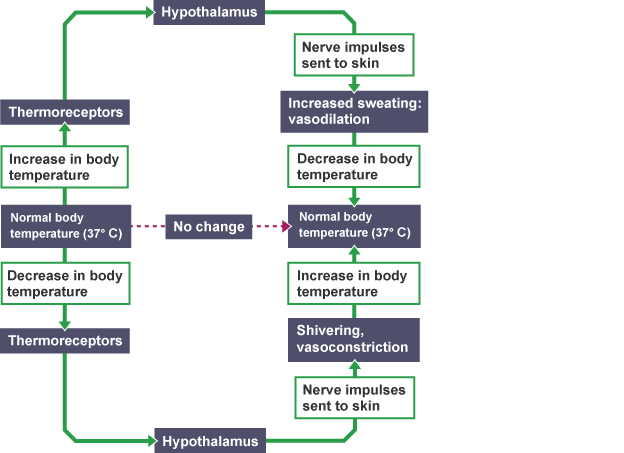
When glucose levels in the blood rise, your brain sends a signal to your pancreas. The pancreas releases insulin, which opens channels in cell membranes to allow glucose to enter the cell, lowering blood sugar levels. This is an example of a:
Positive Feedback Loop
Negative Feedback Loop
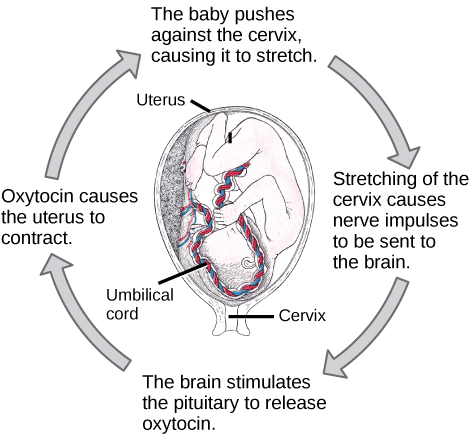
When you get cut, your skin cells release hormones that signal platelets to come and stop the bleeding. Platelets then release more hormones that signal even more platelets to help stop bleeding. The hormone signals continue until the cut is closed. This is an example of what type of feedback?
Positive Feedback Response
Negative Feedback Loop
As you get dehydrated, your blood becomes thicker and harder to pump. Your kidneys will respond by stopping urine production, sending the water from urine into your bloodstream to thin your blood back to normal level. This is an example of what type of feedback?
Positive Feedback Response
Negative Feedback Loop
reverses the direction of change
positive feedback
effector
hypothalamus
negative feedback
increases or speeds up original change
negative feedback
positive feedback
endotherm
ectotherm

Why would it be important to replicate DNA before a cell divides in mitosis?
In order for genetic information to be transferred into daughter cells.
In order for the cell to be able to increase in size.
In order for the DNA to be contained in the nucleus.
In order for the cell to re-order the DNA sequencing in the new cells.
Humans have ________ chromosomes.
21
23
46
None of the above
Loose, uncoiled DNA is called ________________.
Centromere
Chromatid
Karyotype
Chromatin

When a plant cell goes through cytokinesis, _____________.
the 2 new nuclei are separated by the cell membrane pinching off.
4 new cells are formed
a cell plate forms, dividing the 2 new nuclei and cytoplasm to form 2 new daughter cells
None of the above
Which cell cycle checkpoint verifies cell size and checks the DNA for damage?
G1 checkpoint
S checkpoint
G2 checkpoint
M checkpoint
Which cell cycle checkpoint makes sure that chromosomes are duplicated and checks for damage of the replicated DNA?
G1 checkpoint
S checkpoint
G2 checkpoint
M checkpoint
What type of gene prevents the cells with damage from continuing through the cell cycle?
tumor supressor
tumor initiator
stem cell suppressor
stem cell initiator


What is a mutation?
A mistake in DNA which can lead to cancer
A complete copy of DNA
A change in DNA which doesn't cause an issue
A mistake in your body that is caught and removed

Most prokaryotic organisms reproduce mainly by the process of
regeneration
binary fission
budding
production of spores

Proteins that bind to cells and stimulate cell division are called
enzymes.
kinases
growth factors.
carcinogens.

What is the term for the programmed death of cells?
kinase
cyclin
carcinogen
apoptosis

Two internal factors that are important in advancing the cell cycle are
kinases and cyclins.
hormones and enzymes.
phosphates and enzymes.
proteins and platelets
Which one of these is characteristic of cancer cells?
They undergo apoptosis.
They do not respond to growth inhibitors
They respond to growth inhibitors.
Which is a function of cyclins?
Cyclins are carbohydrates that regulate DNA replication during the mitosis phase of the cell cycle.
Cyclins are glycoproteins that repair DNA in the beginning of cell cycle.
Cyclins are proteins that regulate when and how often a cell divides.
Which of the following external factors will promote Mitosis after a wound?
Growth factors
Density Dependent Inhibition
Anchorage dependence
Cyclin-Dependent Kinases
Which of the following external factors prevent cells from entering Mitosis if the cell is not attached to the extracellular matrix?
Growth factors
Density Dependent Inhibition
Anchorage dependence
Cyclin-Dependent Kinases
Which of the following external factors prevent cells from entering Mitosis if they are touching other cells?
Growth factors
Density Dependent Inhibition
Anchorage dependence
Cyclin-Dependent Kinases


What is a locus?
a structure that appears during prophase I and consists of two paired genes
the precise location of a gene on a chromosome
the precise DNA sequence of a gene
a cell with two chromosome sets
Sexual and asexual reproduction are alike in that __________.
they can both occur in multicellular organisms
they both require meiosis to complete the reproductive cycle
in both cases, every parent transmits all of its genes to its progeny
they both involve two parents
A karyotype is __________.
a photograph of all the chromosomes in a single cell from an individual
a list of all the genes a person carries
all the possible gametes a person could produce
a method of identifying crossover events
Which, if any, of the following statements is true?
Haploid cells cannot divide by meiosis.
Haploid cells can divide by mitosis.
Diploid cells can divide by mitosis.
All of the above responses are correct.
Which of the following is part of the life cycle called alternation of generations?
zygote
multicellular haploid stage (gametophyte)
spores
All of the listed responses are correct.
Which of the following is part of the life cycle called alternation of generations?
zygote
multicellular haploid stage (gametophyte)
spores
All of the listed responses are correct.
How many pairs of autosomes do humans have?
23
22
2
1
Sister chromatids __________.
have the same gene loci but may have different alleles of some genes
are involved in mitosis only
are involved in meiosis only
are identical copies of each other formed through DNA synthesis
Which of the following statements about homologous chromosomes is correct?
They pair up in prophase II.
They are found in the cells of human females but not in those of human males.
They are found in haploid cells.
They have genes for the same traits at the same loci.
Somatic cells in humans contain __________ set(s) of chromosomes and are therefore termed __________.
one ... diploid
two ... haploid
one ... haploid
two ... diploid
Nearly all life cycles have both haploid and diploid phases. Usually, the transition from haploid to diploid takes place __________.
at fertilization, when gametes fuse
during embryonic development
when mitotic cytokinesis occurs
when DNA is replicated during the S phase of the cell cycle
Which of the following contributes to genetic variation in sexually reproducing species?
crossing over, internal fertilization, independent assortment
random fertilization, independent assortment, crossing over
internal fertilization, spindle formation, crossing over
random fertilization, DNA synthesis, independent assortment

