wayground logo

Free Printable Worksheets

Font size

S
M
L
XL
Worksheets

Static Electricity

Total questions: 70

Worksheet time: 1hrs 5mins

Name
Class
Date
1.
Ms Jo Jo rubbed two balloons with a piece of wool. What will happen when the balloons are brought near each other?
a)
The balloons will repel each other.
b)
The balloons will attract each other.
c)
The balloons will become positively (+) charged.
d)
The balloons will pop.
2.
What types of charges attract?
a)
Positive and Positive
b)
Positive and Neutral
c)
Negative and Neutral
d)
Positive and Negative
3.
What charge does a proton have?
a)
negative (-)
b)
positive (+)
c)
neutral or no charge (0)
4.
What charge does an electron have?
a)
negative (-)
b)
positive (+)
c)
neutral or no charge (0)
5.
If a substance has a higher number of electrons than protons on its surface, what type of charge does it have?
a)
A positive charge.
b)
A negative charge.
c)
A neutral charge
d)
No charge at all
6.
What happens when you touch a metal doorknob after rubbing your shoes on the carpet?
a)
The doorknob sends a burst of electric current into your body
b)
Millions of electrons go from your finger into the doorknob
c)
The doorknob sends millions of electrons into your finger
d)
our finger becomes negatively charged
7.
Which of the following is caused by static electricity?
a)
a stove getting hot when it is turned on
b)
a magnet being attracted to a refrigerator
c)
a lightning strike during a storm
d)
a light bulb coming on when a switch is turned on
8.
What is static electricity caused by?
a)
A balance of power
b)
A balance of positive and negative charges
c)
. An imbalance of positive and negative charges
d)
An imbalance of protons and neutrons
9.
An object becomes postiively charged when which of the following occurs?
a)
loses electrons
b)
gains electrons
c)
loses protons
d)
gains neutrons
10.
Which of the following an insulator?
a)
copper
b)
wood
c)
silver
d)
salt water
11.
Lightning is _____.
a)
a buildup of neutrons
b)
harmless
c)
a high-voltage electric current
d)
a large discharge of static electricity
12.
If an object has the same number of positive and negative charges, its electrical charge is...
a)
positive
b)
negative
c)
neutral or no charge
d)
opposite
13.
The girl's hair and the comb are attracting  one another.  The hair and the comb have
a)
opposite charges
b)
like charges
14.
In a neutral atom, the number of electrons is equal to the number of _______.
a)
Neutrons
b)
Orbits
c)
Protons
d)
subatomic particles
15.
An object becomes charged when the atoms in the object gain or lose
a)
electrons
b)
protons
c)
neutrons
d)
all of the above
16.
Ms Jo Jo rubbed two balloons with a piece of wool. What will happen when the balloons are brought near each other?
a)
The balloons will repel each other.
b)
The balloons will attract each other.
c)
The balloons will become positively (+) charged.
d)
The balloons will pop.
17.
Lightning is _____.
a)
a buildup of neutrons
b)
harmless
c)
a high-voltage electric current
d)
a large discharge of static electricity
18.
Which of the following is caused by static electricity?
a)
a stove getting hot when it is turned on
b)
a magnet being attracted to a refrigerator
c)
a lightning strike during a storm
d)
a light bulb coming on when a switch is turned on
19.
Rubbing a balloon on hair is an example of static charge build up created by....
a)
conduction
b)
friction
c)
induction
d)
hairduction
20.

Which term means "fixed, stuck, not moving"

a)

current

b)

static

c)

dynamic

d)

electricity

21.

the flow of electrons from one place to another

a)

electricity

b)

magnetism

c)

gravity

d)

forward motion

22.

a material that allows electricity (or electrons) to flow through it easily

a)

elements

b)

compounds

c)

insulator

d)

conductor

23.

a material where electricity (or electrons) do not flow through it easily

a)

elements

b)

compounds

c)

insulator

d)

conductor

24.

a push and pull force that comes from the protons and electrons and how the attract or repel objects

a)

electric charge

b)

electrostatic discharge

c)

magnetism

d)

gravity

25.

the build up of charges on the surface of an insulator

a)

static electricity

b)

current electricity

c)

magnetism

d)

gravity

26.

sudden and momentary flow of electrons as a charged object returns to a neutral state

a)

current electricity

b)

electrostatic discharge

c)

explosion

d)

kinetic energy

27.

Positive to Positive

a)

attract

b)

repel

c)

no force

28.

Negative to Negative

a)

attract

b)

repel

c)

no force

29.

Positive to Negative

a)

attract

b)

repel

c)

no force

30.

Copper wire

a)

insulator

b)

conductor

31.

rubber sole of shoe

a)

insulator

b)

conductor

32.

plastic rod or PVC pipe

a)

insulator

b)

conductor

33.

aluminum foil

a)

insulator

b)

conductor

34.

Wood seems to be

a)

an insulator that can be statically charged

b)

a conductor that can be statically charged

c)

an insulator that cannot be statically charged

d)

a conductor that cannot be statically charged

35.

What is shown when your hair stands on end after lots of combing?

a)

friction

b)

induction

c)

conduction

36.

What would cause two balloons to repel?

a)

one is positive and one is negative

b)

both balloons are positive

c)

both balloons are negative

d)

one balloon is positive and one is neutral

37.

Which of the following is an example of a conductor?

a)

plastic

b)

copper

c)

glass

d)

rubber

38.

If the balloon has a negative charge, the hair must have what charge?

a)

negative

b)

positive

c)

neutral

39.

For an object to have a positive charge, it must ____.

a)

lose electrons

b)

gain electrons

c)

lose protons

d)

gain protons

40.

_______ is when there is a buildup of charges (more of one type of charge) on an object.

a)

static electric discharge

b)

static electricity

c)

current electricity

41.

When someone's hair is charged by the person holding onto the Van de Graaf generator, you are observing ___.

a)

friction

b)

conduction

c)

induction

42.

All of the following are examples of static electric discharge EXCEPT:

a)

lightning

b)

getting shocked by a doorknob

c)

the crackle sound as you pull clothes from the dryer apart

d)

when your hair stands on end as you jump on the trampoline

43.

Select all that describe insulators.

a)

allow charges to flow easily

b)

do not allow charges to flow easily

c)

plastic

d)

metal

e)

surround a wire

44.
Static electricity is:
a)
electricity flowing in a wire
b)
the buildup of electric charges on an object
c)
when protons move between objects
45.
Two objects with LIKE static charges will
a)
attract each other
b)
even out in the end
c)
repel each other
d)
cause a spark
46.
Which is an example of static dischage?
a)
a motor
b)
lightning
c)
thunder
d)
insulators
47.
Static charges build up when
a)
protons move within an object
b)
electrons move within an object
c)
neutrons move within an object
d)
the nucleus moves within an object
48.
Which subatomic particle has a POSITIVE charge?
a)
Proton
b)
Neutron
c)
Electron
d)
Nucleus
49.
Which subatomic particle has a NEGATIVE charge?
a)
Proton
b)
Neutron
c)
Electron
d)
Nucleus
50.
Which of these is NOT a way to create a static charge?
a)
Friction
b)
Induction
c)
Electroaction
d)
Conduction
51.
Is it possible to CREATE electrons?
a)
Yes, that's what static electricity is.
b)
No, you can move them, but they are never created or distroyed.
c)
Sometimes, it depends on the voltage.
d)
Sometimes, it depends on the element.
52.
If two objects with static charge are attracted, what do you know about them?
a)
They are both positively charged.
b)
They are both negatively charged.
c)
One is positively charged and one is negatively charged, but you won't be able to tell which is which.
d)
One is positively charged and one is negatively charged, and you can tell which is which by looking at them.
53.
Rubbing a balloon on hair is an example of static charge build up created by....
a)
conduction
b)
friction
c)
induction
d)
hairduction
54.
True or False:
In static electricity, charges build up on an object, but they do not flow continuously.
a)
True
b)
False
c)
11
d)
Tuesday
55.
True or False:
For an object to have a static charge it must be ferromagnetic.
a)
True
b)
False
c)
Monkey
d)
carrot cake
56.
"Static" comes from the Greek word meaning:
a)
stay
b)
discharge
c)
electricity
d)
noise
57.
The loss of static electricity as electric charges move from one object to another.
a)
Electric field
b)
Electric force
c)
static electricity
d)
static discharge
58.
Charging by ____ occurs when electrons are transferred from one object to another by direct contact.
a)
reduction
b)
induction
c)
conduction
d)
friction
59.
If you rub a glass rod with a piece of silk, the rod becomes positively charged. This means that
a)
friction destroyed electrons in the rod.
b)
the silk has become negatively charged.
c)
protons have moved to the rod.
d)
glass attracts more protons.
60.

What is the major difference between static electricity and current electricity?

a)

Current electricity involves a continuous flow of elecrons; static electricity is a sudden transfer of protons

b)

Current electricity can be deadly; static electricity is almost always safe

c)

In current electricity, there's a single transfer of electrons; in static electricity, there's a steady flow of electrons

d)

Current electricity involves a flow of electrons; static electricity involves a single transfer of electrons

61.
Objects that have opposite charges
a)
are attracted to each other, and the force between the objects pulls them together.
b)
are attracted to each other, and the force between the objects pushes them apart.
c)
are repelled by each other, and the force between the objects pulls them together.
d)
are repelled by each other, and the force between the objects pushes them apart.  
62.

The comb has been rubbed with a piece of wool fabric and placed next to some scraps of paper.

Some paper moves toward the comb. The movement of the paper is caused by

a)

static electricity

b)

mechanical energy

c)

chemical energy

d)

magnetic attraction

63.

Which of the following is true?

a)

Electric charge is transferred only when all objects have balanced charges.

b)

Electric charge is transferred when electrons move.

c)

Electric charge is transferred when protons move.

d)

Electric charge is transferred when protons and neutrons change places.

64.

Look at the set of objects to the right. We could

increase the electric force between Object A and

Object B by each of the following EXCEPT:

a)

Pushing them farther apart.

b)

Increasing the difference between their charges.

c)

Moving them closer together.

d)

Adding lots of negative charges to Object A.

65.

Read the following statements about electric force. Which statement is NOT CORRECT?

a)

The smaller the distance between 2 charged particles, the stronger the electric force.

b)

The higher the charges involved, the stronger the electric force.

c)

The greater the distance between 2 charged particles, the weaker the electric force.

d)

The smaller the distance between 2 charged particles, the weaker the electric force.

66.

Two balloons are hanging from a stick.

One balloon has a positive charge and the other has a negative charge.

How would you expect the balloons to move?

a)

there would be no movement

b)

towards each other

c)

away from each other

67.

Two balloons are hanging from a stick.

Both balloons have a positive charge.

How would you expect the balloons to move?

a)

there would be no movement

b)

towards each other

c)

away from each other

68.

If a substance has a higher number of electrons than protons on its surface, what type of charge does it have?

a)

A positive charge.

b)

A negative charge.

c)

A neutral charge.

d)

No charge at all.

69.

Electricity does not flow well through insulators. A good example of an insulator is _________________.

a)

Metal

b)

Silicon

c)

Carbon

d)

Oil

70.
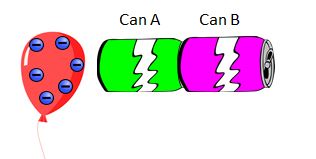
The negatively charged balloon is brought near the two cans. What happens?
a)
The negative charges in Can B move towards the balloon
b)
The negative charges in Can A move away from the balloon
c)
The positive charges in Can B move towards the balloon
d)
The positive charges in Can A move away from the balloon