
 Worksheets
Unit 1: Kinematics
Total questions: 123
Worksheet time: 4hrs 30mins
Shall we Stand and Fight?
The total length traveled is known as
distance.
displacement.
reference point.
wrong answer.
A ______________ quantity is fully described by a number and unit alone.
scalar
vector
A __________ quantity will always include a direction, not just a number and unit.
scalar
vector
You walk 5 meters. Is this 1) distance or displacement, and 2) a scalar or a vector quantity?
distance, scalar
displacement, scalar
distance, vector
displacement, vector
You walk 10 meters to the west. Is this 1) distance or displacement, and 2) a scalar or vector quantity?
distance, scalar
displacement, scalar
distance, vector
displacement, vector
Which of the following is a scalar quantity?
2 miles up I-35
10 feet closer to your car
2 meters
1 centimeter to the right
You drive 2 km to school and then 2 km back home. What is your displacement?
0 km. You are back where you started.
4 km. 2+2 = 4.
5 km. 2+2 = 5.
You drive 2 km to school and then 2 km back home. What is your distance travelled?
0 km. You are back where you started.
4 km. 2+2 = 4.
5 km. 2+2 = 5.
Ricky-Bobby races in the Indy 500, an oval shaped track that is 2.5 miles per lap. The race is 200 laps long. The distance he traveled during the race is 500 miles, because:
Distance is a vector quantity.
Distance is a scalar quantity.
Ricky-Bobby races in the Indy 500, an oval shaped track that is 2.5 miles per lap. The race is 200 laps long, and he ends up exactly where he started. His displacement over the race is 0 miles, because:
Displacement is a vector quantity.
Displacement is a scalar quantity.

Juan rides his bike from point A to point B, then on to point C. What is the distance he has traveled?
3m
4m
5m
7m
Juan rides his bike from point A to point B, then on to point C. What is his displacement?
3m
4m
5m
7m

A skier moves from point A to point B, then moves backwards to point C, before travelling forwards again to point D. What is her displacement? (ignore the time listed)
40m
100m
140m
420m
A skier moves from point A to point B, then moves backwards to point C, before travelling forwards again to point D. What is the distance that she traveled? (ignore the time listed)
40m
100m
140m
420m
What action did your group perform with the fastest average speed?
Running from Beginning to End and Back
Running from Beginning to End
Running from End to Beginning
Hop, Skip, Jump
Running Backwards
What action did your group perform with the slowest average speed?
Running from Beginning to End and Back
Running from Beginning to End
Running from End to Beginning
Hop, Skip, Jump
Running Backwards
For which group motion was the MAGNITUDE of the average velocity GREATEST? (Note: If Motion #1 had an average velocity of -3.2 m/s and Motion #2 had an average velocity of 2.8 m/s, the Motion #1 has a greater magnitude - the negative sign shows the direction)
Running from Beginning to End and Back
Running from Beginning to End
Running from End to Beginning
Hop, Skip, Jump
Running Backwards
For which group motion was the MAGNITUDE of the average velocity LEAST? (By least, we mean the least MAGNITUDE. A velocity of -3.42 m/s has a magnitude of 3.42. The negative sign means "in the negative direction". 0 m/s has a magnitude of zero and therefore is SMALLER.)
Running from Beginning to End and Back
Running from Beginning to End
Running from End to Beginning
Hop, Skip, Jump
Running Backwards
Which of these motions involved a change in direction?
Running from Beginning to End and Back
Running from Beginning to End
Running from End to Beginning
Hop, Skip, Jump
Running Backwards
Why is m/s a more appropriate unit than mi/h for this lab?
You measured the average velocity for these different motions, but the not the instantaneous velocity. Instantaneous velocity is how fast an object is moving at a given moment in time. Give at least two examples from this lab where the average velocity you measured would be different from the instantaneous velocity.
Horizontal line on a Position Time graph indicate that the object is
Speeding up
Slowing down
at Rest
moving at a constant speed
Slope of a Position -Time graph gives
Velocity
Displacement
Acceleration
Distance
Straight line with a slope indicates that the object is
moving with constant speed
speeding up resting
slowing down
resting

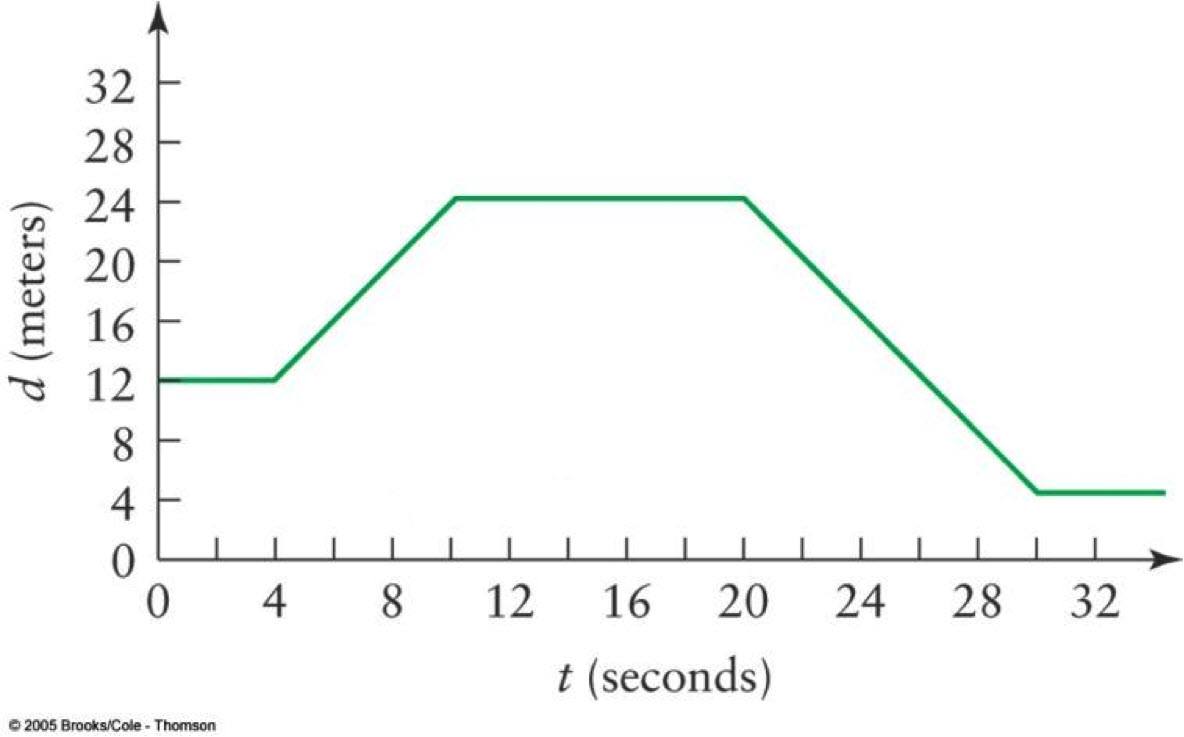
What is the speed of the object between 25 to 60 seconds?
4 m/s
2m/s
0 m/s
5 m/s

What is the speed pf the object in section A?
0 m/s
30 m/s
0.5m/s
2 m/s

What is the speed in the section B?
2 m/s
5 m/s
0 m/s
3 m/s

In which section object is travelling fastest?
A
B
C

In which segment the object stopped?
A
B
C

Line A indicates that the object is
Speeding up in positive direction
Speeding up in negative direction
moving at constant speed in negative direction
moving at constant speed in positive direction

Around What time object is turning and moving in the opposite direction
2 sec
10 sec
4 sec
6 sec

What section of this graph is showing my object at rest?
O - A
A - B
B - C
C - D
D - E

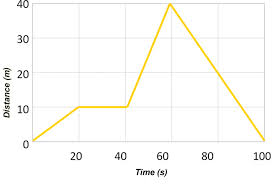
What is the person doing from 60 seconds - 80 seconds?
Constant speed in positive direction
Constant speed and constant position
Constant speed in negative direction
Rapidly slowing down

What is the person doing from 5 seconds - 10 seconds
constant speed in positive direction
constant speed and position
constant speed in negative direction

When is the object at rest?
A - B and B - C
A - B and C - D
C - D and D - E
B - C and C - D

What section of the graph shows constant speed in motion?
A - B
B - C
C - D
D - E

What section of the graph shows changing speed?
A - B
B - C
C - D
D - E

What is the person doing from 40 seconds - 60 seconds?
standing still
moving at a constant speed in a positive direction
slowing down rapidly
moving at a constant speed in a negative direction

What is the person doing from 60 seconds - 100 seconds?
standing still
moving at a constant speed in a positive direction
slowing down
moving at a constant speed in a negative direction

How would you describe the persons movement from 15 seconds to 40 seconds?
moving in a positive direction towards the origin
moving in a positive direction towards the origin and then away from it
moving in a negative direction towards the origin
moving in a negative direction towards the origin and then away from it.

How would you describe the persons motion from 40 seconds to 55 seconds?
moving negative towards the origin
moving negative away from the origin
moving positive towards the origin
moving positive away from the origin

Which of the following correctly describes the motion in this position - time graph?
constant speed, positive direction
changing speed, positive direction
constant speed, negative direction
changing speed, negative direction

Which of the following correctly describes the motion in this position - time graph?
constant speed, positive direction
changing speed, positive direction
constant speed, negative direction
changing speed, negative direction

Which of the following correctly describes the motion in this position - time graph?
slow speed to fast speed
fast speed to slow speed
constant speed

Which of the following correctly describes the motion in this position - time graph?
slow speed to fast speed
fast speed to fast speed
constant speed
fast speed to slow speed

Which of the following correctly describes the motion in this position - time graph?
changing speed
constant
no motion at all
Say Hi To The Future!
Scott travels north 5 miles and then goes west 3 miles before coming straight back south 2 miles. What is his DISTANCE?
10 mi
7 mi
8 mi
6 mi
Distance and direction of an object's change in position from a starting point (HINT: Direct path from starting point to end point)
displacement
distance
motion
reference point
Jasmine runs exactly 3 laps around a 400 meter track. What is the DISPLACEMENT?
800 m
400 m
0 m
1200 m
David walks 3 km north, and then turns east and walks 4 km. What is the DISTANCE?
7 km
3 km
4 km
1 km
What does magnitude mean?
amount or size
vector
frame of reference
motion
Displacement is a vector because it has magnitude and ______________:
meters
direction
motion
frame of reference
How do scalars and vectors differ?
scalers have units
scalers have direction
vectors have units
vectors have direction
Distance is which of the following?
Vector
Scalar
direction
The independent variable always goes on the
x or horizontal axis
y or vertical axis
The dependent variable always goes on the
x or horizontal axis
y or vertical axis

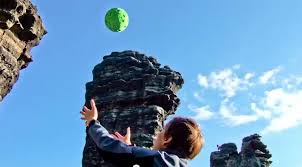
A textbook is dropped from a second floor window and falls to the ground. What happens to the velocity as the book falls to the ground?
the velocity increases
the velocity decreases
the velocity remain constant
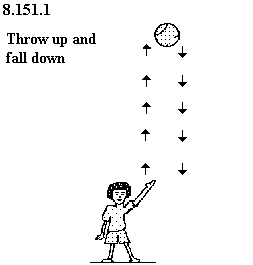
A baseball is thrown up into the air. What happens to the velocity as the ball rises in the air?
the velocity increases
the velocity decreases
the velocity remains constant
Free fall is any motion of a body where ____ is the only force acting upon it.
body attraction
tension
gravity
velocity

Two rocks with different size and mass are dropped from the same height. Which of the rock will reach the ground first?
greater rock
smaller rock
both reach the ground at the same time
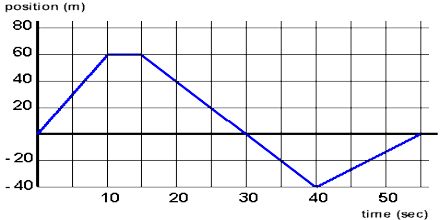
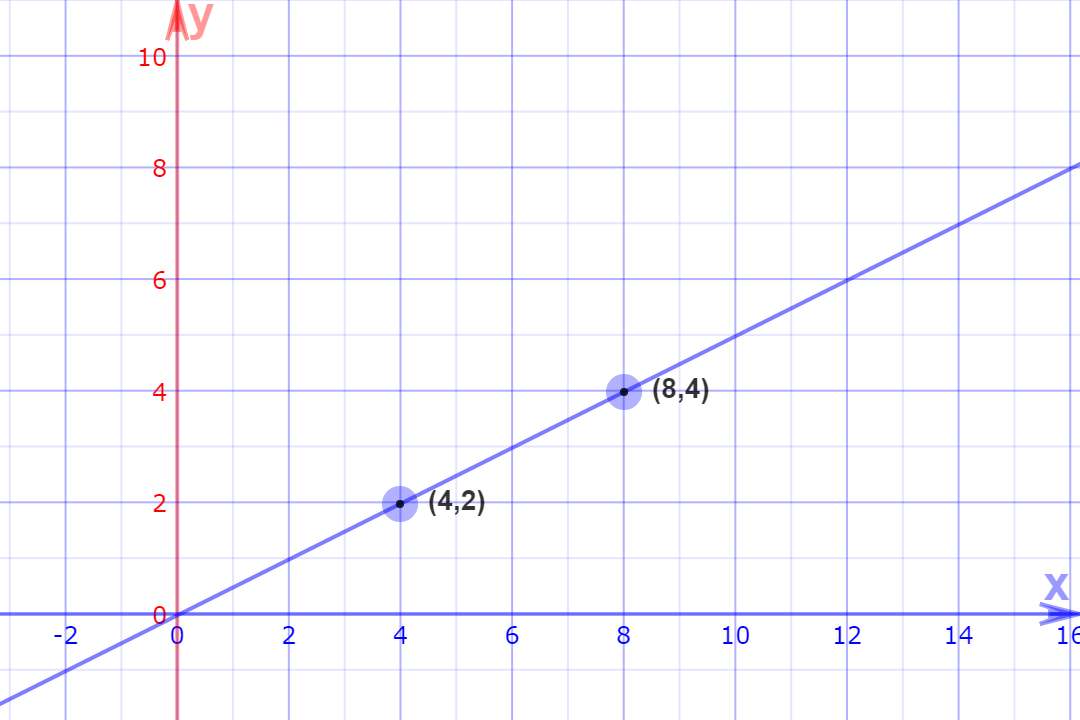
Which of the following graphs best represents free fall motion?
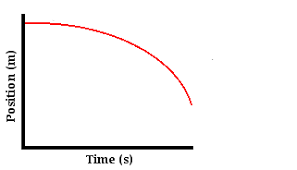
A ball is thrown vertically upward from the surface of the earth. Consider the following quantities:
(I) the displacement of the ball
(II) the velocity of the ball
(III) the acceleration of the ball
Which of these is (are) zero when the ball has reached the maximum height?
II only
I and III only
I and II only
I only

A rock from a volcanic eruption is launched straight up into the air with no appreciable air resistance. Which one of the following statements about this rock while it is in the air is correct?
On the way up, its velocity is upward, and at the highest point its velocity is zero.
On the way down, its velocity is downward, and at the highest point its acceleration is zero.
Throughout the motion, the velocity is always in the same direction as the acceleration.
The acceleration is downward at all point in the motion except that is zero at the highest point.
I. The ball has constant acceleration as it moves upward.
II. The ball has constant acceleration at the top of its path.
III. The ball has constant acceleration as it moves downward.
Juan is standing on the top observation deck of the Eiffel Tower in Paris at a height of 300 meters. He drops his cell phone. How fast will the phone be traveling when it hits the ground? Ignore the effect of air resistance.
9.8 m/s
76.68 m/s
149.76 m/s
46.99 m/s
If an object is in free fall for three seconds, how fast will it be falling at the end of its motion?
9.8 m/s
19.6 m/s
29.4 m/s
39.2 m/s
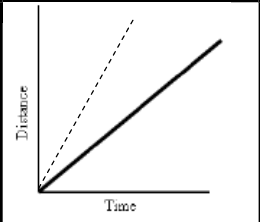

A unicyclist pedals 40 hours at 5 miles per hour without making any stops. How far does she get?
200 miles
8 miles
35 miles
45 miles




At what point is vy= 0 m/s?
A
B
C
D
None of these points
At what point is vx= 0 m/s?
A
B
C
D
None of these points
Which vector pair (arrow pair) correctly represents the acceleration and velocity at point P?


Who do you agree with?
Anita: “A projectile’s vx changes because of gravity, and its vy remains constant.”
Barry: “Both vx and vy are constant.”
Chris: “A projectile has no acceleration in the vertical dimension but it does accelerate horizontally.”
Dave: “A projectile has vertical acceleration and a constant horizontal velocity”

Suppose Lemming A runs off the edge of the cliff at 2 m/s and Lemming B runs off the edge at 1 m/s. Which will hit the ground first?
A
B
Both at the same time
Suppose Lemming A runs off the edge of the cliff at 2 m/s and Lemming B runs off the edge at 1 m/s. Which will hit the ground farther from the base of the cliff?
A
B
Both at the same distance
A ball is thrown into the air at some angle, with initial velocities vx (horizontal) and vy (vertical). At the very top of the ball’s path:
What is its velocity in the horizontal direction?
vx
Greater than vx
Zero
A ball is thrown into the air at some angle, with initial velocities vx (horizontal) and vy (vertical). At the very top of the ball’s path:
What is its velocity in the vertical direction?
vy
Greater than vy
Zero
In the absence of air resistance, the angle at which a thrown ball will go the farthest is?
90°
30°
60°
45°

A package is dropped from an airplane, where will the package hit the ground?
A
B
C


If you throw a baseball straight up, what is its acceleration at the highest point?
-9.8 m/s2
9.8 m/s2
0 m/s2
0 m/s

At which point along this projectile's path is the horizontal component of the velocity equal to the initial horizontal velocity?
A
B
C
ALL OF THEM
At which point along this projectile's path is the acceleration constant?
A
B
C
At all points



