
 Worksheets
waves hook's and thermal
Total questions: 120
Worksheet time: 2hrs 28mins
How is frequency related to wavelength?
directly
inversely
unrelated
How is frequency related to period?
directly
inversely
unrealted
How is period related to frequency?
directly
inversely
unrelated
When the wavelength increases what happens to the period?
it increases
it decreases
it remains the same
When the period increases what happens to the wavelength?
it increases
it decreases
it remains unchanged
What happens to the period as the sound wave travels through the medium?
it increases
it decreases
it remains unchanged
What happens to the frequency as a sound wave travels through the medium?
it increases
it decreases
it remains unchanged
What term describes the number of cycles that an acoustic variable completes in a second?
frequency
wavelength
period
amplitude
Which of these waves has the longest period?
2MHz
50kHz
1kHz
4,000Hz
Which unit corresponds to frequency?
millimeters
hertz
microsecond
centimeters squared
Which unit corresponds to power?
watts/cm squared
hertz
pascals
watts
Which of the following is true for sound waves?
They require a medium.
They are unrelated to vibrations.
They cannot travel through liquids
They can travel in a vacuum
How do electromagnetic and mechanical waves compare?
Mechanical waves can only travel through a vacuum, but electromagnetic waves can travel through a solid, liquid, or gas.
Mechanical waves can travel through a solid, liquid, or gas, but electromagnetic waves can only travel through a gas.
Mechanical waves can only travel through a solid, liquid, or gas, but electromagnetic waves can travel through a vacuum.
Mechanical waves can travel through a solid, liquid, or gas, but electromagnetic waves can only travel through a solid.
A student asks a series of questions about a wave. The answer to which question will allow the student to determine whether the wave is electromagnetic or mechanical?
Does it require a medium in order to travel?
Can it pass through air and water?
Does it have a measurable speed?
Does it have a measurable frequency?
What is the term used to describe the maximum distance that a sound wave displaces air molecules from their original undisturbed position?
Amplitude
Speed
Frequency
Wavelength
A student is measuring the distance between the crest and the rest position of both a mechanical wave and an electromagnetic wave. Which question is the student trying to answer?
What is the speed of the waves?
What is the amplitude of the waves?
What is the wavelength of the waves?
What is the frequency of the waves?

Which distance represents the wavelength?
W
X
Y
Z

Which distance represents the amplitude?
W
X
Y
Z
What do radio waves, microwaves, X-rays, and gamma rays all have in common?
They all have the same wavelength.
They are electromagnetic waves.
They are detected in the same way.
They store the same amount of energy.

How many wavelengths separate point A and point B?
1.5
2.0
2.5
3.0

Point A represents what?
Trough
Midpoint
Crest
node
Which are properties of a mechanical wave?
none of the answers
can move through space
must have matter to move
carries energy
A wave that can travel through matter and empty space is a:
electromagnetic wave
longitudinal wavy
transverse wave
What does a wave carry from place to place?
energy
matter
people


Which letter represents the trough?
A
B
C
D

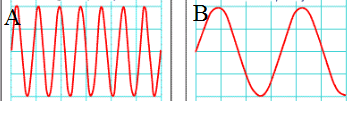
The two waves have different...
amplitudes
speeds
wavelengths
frequencies

Which electromagnetic radiation has the shortest wavelength?
infrared
gamma
microwave
ultraviolet

Which is an example of a longitudinal wave?
x ray
microwave
sound wave
water wave
Which electromagnetic radiation has the longest wavelength?
infrared
gamma
radio
ultraviolet
Which letter represents the crest?
A
B
C
D

What travels through a wave?
mass
energy
mass and energy
neither mass nor energy

Which wave has the lowest frequency?
A
B
C
D
Mechanical waves (like sound) cannot travel through...
metal
a tree
empty space (vacuum)
a door

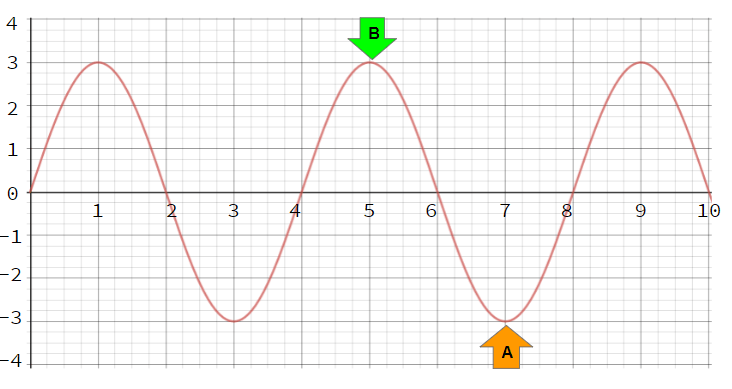
What is the amplitude of this wave?
2
3
6
10
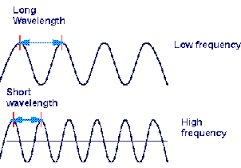
Wavelength and Frequency are related in that...
they are always the same
when one increases, the other decreases (inversely proportional)
there is no correlation
they both vary in an irregular pattern
Wavelength= .5m
Frequency= 150 hertz
Wavelength= 2.0m
Frequency= _________
A wave has frequency of 5 Hz and a speed of 25 m/s. What is the wavelength of the wave?
5 m
5 Hz
125 m
125 Hz
d=50 m
w=??


t = 25 seconds
P = ???
It takes 5 seconds and 250 joules to move a full wagon across the street. How much power is needed?
50 W
0.02 J
50 J
Calculate the energy transferred when raising the temperature of 16000g of water by 3˚C
785 J
126000J
22000J
200640 J
Which substance would require the most heat intake to increase its temperature by the same amount as the other samples listed?
aluminum
water
copper
gold
How much heat(Q) is released when a 10 g piece of lead cools from 100°C to 35°C?
66.5 J
665 J
-83.85 J
0.665 J
The SI units J/g°C measures
Specific heat
mass
temperature
heat energy
If 20 g of water undergoes a temperature change from 25° C to 30° C, how much heat energy (Q) moves from the water to the surroundings?
418 J
209 J
83 J
4.18 J
The specific heat of platinum is 0.133 J/g°C. How much heat(Q) is absorbed when a 10 g piece of platinum warms from 100°C to 150°C?
66.5 J
665 J
0.0266 J
0.665 J
Changing water from a SOLID to a LIQUID is called LATEN HEAT OF ________?
Transfer
Fusion
Vaporization
Condensation
Water Freezes and Melts at what Temperature C at sea level?
0
32
100
212
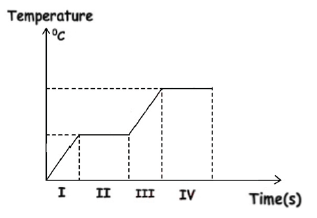
Consider the following temperature-time graph when a solid is heated. which part of the graph involves latent heat of vaporization?
Part I
Part II
Part III
Part IV

The specific latent heat released at stages?
How much energy is required to change 2600 g of water at 100 ° C into steam temperature? (latent heat of vaporization is 2.26 x 10⁶ )
Q = 5.9 X 10⁶ J
M = 5.9 Xundefined J
C = 5.9 Xundefined J
Δ T = 5.9 X J
How much energy is required to melt down a 2000 g of mercury?(latent heat of fusion is 1.14 x 10⁴ J/kg)
2.55 x undefinedJ
2.28 x undefinedJ
2,280 x undefinedJ
3.28 x undefinedJ
What is the formula to calculate specific latent heat of vaporisation?
l=mQ
c = Q/(mΔƟ)
Q = mcΔƟ
Q=ml
the symbol for specific latent heat is
c
l
Q
m
The heat absorbed by melting a solid is known as
latent heat of fusion
latent heat of solid
latent heat of liquid
latent heat of vaporisation
Latent heat is
the heat absorbed or released at a boiling process during a change of phase
the heat absorbed or released at a constant temperature during a change of phase
the heat absorbed or released at a constant temperature during a change of phase of 1 kg object
the heat absorbed or released by an object to increase or decrease its temperature by 1 degree Celcius
The energy required per kilogram and per degree celsius to raise the temperature of a substances is called…
specific heat capacity
specific heat
specific latent heat
How much energy will a 30 W heater provide in 5 minutes?
150 J
300 J
9,000 J

There are four cups of hot cocoa. The cup sizes are shown. The temperature of the cocoa in each cup is 25 degree Celsius.
Which cup has the MOST thermal energy?
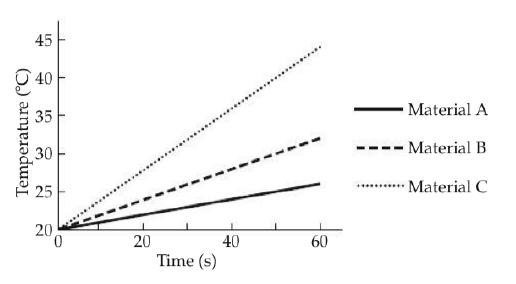
The graph shows the temperature of 1 kg samples of three materials, A, B, and C, as they are heated. Heating occurs at a constant rate.
If material A starts to melt at 60 oC. At that point, the line on the graph will __________.
continue on as before
begin to curve upward
become steeper
become horizontal
The graph shows the temperature of 1 kg samples of three materials, A, B, and C, as they are heated. Heating occurs at a constant rate.
Which material has molecules with the highest average kinetic energy after 40 s of heating?
Material A
Material B
Material C
Impossible to determine from the graph
Consider the following temperature-time graph when a solid is heated. which part of the graph involves latent heat of vaporization?
Part I
Part II
Part III
Part IV

Which will heat up slower?
water
lead
granite
iron

Which will heat up faster?
copper
granite
iron
basalt
When an electric heater is supplied with an electric power of 2.0 kW to heat 4.0 kg of water for 1 minute, calculate the increase in temperature of the water. Assume that the specific heat capacity of water is 4200 J kg-1 0C-1 and there is no heat loss to the surroundings.
3.050C
7.10C
140C
300C
Danny pours some 95°C water into a cup of instant noodles. The final temperature of the mixture is 85°C. If the masses of the hot water and noodles are 500 g and 150 g respectively, find the specific heat capacity of the noodles.
Give that the original temperature of the noodles is 25°C and the specific heat capacity of the water is 4200 J kg-1 °C-1.
500 J kg-1 °C-1
1.08 x 10³ J kg-1 °C-1
2.33 x 10³ J kg-1 °C-1
6.00 x 10³ J kg-1 °C-1

Energy is supplied at a constant rate to a fixed mass of a material. The material begins as a solid. The graph shows the variation of the temperature of the material with time.
The specific heat capacities of the solid, liquid and gaseous forms of the material are cs cl and cg respectively. What can be deduced about the values of cs cl and cg?
cs > cg > cl
cl > cs > cg
cl > cg > cs
cg > cs > cl
A mass m of ice at a temperature of –5 °C is changed into water at a temperature of 50 °C.
Specific heat capacity of ice = ci
Specific heat capacity of water = cw
Specific latent heat of fusion of ice = L
Which expression gives the energy needed for this change to occur?
55 m cw + m L
55 m ci + 5 m L
5 m ci + 50 m cw + m L
5 m ci + 50 m cw + 5 m L
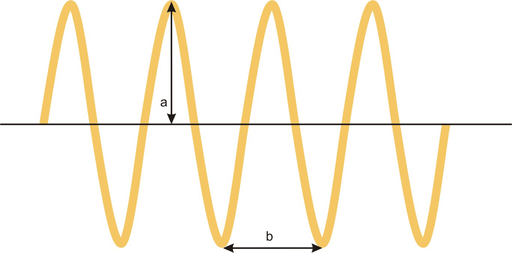
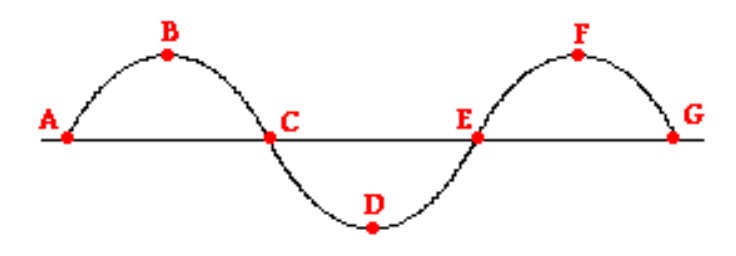

sound wave
longitudinal wave that can only travel through matter
compression
when particles in a wave are packed closely together
rarefaction
when particles in a wave are spread apart
pitch
the perception of how high or low a sound seems
echo
when a sound wave is reflected
Travels the fastest through air
Light
Sound
Both
This is a transverse wave
Light
Sound
Both
This is a longitudinal wave
Light
Sound
Both
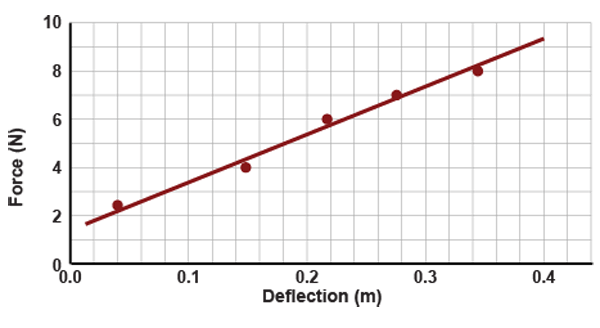

The graph shows the relationship between force and extension as a spring is extended. What is another name for point A?
Point A is the elastic limit
Point A is the elastic summet
Point A is the plastic limit
Point A is the extension limit
Which statement most accurately represents Hooke's Law?
a) The stretch of a spring is directly proportional to the force applied.
b) The stretch of a spring is proportional to the number of coils.
c) The stretch of a spring is inversely proportional to the force applied.
d) Thickness of a spring wire is proportional to the force applied.

An unstretched spring becomes longer when a force is applied to it. Which word describes the additional length of the spring gains?
Expansion
Extension
Stretched

Select a logical prediction for the investigation.
As the force applied to the spring increases, the extension of the spring will decrease.
As the force applied to the spring increases, the extension of the spring will stay the same
As the force applied to the spring increases, the extension of the spring will also increase.

In the diagram, a force is used to stretch a spring. The spring is temporarily deformed when the force is applied. When the force is removed, the spring . . .
returns to its original length.
stays the same length.

1. Objects with different masses are hung on a spring. The diagram shows how much the spring stretches.
110g
150g
200g
300g

What type of force is shown inside of the picture?
Tension
Friction
Elastic
Gravitational


When comparing spring A to B,
both experience the same maximum force
both experience the same elongation
both store the same amount of elastic potential energy
both have identical spring constants
When comparing spring A to B,
A has a larger spring constant than B so A is a stiffer spring
B has a larger spring constant than A so A is a stiffer spring
A has a larger spring constant than B so B is a stiffer spring
B has a larger spring constant than A so B is a stiffer spring
Elasticity is the property of material that enables an object to return to its original ___________ after the force applied on it is removed.
shape and size
colour and size
type and shape
height and weight
the extension of a spring is ___________ to the force applied on the spring.
directly proportional
inversely proportional

