
 Worksheets
Term II Review
Total questions: 110
Worksheet time: 2hrs 34mins
What is the function of the cell membrane?
Controls the movement of substances in and out of the cell
Stores genetic information
Regulates the cell's temperature
Provides energy to the cell
What is the function of the nucleus?
Cell wall formation
Waste disposal
Energy production
Control center of the cell
Which organelle is responsible for protein synthesis?
mitochondria
nucleus
endoplasmic reticulum
ribosome
What is the function of the cytoplasm?
Storing genetic information
Holding organelles in place and transporting materials within the cell
Producing energy for the cell
Regulating cell activities
Which organelle is responsible for breaking down and recycling cellular waste?
nucleus
lysosome
mitochondria
endoplasmic reticulum
What is the function of the endoplasmic reticulum?
Protein and lipid synthesis, and transportation of molecules within the cell
Regulation of cell division
Energy production through photosynthesis
Storage of genetic material
Which organelle is responsible for storing water, nutrients, and waste products?
mitochondria
ribosome
nucleus
vacuole
What is the function of the Golgi apparatus?
Modifying, sorting, and packaging proteins and lipids
Storing genetic information
Producing energy for the cell
Regulating cell growth and division
Which organelle is responsible for maintaining the cell's shape and providing structural support?
Golgi apparatus
Mitochondria
Endoplasmic reticulum
Cytoskeleton
Cells that do not contain a nucleus or membrane-bound organelles.
Prokaryotic
Eukaryotic
Complex cells that contain a nucleus and other membrane bound organelles.
Prokaryotic
Eukaryotic
Not found in animal cells. This rigid outer covering helps to support and protect plant cells while letting some substances like water and oxygen into the cell.
Cell membrane
Cell wall
Cytoplasm
Found only in plant cells. These organelles convert sunlight energy into food molecules during photosynthesis.
vacuole
lysosome
mitochondria
chloroplast
The porous membrane the surrounds the nucleus.
Cell membrane
Chromatin
nuclear envelope
nucleolus
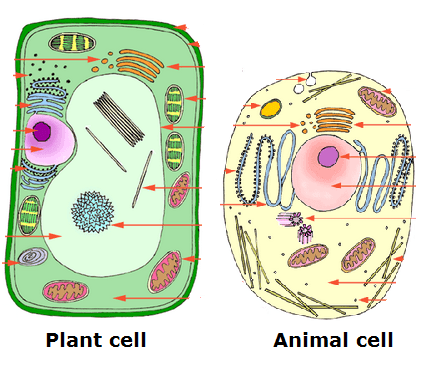
What distinguishes a plant cell from an animal cell? (How do you tell them apart) Hint: There's 3 ways (Check all 3)
Central Vacuole
Mitochondria
Cell Wall
Ribosomes
Chloroplasts

Which type of cell is this?
Prokaryote
Eukaryote
Which of the following structures is ALWAYS found in both eukaryotic and prokaryotic cells?
nucleus
mitochondria
ribosomes
cell wall
Plant and animal cells are examples of
prokaryotic cells
eukaryotic cells


Which letter represents the central vacuole?
B
C
D
E

Which letter represents the cell membrane?
F
G
H
I


Function of this organelle?
transport proteins
package and ship proteins
synthesize proteins
digests food and worn-out organelles


Increase surface area for storage of ATP
Thylakoids
Chromatin
Cytoplasm
Cristae

Short hairs for movement
Cilia
Flagella
Cytoskeleton
Spindle Fibers

Make ribosomes
Nucleus
Nucleolus
Smooth E.R.
Plastid
Select ALL the correct answers for the cell theory
All living things are made of cells
All cells have a nucleus
Cell are the basic unit of structure and function
Cell come from existing cells
All cells have a cell wall
Particle of movement from an area of lower concentration to an area of higher concentration.
Active transport
Passive transport
Particle of movement from an area of higher concentration to an area of lower concentration.
Active transport
Passive transport
Which type of transport uses energy in the form of ATP to transport substances?
Active transport
Passive transport
Which type of transport does not use energy to transport substances?
Active transport
Passive transport
Which type of passive transport uses transport proteins to transport items such as glucose through the membrane?
Facilitated diffusion
Osmosis
Diffusion
Which type of passive transport focuses on the movement of water through the membrane?
Facilitated diffusion
Osmosis
Diffusion
Which type of passive transport occurs when molecules move randomly from high to low concentration like color dye in a beaker?
Facilitated diffusion
Osmosis
Diffusion

Which type of diffusion is represented?
Facilitated diffusion
Osmosis
Diffusion
Which type of solution has a greater solute concentration INSIDE of the cell?
Hypertonic
Hypotonic
Isotonic
Which type of solution has the same solute concentration inside of and outside of the cell?
Hypertonic
Hypotonic
Isotonic

The cell shrunk in size, which means it was placed in a ____ solution.
Isotonic
Hypertonic
Hypotonic

The cell expanded in size to the point of lysing (bursting), which means it was placed in a ____ solution.
Isotonic
Hypertonic
Hypotonic

The cell shows water moving in and out equally, which means it was placed in a ___ solution.
Isotonic
Hypertonic
Hypotonic

Which type of active transport is displayed?
Endocytosis
Exocytosis
Which type of active transport uses a vesicle to allow a large molecule to exit the cell?
Endocytosis
Exocytosis


A cell which is 5 percent dissolved solute is in a solution which has 15 percent dissolved solute. What will happen to the cell?
water will move into the cell and it will swell
water will move out of the cell and it will shrink
water will not move through the cell membrane without energy being added

The cell membrane bilayer is primarily made of which macromolecule?
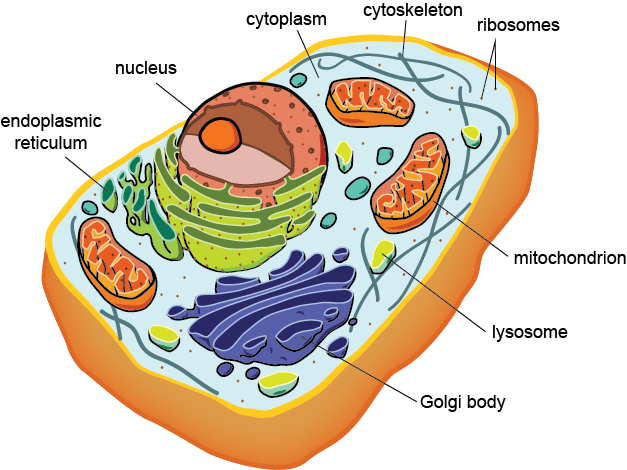
Which of the following statements is NOT part of the cell theory?
Cells are the basic unit of structure and function in all living things.
All cells are produced from other cells.
Only things that move are composed of cells.
All living things are composed of cells.

What is the function of aquaporins?
Transporting glucose
Facilitating transport of water
Breaking down ATP
Pumping sodium and potassium

What type of molecules can directly go through the phospholipid bilayer without assistance?
Very small non-polar molecules
Large carbohydrates
Large polar molecules
Charged ions
What is the function of aquaporins?
Transporting glucose
Facilitating transport of water
Breaking down ATP
Pumping sodium and potassium

What is the sodium-potassium pump an example of?
Simple diffusion
Endocytosis
Active transport
Facilitated diffusion
What is the purpose of the diaphragm on the microscope?
It is the light source
It regulates/controls the amount of light
Supports the stage
Used for rotating the objective lenses
Which adjustment knob is used for final focusing (small adjustments to increase the focus of the lens)?
Coarse Adjustment Knob
Fine Adjustment Knob
Which adjustment knob is used for first focusing? (I.e. moving the stage closer or farther away from the objective lenses to find the specimen).
Coarse Adjustment Knob
Fine Adjustment Knob

Using a 10x eyepiece and a 40x objective would give a total magnification of ___
40x
50x
400x
500x
What is the magnification of the ocular/eyepiece lens on a microscope?
4x
10x
40x
100x
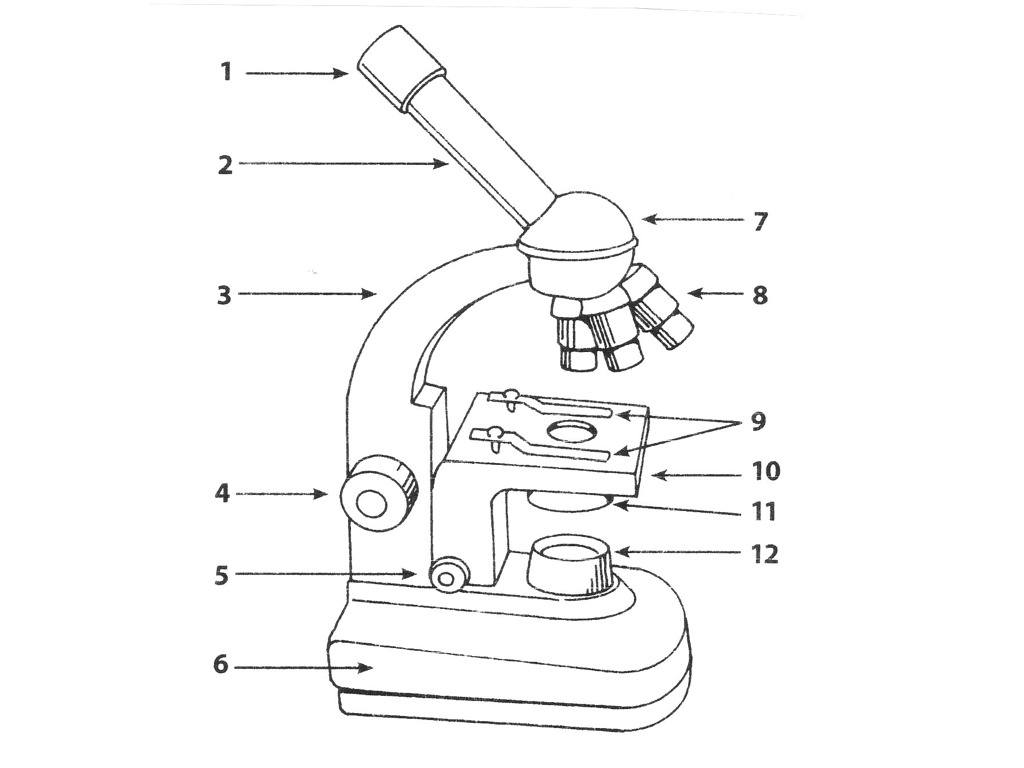

This part contains the lens you look through.
nosepiece
eyepiece
low power objective lens
high power objective lens

If you wanted to center the image what direction would you move your slide in?
Down and left
Down and right
Up and left
Up and right

What would the letter "F" look like under the scope ?


What organelles are visible in these cells?
nucleus and chloroplasts
nucleus and cell membrane
cell wall and nucleus
cell wall and chloroplasts

What type of cells are these?
Plant cells
Animal cells
Bacterial Cells
Protist Cells
Photosynthesis is the process by which energy from the sun is used to make .
water (H2O)
chlorophyll
glucose
carbon dioxide (CO2)
The purpose of photosynthesis is to ____.
make ATP for humans
build proteins in plants
store solar energy as sugar
A and C
Which of the following is released as a byproduct of photosynthesis?
carbon dioxide
carbon
oxygen
water
Which best describes light-independent reactions?
They are the first stage of photosynthesis.
They utilize the energy stored in ATP and NADPH to create glucose.
They use carbon dioxide to synthesize proteins.
They create ATP and NADPH that is used to make oxygen.
Which of the following is the correct chemical equation for photosynthesis?
6CO2 + 6H2O + light energy 🡪 C6H12O6 + 6O2
C6H12O6 + 6O2 🡪 6CO2 + 6H2O + light energy
C6H12O6 + 6H2O 🡪 6CO2 + 6O2 + light energy
6CO2 + C6H12O6 + light energy 🡪 6H2O + 6O2
Which of the following is NOT a reactant of photosynthesis?
water
light energy
carbon dioxide
glucose
Why are plants usually green?
Because the chlorophyll reflects green light
Because the chlorophyll absorbs green light
Because the accessory pigments combine to make green
Because the accessory pigments only absorb green light
How does most of the water needed by the plant get into its leaves?
It enters through the stomata
The roots absorb it and then it travels up the stem
It's made during a chemical reaction in the leaf
The flowers capture water and deliver it to the leaves
Series of electron carrier proteins that shuttle high-energy electrons during ATP-generating reactions
NADP+
Light-independent
Light-dependent
Electron transport chains
The oxygen gas we breathe comes from the splitting of water during the light reaction
True
False

Rubisco is important in which step of photosynthesis
energizing the electrons in chlorophyll
carbon fixation when CO2 is connected to RUBP during calvin cycle
regeneration phase as RUBP is made during calvin cycle
reduction of the carbon chain during the calvin cycle
The NADP+ is
oxidized during the light reaction
reduced during the light reaction
oxidized during the Calvin cycle
reduced during the Calvin cycle

What letter is the light reaction?
a
b
c
d
e

Letter H is called the
Glycolysis
Krebs cycle
Calvin cycle
electron transport chain

This diagram is of the
Krebs Cycle
CAlvin Cycle
electron transport chain
thylakoid membrane
How is cellular respiration related to photosynthesis?
Both require oxygen to start
It is the reverse reaction of photosynthesis
Both start with glycolysis
Both end with 38 ATP for cells
Which of the following statements are false?
Glycolysis does not require oxygen
Glycolysis is the first step in both anaerobic and aerobic respiration
Glycolysis occurs in the mitochondria
Glycolysis produces 2 ATP, 2 Pyruvates, and 2 NADH
The Electron Transport Chain (ETC) occurs across the ________ and so extra folds called ________ enable it to occur more often
Mitochondrial matrix, villi
Outer mitochondrial membrane, flagella
Inner mitochondrial membrane, cristae
Cytoplasm, endoplasmic reticulum
What process is found in both aerobic and anaerobic metabolism?
the Kreb's cycle
oxidative phosphorylation
the citric acid cycle
glycolysis
The final electron acceptor of aerobic respiration is _______ and this allows _______________ to continue.
oxygen, electron flow
water, citric acid cycle
carbon dioxide, aerobic respiration
NAD+, chemiosmosis
The main purpose of fermentation is to
produce oxygen
replenish NAD+ for glycolysis
replenish oxaloacetic acid for the Krebs cycle
produce ATP

It is possible for both prokaryotes and eukaryotes to perform glycolysis because it occurs in the _____________
mitochondrial matrix
inner membrane
cytoplasm
cell membrane
Anaerobic respiration yields about ______ ATP per glucose whereas aerobic respiration yields about _______ ATP per glucose.
38, 2
2, 38
2, 18
18, 2
Anaerobic respiration yields about ______ ATP per glucose whereas aerobic respiration yields about _______ ATP per glucose.
38, 2
2, 38
2, 18
18, 2
The electrons that transfer energy to pump protons across the inner mitochondrial membrane were supplied by
ATP and NADPH
NADH and FADH2
water and oxygen
Which reaction moves the cellular respiration process from the cytoplasm to the mitochondria?
glycolysis ---> pyruvate
pyruvate ---> acetyl CoA
acetyl CoA ---> PGA
PGA ---> PGAL
Aerobic cellular respiration also occurs in some aerobic bacteria (prokaryotes). Since these organisms do not have mitochondria, what is the likely location of the electron transport chain (ETC)?
the nuclear membrane
the endoplasmic reticulum
the cell membrane
the chloroplast
Aerobic cellular respiration also occurs in some aerobic bacteria (prokaryotes). Since these organisms do not have mitochondria, what is the likely location of the electron transport chain (ETC)?
the nuclear membrane
the endoplasmic reticulum
the cell membrane
the chloroplast
Photosynthesis is an energy storing process (in glucose) and cellular respiration is an energy releasing process (to ATP)
true
false

