
 Worksheets
Waves
Total questions: 58
Worksheet time: 2hrs 20mins

What do all waves transfer?
Matter
Heat
Electricity
Energy

Which of the following can waves transfer energy through?
solid
liquid
gas
empty space
all of the above

What is the number of complete waves passing a fixed point in a given amount of time?
Amplitude
Intensity
Wavelength
Frequency

What is frequency measured in?
Milliseconds
Miles
Hertz
Kilograms

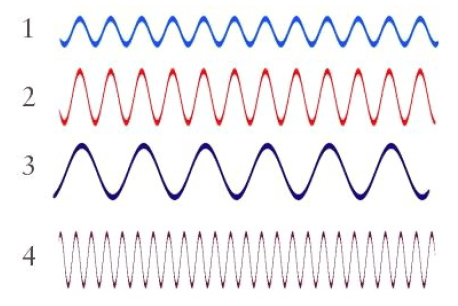
What does #1 represent?
Period
Frequency
Wavelength
Amplitude

What does #2 represent?
Period
Frequency
Wavelength
Amplitude
Electromagnetic waves include the following except
radio waves
X-rays
ocean waves
microwaves


Which type of wave moves parallel to the direction of the wave?
transverse
longitudinal
surface
electromagnetic

It is the high pressure part of the wave where the particles are close together. It is part A on this picture.
Compression
Amplituide
Rarefaction
Wavelength
What is the distance between crests?
amplitude
wavelength
A substance (like solid, liquid or gas) that the energy of a wave can travel through
amplitude
compression
medium
frequency
Disturbance caused by the vibration of movement of objects.
Amplitude
Mechanical wave
Frequency
Wavelength
Mechanical waves that travel through a medium moving perpendicular to the motion of the wave.
Transverse wave
Surface wave
Longitudinal wave
medium
Mechanical waves (like sound) cannot travel through...
metal
a tree
empty space (vacuum)
a door

Which wave has the lowest frequency?
A
B
C
D

The two waves have different...
amplitudes
speeds
wavelengths
frequencies
A wave that can travel through matter and empty space is a:
electromagnetic wave
longitudinal wavy
transverse wave
Which are properties of a mechanical wave?
none of the answers
can move through space
must have matter to move
carries energy
What are properties of electromagnetic waves?
carry energy
can move through space
can move through matter
include x-rays

What is the amplitude of this wave?
3
-3
6
4
What is the wavelength of this wave?
3
8
10
4
Longitudinal waves have:
crests and troughs
crests and compressions
compressions and rarefactions
troughs and rarefactions
What does a longitudinal wave look like?
A bunch of air particles
A wave like water
A slinky

Letter G represents a (a) .

Waves P and Q have the same __________, but wave P has twice the __________ of wave Q.
amplitude, wavelength
wavelength, amplitude
amplitude, frequency

Waves Q and R have the same __________, but wave R has twice the __________ of wave Q.
amplitude, wavelength
wavelength, frequency
wavelength, amplitude

Letter H represents a _______________ and
letter I represents a _______________.
rarefaction, compression
compression, rarefaction
wavelength, compression
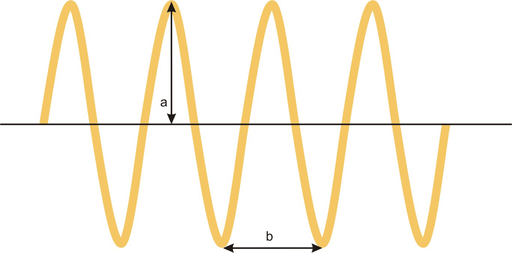
What is a wave?
A static disturbance that does not transfer energy.
A repeating disturbance that transfers energy through matter or space.
A one-time disturbance that transfers matter through space.
A continuous flow of energy without any disturbance.
Types of Electromagnetic waves
Radio
Infrared
Ocean
seismic
Needs a medium
Mechanical Waves
Longitudinal Waves
A wave has a frequency of 5 hz and a wave length of 5 m. What is the wave speed (velocity)?
25 m/s
1 m/s
10 m/s
0 m/s
A wave has a frequency of 4 hz and a wave length of 3 m. What is the wave speed (velocity)?
25 m/s
1 m/s
7 m/s
12 m/s
Wave ________ is the number of complete waves that pass a given point in a certain amount of time.
wavelength
amplitude
frequency
speed
If the wavelength is 8.2cm and frequency is 5 what is the speed?
41
39
62
28

distance between two consecutive wave crests or between two consecutive wave troughs.
Wave
Amplitude
Wave Length
Wave Trough
Wave Height
electromagnetic waves.
Draw the formula for finding the speed of a wave

Mechanical Waves
Water
Sound Waves
Microwaves
Radio Waves

