
 Worksheets
Chapter 4 Test Review
Total questions: 69
Worksheet time: 2hrs 47mins
Label the structures in light-dependent reactions.
Thylakoid Space
Photosystem I
Photosystem II
ATP Synthase
Stroma
Organize the options into reactants and products for light dependent reactions.
water
NADP+
ADP
NADPH
oxygen
ATP
glucose
carbon dioxide
Match the following parts of water with their function in light dependent reactions.
Build up in the thylakoid space to create a concentration gradient that will cause ATP synthase to rotate and add a phosphate to ADP to form ATP
Hydrogen Ions (H+)
Released as a byproduct
Oxygen
Replace those that were used in the chlorophyll at photosystem II
Electrons (e-)
What happens at Photosystems I and II in light-dependent reactions?
Photosystems I and II absorb light energy to energize electrons.
Photosystem II transports H+ ions across the thylakoid membrane for ATP producing process
Photosystem I produces ATP from ADP.
Both Photosystem I and II produce NADPH and ATP for light-independent reactions.
Put the steps of ATP production in order.
Water is broken down.
H+ ions build up in the thylakoid space.
A concentration gradient forms between the thylakoid space and the stroma.
H+ Ions move through APT synthase.
ATP Synthase rotates & adds a phosphate to ADP to form ATP.
Which two products of light-dependent reactions are used in light-independent reactions (the Calvin Cycle) to create sugar?
Oxygen & ATP
ATP & NADPH
ADP & NADP+
Carbon Dioxide and Oxygen


Choose the statement that best describes light reaction.
It converts CO2 to sugar molecule
It converts light energy to chemical energy of ATP and NADPH
It takes place in the stroma
Sunlight is used during photosynthesis to-
Break down the xylem
Break down the stomata
Break down the water
Capture the water
Label part a of this process
PSII
PSI
H+
Light
Water
2H+
1/2 O2
e-
Main products of the Calvin Cycle
Oxygen, NADP+, ADP
Glucose, CO2, ADP
ADP, NADP+, Glucose
ATP, NADPH, Oxygen
The Calvin Cycle occurs in the
Thylakoid
Grana
Inner membrane of chloroplast
Stroma
5 carbon sugar that combines with CO2 in the Calvin Cycle
3-PGA
G3P
RuBP
Glucose
Which of the following is true of the Calvin Cycle?
carbon dioxide and energy (ATP and NADPH) are used to make organic compounds
energy is absorbed from sunlight and converted to chemical energy stored in ATP and NADPH
Occurs in the thylakoid
Occurs in the cytoplasm
Increasing carbon dioxide can increase photosynthesis, but only to a maximum rate because
There are not enough RuBP molecules
Oxygen cannot leave fast enough
Large amounts of CO2 cannot fit in the chloroplast
Calvin cycle can only go as fast as the light reactions


PGA
Rubisco

What is the second stage of the Calvin Cycle?
Carbon fixation
Reduction
Regeneration of RUBP
Secondary
What is the first stage of the Calvin Cycle?
Carbon fixation
Reduction
Regeneration of RUBP
Primary
Thylakoids contain clusters of chlorophyll and proteins known as (a) . they absorb sunlight and generate high-energy (b) that pass along the (c) .
The light-independent reactions of photosynthesis are also known as (a) . During this process, energy from ATP and (b) is used to assemble high-energy (c) .
The thylakoid membrane contains a protein called ATP synthase. As
hydrogen ions pass through the protein, ADP and a phosphate group are
combined to form ATP. What is the direct energy source, if any, for the
movement of hydrogen ions and the formation of ATP?
The energy source is the high-energy electrons that accompany the hydrogen
ions.
The energy source is the concentration difference of hydrogen ions across
the membrane.
The energy source is a set of ATP molecules that gather inside the thylakoid.
There is no energy source; the process occurs without an energy input.
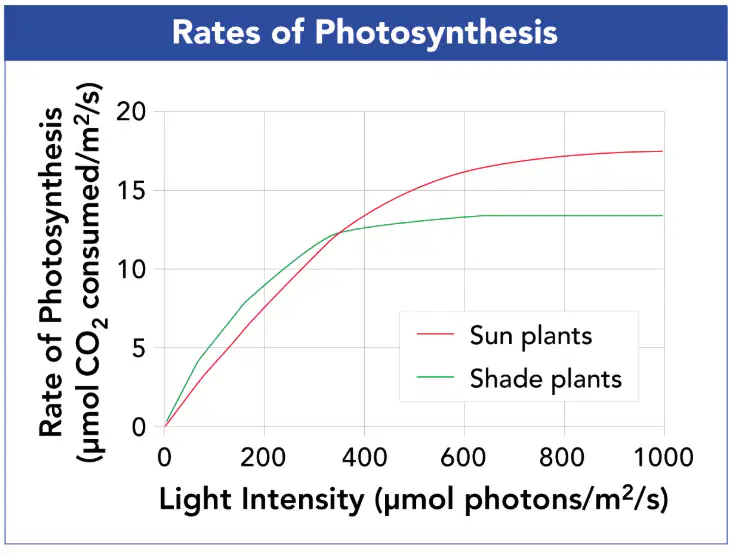
The graph shows how the rates of photosynthesis vary with light intensity
for two groups of plants: plants that thrive in direct sunlight, and plants that thrive
in the shade. The plants in both groups receive the same amount of water and
are kept at the same temperature.
For both groups of plants, what best describes the relationship between light
intensity and rate of photosynthesis?
The rate of photosynthesis increases with light intensity, and might be limited
by other factors such as water and temperature.
The rate of photosynthesis increases with light intensity, and it increases
without limit.
The rate of photosynthesis is independent of light intensity, but may be
limited by other factors such as water and temperature.
The rate of photosynthesis is at a maximum over a narrow range of light
intensities.
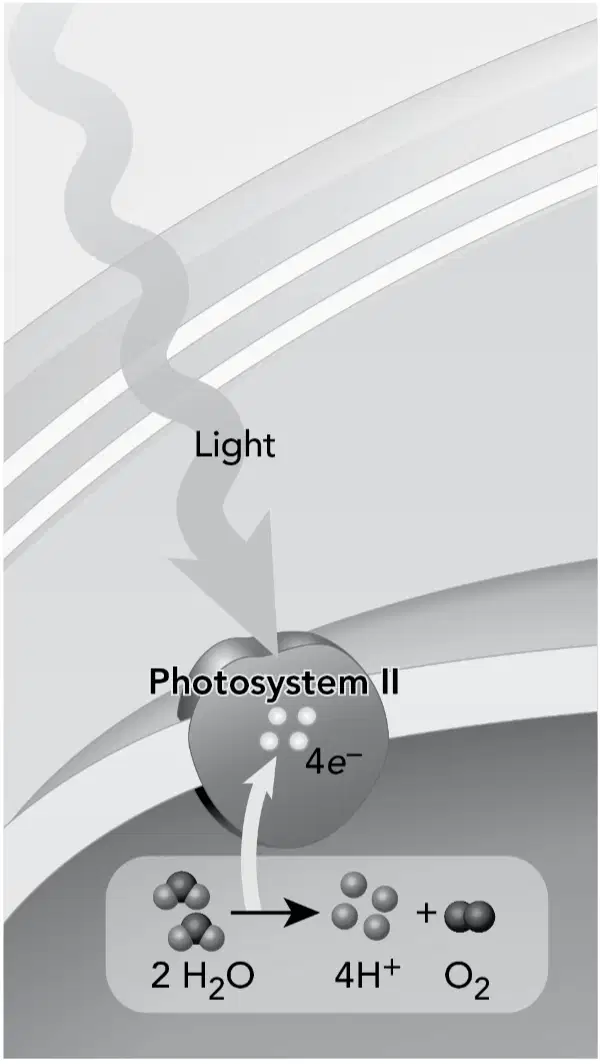
Briana is studying a model of the light-dependent reactions of
photosynthesis. The diagram shows a part of this model.
Briana notices the electrons that the water molecules release. She asks, “Will the
electrons build up in the chloroplast?” Which addition to the diagram would be
most useful for answering Briana’s question?
a wavy arrow that shows Photosystem 1
an equation for the chemical reaction that forms water from hydrogen ions,
electrons, and oxygen molecules
an arrow that shows the electrons moving through electron carriers, and
being received by NADP +
an equation for the chemical reaction that forms hydrogen gas from hydrogen
ions and electrons
During the light-independent reactions of photosynthesis, carbon dioxide
is combined with hydrogen to form sugars. What is the energy source, if any, that
allows this process to occur?
The energy source is high-energy bonds in sugar molecules.
The energy source is ATP from the light-dependent reactions.
The energy source is ATP from processes that occur in other organelles of
the cell.
No energy source is used; the process occurs without an energy input.
When the light-independent reactions are occurring, gases diffuse
between the chloroplast and the air that surrounds the plant. Why is gas diffusion
essential during this stage of photosynthesis?
Water vapor is used to assemble sugar molecules.
Carbon dioxide is used to assemble sugar molecules.
Molecular oxygen is used to assemble sugar molecules.
Water vapor is released as a waste product.
Although animals do not perform photosynthesis, their food supply
depends on the sugars that photosynthesis produces. What is the other
significant benefit to animals that photosynthesis provides?
generating ATP and NADPH
removing water from the environment
adding carbon dioxide to the atmosphere
adding oxygen to the atmosphere
Betel is developing a model of the process of photosynthesis. One of her
goals is to identify the products of photosynthesis that will later be used to
assemble sugars, lipids, amino acids, and other essential compounds for the
organisms. In which part of the model should these products be identified?
in the light-dependent reactions, where water molecules are split
in the light-dependent reactions, where ATP is synthesized
in the light-independent reactions, where carbon dioxide enters the cycle
in the light-independent reactions, where 3-carbon sugars exit the cycle
🌱Photosynthesis 🌱
Carbon dioxide (a) + Water (b) + ☼ → Glucose (c) + Oxygen gas (d)
Label the diagram for photosynthesis.
Carbon DIoxide
NADPH
ATP
Sugars
Oxygen
Water
NADP+
ADP
Thylakoid Membrane
Stroma
Photosynthesis Notes
Select the structure that represents the membrane bound disk responsible for the light dependent reaction.
Select the 2 locations where electrons in the chlorophyll are energized by sunlight.
Label part a of this process
PSII
PSI
H+
Light
Water
2H+
1/2 O2
e-
Label the picture of the chloroplast
thylakoid
granum
stroma

During photosynthesis, energy is released as -
CO2 and glucose
O2 and glucose
H2O and C6H12O6
H2O and CO2
Eating a sweet potato provides energy for human metabolic processes. The original source of this energy is the energy
in protein molecules stored within the potato
from glucose molecules absorbed by the potato plant
from the sun
in vitamins and minerals found in the soil
______&_____ carry energy from the light-dependent rxn to the light-independent rxn.
(a)
What is the role of NADPH in photosynthesis?
Make chlorophyll
Make glucose
Carries electrons and Hydrogen
Makes oxygen
What is the role of ATP in photosynthesis?
To provide energy for the light-independent reaction
To convert carbon dioxide into glucose for plants
To release oxygen from the stomata
To capture light energy
What is the function of NADPH and ATP?
They absorb light
They are light-reflecting pigments
They power the light-dependent reactions
They act as short-term energy storage
What does a C4 plant do?
stores CO2 in a separate cell from its photosynthetic cell during the day
stores CO2 in a vacuole during the night.
can't store CO2 so it sufferes photorespiration
can't store CO2 so it speeds up cellular respiration in order to make more CO2
Which of these would be considered a C4 Pathway plant?
cactus
sugar cane
oak tree
aglae
What type of plant is a CAM plant?
A CAM plant is a type of plant that only grows in cold climates
A CAM plant is a type of plant that does not undergo photosynthesis
A CAM plant is a type of plant that uses Crassulacean Acid Metabolism to fix carbon dioxide during photosynthesis, such as cacti and succulents.
A CAM plant is a type of plant that grows in water
What is the process of carbon fixation in CAM plants?
The process of carbon fixation in CAM plants involves the initial fixation of carbon dioxide into a four-carbon compound, which is then used to produce sugars during the day when the stomata are closed.
The process of carbon fixation in CAM plants involves the conversion of carbon dioxide into oxygen through photosynthesis
The process of carbon fixation in CAM plants involves the absorption of carbon dioxide through the roots
The process of carbon fixation in CAM plants involves the release of carbon dioxide into the atmosphere
What is the ecological significance of CAM plants?
CAM plants have no ecological significance
CAM plants have ecological significance as they are able to conserve water by opening their stomata at night and closing them during the day, reducing water loss through transpiration. This adaptation allows CAM plants to thrive in arid environments and contribute to the ecosystem by providing habitat and food for other organisms.
CAM plants are harmful to the ecosystem
CAM plants contribute to global warming
How do C4 plants prevent photorespiration?
they close the stomata during the day
they fix CO2 during the night
they fix CO2 in a cell that does not contain RubisCO
they fix CO2 in the guard cells
CAM plants have a different adaptation to what climate
cold and wet
hot and dry
both
none of the above
Which type of plant fixes carbon only at night?
C3
C4
CAM
all of these
Why do CAM plants open their stomata at night
It just happens
To take in oxygen
To collect Carbon Dioxide
None of the above
CAM plants keep stomata closed in daytime, thus reducing loss of water. They can do this because they
fix CO2 into organic acids during the night when temperatures are cooler.
fix CO2 into by combining it with RuBP in the Calvin cycle.
obtain CO2 through their roots during the day.
fix CO2 into organic acids in the mesophyll cells, which do not rely on stomata.
Which of these would be considered a CAM pathway plant?
cactus
corn
elm tree
algae
What are the most important factors that affect photosynthesis are
Sunlight, water.
temperature, light intensity, and the availability of water.
co2, o2
What do most plants do under bright, hot conditions?
They open the small openings in their leaves that normally admit carbon dioxide.
They close the small openings in their leaves that normally admit carbon dioxide.

The peak photosynthetic rate occurs at (a) degrees C. At (b) degrees and above, the rate of photosynthesis decreases. The temperature that causes the slowest rate is at (c) degrees.
There is an enzyme called Rubisco that helps convert CO2 into glucose during the light independent (calvin cycle) reaction. How does this data help back up the ideas of enzymes denaturing?
At 30 degrees, the Rubisco enzyme is fully denatured and oxygen production peaks.
Only high temperatures denatur the Rubisco enzyme, as oxygen production goes down above 30 degrees.
Temperatures above and below 30 degrees starts to denature rubisco, lowing Oxygen production/PS rate.
Rubisco is not able to be denatured, it is resistant to any big changes in temperature.

The graph is showing you that plants will have an (a) temperature where the (b) of photosynthesis will be highest. Too (c) or too low of temperatures will (d) down the rate/stop the reaction.

Sunlight is used during photosynthesis to-
Break down the xylem
Break down the stomata
Break down the water
Capture the water

