
 Worksheets
EES Astronomy
Total questions: 70
Worksheet time: 44mins
The perioed of one rotation of earth is known as
Sun day
Earth day
Moon day
None of the above
Which one of the following is the source of light on earth
Sun
Moon
Space
Satellite
Motion of the earth on its axis in about 24 hours is called
Revolution
Rotation
Both a and b
None of the above
Motion of the earth around the sun is called
Revolution
Rotation
Both a and b
None of the above
When do longest day and shortest night occure in northern hemisphere
21 june
23 September
22 December
21 march
A student records the following information about a planet:
- Its largest moon is named Titan
- It is made up mostly of gases
- It is surrounded by rings
- It is the sixth planet from the sun.
Which planet is the student studying?
Saturn
Uranus
Jupiter
Mars

Asteroids are large bodies of rock that are too small to be planets. An asteroid belt has many asteroids. The diagram shows the asteroid belt located between Mars and the first outer planet.
Which outer planet is closest to this asteroid belt?
Uranus
Neptune
Saturn
Jupiter
Which planet in the solar system is farthest from the sun?
Mercury
Neptune
Saturn
Venus
One of the brightest objects in the night sky is a planet that is closer to the sun than Earth is. What is the name of this planet?
Mars
Saturn
Venus
Jupiter
The solar system has eight planets and one sun. What is the correct order of these planets, starting from closest to the Sun?
Mercury, Venus, Earth, Mars, Saturn, Uranus, Neptune, Jupiter
Mars, Venus, Earth, Mercury, Jupiter, Saturn, Uranus, Neptune
Venus, Mercury, Jupiter, Earth, Saturn, Neptune, Mars, Uranus
Mercury, Venus, Earth, Mars, Jupiter, Saturn, Uranus, Neptune
Most scientists agree that Earth is the only planet in the solar system that supports life. What is planet Earth's position from the Sun?
first
second
third
fifth

Which planet is seventh from the Sun?
Uranus
Neptune
Jupiter
Venus

Which planet is identified by the letter B?
Neptune
Saturn
Mercury
Mars
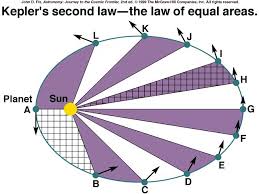
Keplers First Law
When comparing 2 planets the closest move the fastest.
Planet move faster when closer to the sun
Describes the shapes of the orbit
Planets orbit the sun in an ellipses
Keplers Second Law
When comparing 2 planets the closest move the fastest.
Planet move faster when closer to the sun
Describes the shapes of the orbit
Planets orbit the sun in an ellipses
Keplers Third Law
the period for a planet to orbit the sun increases with the radius of its orbit
Planet move faster when closer to the sun
Describes the shapes of the orbit
Planets orbit the sun in an ellipses


If Earth was not tilted, what statement would be correct?
The seasons are unaffected.
The seasons are reversed.
There are no seasons.
What happens to our day and night hours on December 21st (Winter Solstice)?
Days are longer and nights are shorter.
Days and nights are 12 hours.
We probably have eclipses.
Days are shorter and nights are longer.
What happens to our day and night hours on June 21st (Summer Solstice)?
Days are shorter and nights are longer.
Days and nights are 12 hours.
We probably have eclipses.
Days are longer and nights are shorter.
____________ is an imaginary line that runs through the Earth from the North to South pole.
Axis
Orbit
Equator
Rotate
When it is Summer in the Northern Hemisphere, what season is it in the Southern Hemisphere?
Also Summer
Spring
Winter
Autumn

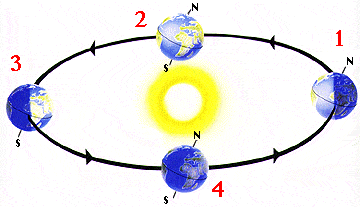
An equinox occurs when
The sun's rays reach their highest or lowest point in respect to the equator
The sun's rays shine most directly on the equator
The Earth experiences the greatest period of daylight hours
What direction does the sun appear to move across the sky?
west to east
north to south
east to west
south to north

The center of mass between two objects. This is what the planets truly orbit.
barycenter
precession
nutation
ellipse
This movement changes the direction of the Earth's axis and will cause the north star to change over time.
barycenter
precession
nutation
ellipse
Earth's wobble cause by the gravitational pull from the Moon only. This changes the degree of the Earth's tilt and will cause seasonal changes.
barycenter
precession
nutation
ellipse


A wobble back and forth in the Earth's path of precession.
Rotation
Nutation
Revolution


What is the wobbling of Earth on its axis called?
precession
Nutation
Rotation
Revolution

What is the circular offset of Earth’s position due to its rotation on its axis?
Precession
Nutation
Barycenter
Rotation

Wobbling around the processional axis
Revolution
Tide
Nutation
Universe
what's the earths natural satellite
the sun
a light
the moon
Jupiter


The sun is
A planet
made of ice
A Galaxy
a star
What is the source of the thermal energy that heats our planet’s atmosphere?
Earth's core
Green plants
The Sun
Fossil Fuels


Kevin is describing the orbit of Earth. At what point in Earth's orbit is Earth farthest from the sun?
when Earth reaches aphelion
when Earth reaches perihelion
when Earth reaches its fastest speed
when Earth reaches its average distance from the sun

Stronger high tide, lower low tides; occur when the Earth, moon, and Sun are in a line
Spring Tide
Neap Tide
Perigee
Albedo
Especially weak tides; occur when the Moon and the Sun are perpendicular to one another
Spring Tide
Neap Tide
Perigee
Apogee
Closest point in the Moon’s orbit to Earth
Perigee
Apogee
Regolith
Umbra
Farthest point in the Moon’s orbit to Earth
Perigee
Apogee
Mare
Regolith

First day of fall
Autumnal Equinox
Summer Solstice
Winter Solstice
Vernal Equinox
What is it called when the length of day and night are equal?
revolution
orbit
equinox
dormant
The day of the year with the most daylight hours is the
spring equinox
fall equinox
summer solstice
winter solstice
The day of the year with the fewest daylight hours is called the
spring equinox
fall equinox
summer solstice
winter solstice

