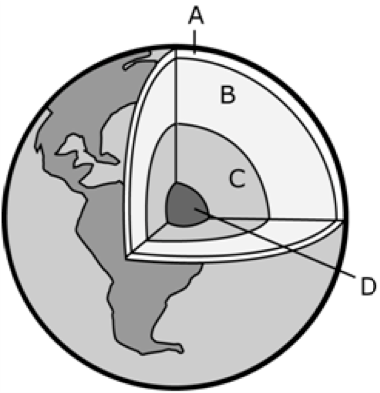
wayground logo

Free Printable Worksheets

Font size

S
M
L
XL
Worksheets

Earth's Layers Quiz

Total questions: 86

Worksheet time: 1hrs 20mins

Name
Class
Date
1.
All the water on Earth. This includes all of the rivers, lakes, streams, oceans, groundwater, polar ice caps and glaciers.
a)
geosphere
b)
biosphere
c)
hydrosphere
d)
atmosphere
2.
All of the rocks, minerals, and ground that are found on and in Earth
a)
geosphere
b)
biosphere
c)
hydrosphere
d)
atmosphere
3.
All of the living organisms on earth, including all plants and animals.
a)
geosphere
b)
biosphere
c)
hydrosphere
d)
atmosphere
4.
The outer layer of earth, contains all of the gases on earth
a)
geosphere
b)
biosphere
c)
hydrosphere
d)
atmosphere
5.
Geo = 
a)
Earth
b)

Air

c)
Life
d)
Water
6.
Hydro = 
a)

Air

b)
Earth
c)
Life
d)
Water
7.

Atmo = 

a)

Air

b)
Earth
c)
Life
d)
Water
8.
Bio = 
a)
Earth
b)

Air

c)
Life
d)
Water
9.

An erupting volcano can release a lot of carbon dioxide. This is an interaction between the:

a)

Geosphere and Atmosphere

b)

Biosphere and Hydrosphere

c)

Geosphere and Hydrosphere

d)

Geosphere and Biosphere

10.
Which layer of Earth is the thinnest? 
a)
Crust
b)
Mantle
c)
Inner Core
d)
Outer Core
11.
Temperature _____________________ as you go deeper into the earth.
a)
increases
b)
decreases
c)
goes up and down depending on the layer
d)
stays the same
12.
Pressure ______________________ as you go deeper into the Earth
a)
increases
b)
decreases 
c)
goes up or down depending on the layer
d)
stays the same
13.
The INNER core is solid because of it's intensely high ________.
a)
Pressure
b)
Temperature
14.
The outermost solid layer of the Earth is called the
a)
mantle
b)
outer core
c)
inner core
d)
crust
15.
A dense ball of solid iron and nickel.
a)
crust
b)
inner core
c)
mantle 
d)
outer core
16.
Is the outer core a liquid or solid?
a)
liquid
b)
solid
17.

Scientists know about the Earth Layers due to _________.

a)

volcanic activity

b)

seismic waves

c)

magnetic properties

18.
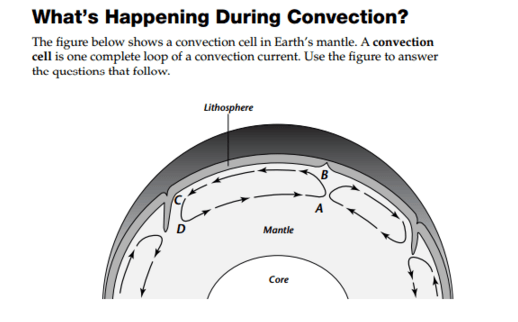
Where does the heat come from that drives this convection current in the mantle?
a)
the sun
b)
the core
c)
the ocean
d)
the mantle
19.
What causes the convection cell to turn left at point B?
a)
material hits the crust and is "trapped" in the current
b)
material is getting less dense
c)
material is getting hotter
20.
What happens to the temperature and density of materials between point B and point C?
a)
material is getting colder and more dense
b)
material is getting hotter and less dense
21.
What happens to the temperature and density of materials between point D and point A?
a)
material is getting colder and more dense
b)
material is getting hotter and less dense
22.

Which best describes the mantle?

a)

molten (melted) metal

b)

hot, slow flowing rock

c)

dry land and ocean floor

23.
Which box has a higher density?  
a)
Box A
b)
Box B
c)
cannot be determined
d)
they are the same
24.

As an object is heated its density

a)

increases

b)

decreases

c)

remains the same

25.

Imagine you are drilling a hole from the surface of the Earth. You would encounter the (a)   directly below the crust.

Choose from the below words
Crust
Mantle
Outer Core
Inner Core
26.

Imagine you are on a journey to the center of the Earth. After passing through the mantle, you would encounter the (a)   next.

Choose from the below words
Crust
Mantle
Outer Core
Inner Core
27.
This layer is the innermost layer of the Earth.
a)
Crust
b)
Mantle
c)
Outer Core
d)
Inner Core
28.

This layer of the Earth includes areas of soft, thick, flowing rock and areas of more solid rock.

a)
Crust
b)
Mantle
c)
Outer Core
d)
Inner Core
29.

This layer of the Earth is entirely made of molten (liquid) metal.

a)
Crust
b)
Mantle
c)
Outer Core
d)
Inner Core
30.

This layer of the Earth is a solid sphere of iron and nickel.

a)
Crust
b)
Mantle
c)
Outer Core
d)
Inner Core
31.

This layer of the Earth includes all dry land and the ocean floor.

a)
Crust
b)
Mantle
c)
Outer Core
d)
Inner Core
32.

The (a)   is the thickest layer of the Earth making up two-thirds (2/3) of its mass from hot molten rock (magma) that flows like caramel or road tar.

Choose from the below words
Outer Core
Inner Core
Crust
Mantle
33.

What layer is the deepest layer beneath the Earth's surface at 1,500 miles and is considered to be a solid iron ball because of the pressure it is placed under?

a)

Outer Core

b)

Crust

c)

Mantle

d)

Inner Core

34.

The (a)   of the Earth is broken into tectonic plates like pieces of a puzzle.
Choose from the below words
Outer Core
Crust
Mantle
Core
35.

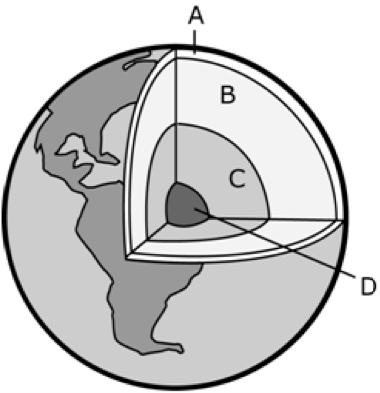
Which letter in the diagram identifies the layer of Earth made up of solid nickel and iron?

a)

layer A

b)

layer B

c)

layer C

d)

layer D

36.

Sally is researching the differences that exist in each layer of the Earth. Which of the following best describes Earth's crust?

a)

Solid, rocky

b)

Liquid, metallic

c)

Semisolid, convecting

d)

Dense, extremely hot

37.

What letter in the diagram identifies the layer that is composed of continental and oceanic plates?

a)

layer A

b)

layer B

c)

layer C

d)

layer D

38.

You are a geologist studying the Earth's structure. You need to correctly identify the order of the layers from the innermost to the outermost. Which of the following is the correct order?

a)

inner core

outer core

mantle

crust

b)

mantle

crust

inner core

outer core

c)

mantle

outer core

crust

inner core

d)

crust

inner core

mantle

outer core

39.
What happens to pressure as we move from the crust down into the inner core?
a)

Pressure decreases

b)

Pressure increases

c)

Pressure stays the same

40.
What happens to temperature as we move from the crust down into the inner core?
a)

Temperature increases

b)

Temperature decreases

c)

Temperature stays the same

41.
Which layer of the earth has the lowest temperature?
a)
Crust
b)
Mantle
c)
Outer Core
d)
Inner Core
42.
Which layer of the earth is under the highest pressure?
a)
Crust
b)
Mantle
c)
Outer Core
d)
Inner Core
43.

What is the coolest layer?

a)

Crust

b)

Mantle

c)

Outer Core

d)

Inner Core

44.

What is the hottest layer?

a)

Crust

b)

Mantle

c)

Outer Core

d)

Inner Core

45.

The (a)   layer is the most dense.

Choose from the below words
Crust
Mantle
Outer Core
Inner Core
46.

What are convection currents?

a)

The cycle of heated materials rising, and cooling materials sinking

b)

The cycle of cooling materials rising, and heated materials sinking

c)

An electric current found in the mantle

d)

An electric current found in the outer core

47.

If we can't travel to the center of the Earth, how do we know so much about it?

a)

Seismic waves, made by earthquakes and man-made explosions

b)

special camera scopes sent through all the layers of the earth

c)

very long thermometers that can reach to the inner core

d)

super powerful x-rays

48.

The layer of the Earth represented by the letter C is (a)   .

Choose from the below words
Crust
Mantle
Outer Core
Inner Core
49.

What layer of the Earth is represented by the letter D?

a)

Crust

b)

Mantle

c)

Outer Core

d)

Inner Core

50.
The four spheres of Earth...
a)
are all connected
b)
have nothing to do with one another
c)
exist on Venus and Mars
d)
don't affect human life
51.
When plants draw nutrients from the soil, the interaction is between which two spheres? 
a)
The atmosphere and the geosphere 
b)
The geosphere and the hydrosphere 
c)
The hydrosphere and atmosphere 
d)
The biosphere and the geosphere 
52.

If a deer was drinking from a pond, what two spheres would be interacting?

a)

Hydrosphere and Atmosphere

b)

Geosphere and Biosphere

c)

Biosphere and Hydrosphere

d)

Atmosphere and Geosphere

53.
When volcanoes erupt, dust and ash particles spread through much of the air blocking the sun.  Which two spheres are interacting? 
a)
Hydrosphere and atmosphere 
b)
Geosphere and atmosphere 
c)
Biosphere and atmosphere 
d)
Atmosphere and atmosphere 
54.
This picture best describes which connection?
a)
Atmosphere-Biosphere
b)
Hydrosphere-Atmosphere
c)
Hydrosphere-Geosphere
d)
Geosphere-Biosphere
55.

A change in one of Earth's spheres will...

a)

Affect all other spheres

b)

Affect none of the other spheres

c)

Affect only one of the other spheres

d)

Affect spheres on every planet in the solar system

56.
Oceans, rain, and glaciers belong to this sphere.
a)
Atmosphere
b)
Biosphere 
c)
Lithosphere
d)
Hydrosphere
57.
Which two spheres both contain water?
a)
cryosphere and hydrosphere
b)
cryosphere and geosphere
c)
hydrosphere and geosphere
d)
atmosphere and geosphere
58.

When do particles move faster?

a)

When they are warm

b)

When they are cold

59.

Which picture shows material that is more dense?

a)

The picture of the left

b)

The picture on the right

60.

In convection, WARM substances

a)

Rise

b)

Sink

61.

In convection, COOL substances

a)

Rise

b)

Sink

62.

Convection currents happen inside the Earth. Magma is heated by ______ and rises towards the crust.

a)

the sun

b)

the core

c)

plate tectonics

63.

Convection currents happen inside the Earth. Hot magma from the mantle cools as it touches the ______ and transfers heat. Then it sinks back down again.

a)

crust

b)

core

c)

mantle

64.

As an object is heated its density

a)

increases

b)

decreases

c)

remains the same

65.

Organize the Layers from the Surface to the Deepest.

a)

Crust

b)

Mantle

c)

Outer Core

d)

Inner Core

1)
2)
3)
4)
66.

When molecules are heated, what happens to them?

a)

They speed up, becomes less dense, and rise

b)

They speed up, become more dense, and rise

c)

They slow down, become less dense, and sink

d)

They slow down, become more dense, and sink

67.

Label the layers of the Earth

68.
Question Image

Match root-word to the meaning

a)

Atmos

1.

gas

b)

Bio

2.

life

c)

Geo

3.

earth

d)

Hydro

4.

water

e)

Cryo

5.

cold

69.

Fossil records support continental drift.

a)

True

b)

False

70.

Evidence of continental drift includes:

a)

plants and animals match

b)

the shape of the continents

c)

the oceans are close together

d)

rocks match

71.

Alfred Wegener thought South America and Africa have similar coastlines because...

a)

the mesosaurus fossils were found on both continents

b)

He noticed that similar rocks were found on both continents

c)

he thought that the continents used be be joined together

d)

Pangaea was 250 million years ago

72.

What evidence of an ancient organism was used to support the theory that the continents used to be joined?

a)

Same rocks were found on different continents

b)

Glacial grooves were found on different continents

c)

Fossilized evidence of the same organism found on different continents

d)

Africa and South America look like puzzle pieces that fit together

73.

What was Pangaea?

a)

It was a supercontinent, made of all of the landmasses on Earth.

b)

It was 2 separate landmasses, one on the Northern Hemisphere and one on the Southern Hemisphere.

c)

It was a supercontinent made of 3 landmasses

d)

It was the name of an ancient organism

74.
What are the puzzle pieces of the Earth's surface called?
a)
Tectonic plates
b)
Puzzles
c)
Earthquakes
75.
How long ago is Pangea believed to have existed?
a)
200-300 million years ago
b)
1000-2000 years ago
c)
10,000-20,000 years ago
d)
20-30 billion years ago
76.

Where did Wegener find plant fossils that today would not be able to survive on that type of land?

a)

North America

b)

Antarctica

c)

China

d)

India

77.
Who is the person credited with developing the theory of continental drift?
a)
Harry Hess
b)
Galileo
c)
Alfred Wegener
d)
Newton
78.

How was Wegener's theory received by other scientists at the time?

a)

They thought it was great

b)

They did not accept it

79.
Most geologists rejected Alfred Wegener's idea of continental drift because...
a)
it did not agree with their current theory
b)
Wegener was interested in what Earth was like millions of years ago
c)
Wegener used several different types of evidence to support his hypothesis
d)
Wegener could not identify the force that moved the continents
80.
What are the two types of crust?
a)
continental and oceanic
b)
ocean and basin
c)
lower and upper
d)
thick and thin
81.

Order the layers from most dense to least dense.

a)

Inner core, mantle, outer core, crust

b)

Crust, mantle, outer core, inner core

c)

inner core, outer core, mantle, crust

d)

outer core, inner core, mantle, crust

82.

Pressure _________ as you go deeper into the Earth.

a)

increases

b)

stays the same

c)

decreases

d)

goes up or down depending on the layer

83.

Oceanic crust is more dense than continental crust?

a)

true

b)

false

84.
What heats material in the mantle causing the convection cycle?
a)
Solar Radiation
b)
The Earths Core
c)
Fire
d)
Hard Work
85.
This layer of Earth is the thickest part
a)
crust
b)
outer core
c)
mantle
d)
inner core
86.
As you travel from the inner core to the crust, how would temperature, pressure and density of the material change?
a)
The would all increase
b)
The would all decrease.
c)
They would stay the same.  
d)
Temperature would decrease, but pressure and density would increase.