
Font size
 Worksheets
Optics Physics
Total questions: 75
Worksheet time: 1hrs 15mins
a real image...
is produced by virtual rays and can be projected on a screen
is produced by real rays and cannot be projected on a screen
is produced by virtual rays and cannot be projected on a screen
is produced by real rays and can be projected on a screen


Which picture represents what happens when light travels through a CONVERGING lens?
A- left picture
B - Right picture
We see colors because those colors are reflected back to our eyes.
An object is located 30 cm from a concave mirror. The mirror forms a real image at a distance of 20 cm. What is the focal length of this mirror?
13.5 cm
0.0833 cm
12.0 cm
8.7 cm
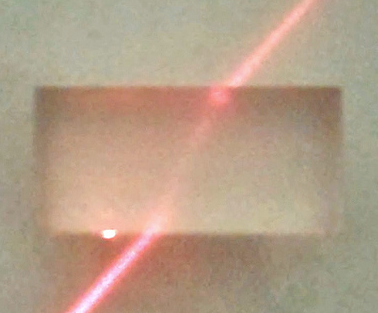
this is an example of
refraction
diffraction
infraction
reflection

what type of mirror is this
concave
convex
translucent
plane

The angle of incidence is _________ the angle of reflection
Images seen in a plane mirror are always
Upright and Virtual
Upright and Real
Inverted and Virtual
Farther and Virtual

Light produced by an object due to being a very high temperature is called
fluorescent
electric discharge
incandescent
triboluminescence
the larger the index of refraction the ...
larger the critical angle
smaller the critical angle
no change to the critical angle
what?!

An object is held 9cm from a convex mirror and produces an image 6cm tall that is 4cm away from the mirror. What is the height of the object?
-13.5 cm
13 cm
2.7 cm
-2.7 cm


A tree 20 m high is located 40 m from the converging lens of focal length 0.08 m.Calculate the distance from the lens to the image.
0.08 m
0.01 m
0.10 m
0.20 m

What type of image is formed?
virtual and inverted
virtual and upright
real and upright
real and inverted

In the given figure, which of the following holds TRUE?
The angle of incidence is 10°.
The angle of incidence is 80°.
The angle of reflection is 10°.
The angle of reflection is 90°.
Which of the following is TRUE about spherical mirrors?
They don't obey the Law of Reflection.
They have a flat, planar surface.
Their surface either bulges outward or inward.
They always give images that are of the same size as the object.
In a ray diagram, which term refers to the distance from the vertex to the center of curvature?
focal point
focal length
radius of curvature
diameter

In the ray diagram shown, which set of descriptions of the image formed is completely accurate?
The image is minimized, inverted, and real.
The image is magnified, inverted, and real.
The image is minimized, inverted, and virtual.
The image is magnified, inverted, and virtual.

In the ray diagram shown, which set of descriptions of the image formed is completely accurate?
The image is minimized, upright, and real.
The image is magnified, inverted, and real.
The image is minimized, upright, and virtual.
The image is magnified, inverted, and virtual.
In ray diagram for concave mirrors, if an incident ray passes through the focal point, how does the reflected ray look like?
It reflects back on itself.
The reflected ray bounces vertically upward.
The reflected ray will be parallel to the principal axis.
The reflected ray gets projected vertically downward.
Which of the following correctly describes the image characteristics formed in plane mirrors?
virtual, upright, diminished
virtual, upright, same size
real, inverted, diminished
real, upright, same size
In ray diagrams for spherical mirrors, which term refers to the distance between the mirror and the focal point?
focal length
principal axis
radius of curvature
vertex
The magnification of a concave mirror CANNOT be
greater than 1
less than -1
between 0 and 1
between -1 and 0
The magnification of a convex mirror is
m > 1
m = 0
0 < m < 1
m < 0
What is the index of refraction of a refractive liquid if the angle of incidence in the air is 60 degrees and the angle of refraction is 30 degrees?
1.33
1.41
1.73
2.23

which type of lens
concave
convex
opaque
plano
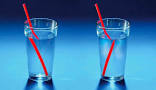
Which colour bends the maximum in the prism?
Violet
Indigo
Red
Green

What happens to light during total internal reflection?
The angle of incidence is greater than the critical angle.
The angle of reflection is the same as the critical angle.
The angle of refraction is less than the critical angle.
The angle of incidence is zero.
When angle of incident (i) equals to critical angle (c) if light is traveled from a denser medium to a less dense medium,
total internal reflection occurs.
angle of refraction is equal to 90 degree.
light is refracted out
light travel in straight line
Chose the TWO conditions are NOT correct for total internal reflection to take place
The incident angle should be less than the critical angle
The incident angle should be greater than the critical angle
Light should travel from a denser to a lighter medium
Light should travel from a lighter to a denser medium
What is total internal reflection
Where a wave is refracted at the boundary between a dense medium and a less dense medium when the angle of incidence is greater than the critical angle.
Where a wave is refracted at the boundary between a dense medium and a less dense medium when the angle of incidence is smaller than the critical angle.
Where a wave is reflected at the boundary between a dense medium and a less dense medium when the angle of incidence is greater than the critical angle.
Where a wave is reflected at the boundary between a dense medium and a less dense medium when the angle of incidence is smaller than the critical angle.
What is total internal reflection
Where a wave is refracted at the boundary between a dense medium and a less dense medium when the angle of incidence is greater than the critical angle.
Where a wave is refracted at the boundary between a dense medium and a less dense medium when the angle of incidence is smaller than the critical angle.
Where a wave is reflected at the boundary between a dense medium and a less dense medium when the angle of incidence is greater than the critical angle.
Where a wave is reflected at the boundary between a dense medium and a less dense medium when the angle of incidence is smaller than the critical angle.

Which of the following has the lowest energy?
The color yellow
The color blue
The color indigo
The color orange

Which of the following has the shortest wavelength?
Infrared
The color Indigo
Infrared
TV

C = λν
If an AM radio station broadcasts at
9.95 x 10⁵ Hz, what is the wavelength of this radiation?
The sun is an example of what kind of light?
Incandescent
Luminescence
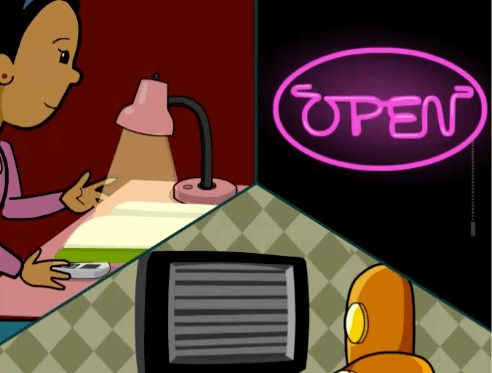
Which of these are examples of Non-Luminous sources of light?
Lightbulbs
Neon signs
Lamp Shades
ALL of them

How does one singular wavelength of light travel/move?
In ONE direction, VERY fast
In ALL directions, VERY fast

The fact that a hot stove coil glows red can be explained by what process?
Phosphorescence
Fluorescence
Spectroscopy
Incandescence
"Glow in the dark" toys are an example of
Incandescence
Flourescence
Phosphorescence
Holography

