wayground logo

Free Printable Worksheets

Font size

S
M
L
XL
Worksheets

Biology Cells Unit Review

Total questions: 45

Worksheet time: 40mins

Name
Class
Date
1.
What is smallest unit that can perform all the processes necessary for life?
a)
Cell
b)
Nucleus
c)
Organelle
d)
protist
2.
No nucleus
a)
Eukaryote
b)
Prokaryote
c)
Both
3.
Bacteria
a)
Eukaryote
b)
Prokaryote
c)
Both
4.
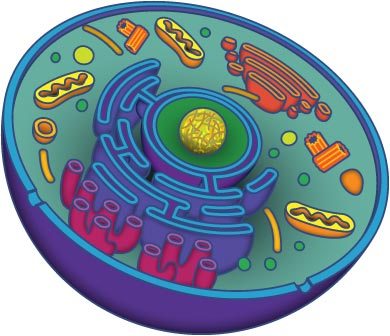
Which type of cell?
a)
Prokaryote
b)
Eukaryote
5.
Plants and animal cells are examples of ___ cells 
a)
prokaryotic cells 
b)
eukaryotic cells 
6.
All eukaryotes and prokaryotes are surrounded by a _____.
a)
cell wall
b)
cell membrane
c)
cell envelope
d)
loving, supportive family
7.
Which type of cell?
a)
Prokaryote
b)
Eukaryote
8.
All living things are made up of...
a)
cells
b)
cell tissues
c)
organ
d)
organ systems
9.

Jorge concludes that the cells he is observing through a microscope are eukaryotic cells. Which of these structures did he most likely see?

a)

nucleus

b)

cytoplasm

c)

cell membrane

d)

genetic material

10.
When many organ systems work together it can form...
a)
organ
b)
cells
c)
organ system
d)
organism 
11.
A group of tissues that perform a similar function is called_____. (Examples include the heart, lungs or stomach)
a)
cells
b)
tissues
c)
organs
d)
organ system
12.

The DNA structure in a prokaryotic cell is...

a)

double helix

b)

circular

c)

found in the nucleus

13.
Cell membranes are said to be
a)
selectively permeable
b)
non-permeable
c)
permeable
d)
psuedopermeable
14.
The head of a phospholipid is hydrophobic
a)
true
b)
false
15.
A special type of diffusion that involves water only
a)
osmosis
b)
facilitated diffusion
c)
active transport
d)
bulk transport
16.
Which of the following requires ATP
a)
osmosis
b)
diffusion
c)
active transport
d)
facilitated diffusion
17.
Which of the following is the bulk uptake of solid material?
a)
pinocytosis
b)
phagocytosis
c)
endocytosis
d)
exocytosis
18.
Which of the following is the bulk uptake of fluids?
a)
phagocytosis
b)
pinocytosis
c)
endocytosis
d)
exocytosis
19.

What will be the net movement of water of a hypotonic cell in a hypertonic solution?

a)

into the cell

b)

out of the cell

c)

both in and out of the cell

d)

no movement

20.
What organelle is called the "powerhouse" of a cell?

a)
Endoplasmic Reticulum
b)
Nucleus
c)
Mitochondria
d)
Nucleolus
21.
What is the function of the vacuole?
a)
Sac that stores water, nutrients, and waste products
b)
Sac filled with digestive chemicals
c)
Jelly-like substance within the plasma membrane
d)
stack of membranes that packages chemicals
22.
What cell part is NOT found in all cells?
a)
Cell Wall
b)
Cell Membrane
c)
Cytoplasm
d)
Genetic Material
23.
Where are proteins made?
a)
Golgi body
b)
Mitoichondria
c)
Chromosomes
d)
Ribosomes
24.
What is diffusion?
a)
when molecules move 
b)
when molecules move from a high concentration to a low.
c)
no movement 
d)
molecules move everywhere
25.
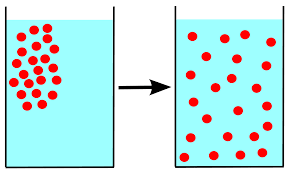
The picture below is an example of _________________.
a)
osmosis
b)
isotonic
c)
diffusion
d)
active transport
26.
Osmosis is the movement of _____ across a membrane.
a)
food
b)
energy
c)
oxygen
d)
water
27.
What is the definition of  Selective Permeability?
a)
The movement of materials across the cell membrane that requires NO ENERGY from the cell.
b)
The movement of materials through (or across) the cell membrane
c)
The ability of the cell membrane to allow some things to pass through while preventing other things from passing through.
d)
The movement of molecules from an area of high concentration to a area of low concentration 
28.
When both inside and outside of a cell have the same amount of water it is said that the cell has reached a state of
a)
Osmosis
b)
Diffusion
c)
Equilibrium
29.
Passive transport requires no
a)
concentration gradients
b)
osmosis
c)
motion
d)
energy
30.
The movement of molecules against a concentration gradient
a)
simple diffusion
b)
facilitated diffusion
c)
active transport
d)
osmosis
31.

What is the difference between active and passive transport?

a)

Active transport requires energy, passive transport doesn't.

b)

Active transport molecules move across a cell membrane and passive transport doesn't.

c)

Active transport involves oxygen and water molecules, passive transport does not.
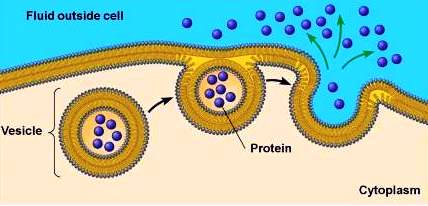
32.
Which form of active transport is being shown?
a)
Facilitated Diffusion
b)
Exocytosis
c)
Endocytosis
d)
Protein Pumps
33.
Which is NOT a form of active transport?
a)
Endocytosis
b)
Osmosis
c)
Exocytosis
d)
Pinocytosis
34.
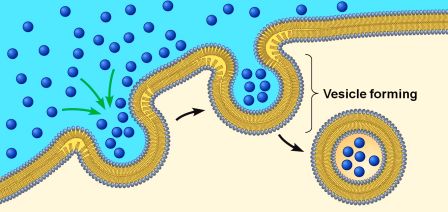
Which form of active transport is being shown?
a)
Pinocytosis
b)
Endocytosis
c)
Exocytosis
d)
Osmosis
35.

Which of the following is an example of active transport?

a)

osmosis

b)

diffusion

c)

cell communication

d)

sodium potassium pump

36.

True or False:

All living things are composed of MANY cells

a)

True

b)

False

37.

True or False:

During osmosis, water always diffuses from hypertonic to hypotonic

a)

True

b)

False

38.
Which statement is a part of the cell theory?
a)
all cells come from preexisting cells
b)
bacteria are prokaryotic cells
c)
eukaryotic cells are complex
d)
humans are multicellular
39.
Who looked at cork and named the cell?
a)
Robert Hooke
b)
Van Leeuwenhoek
c)
Robert Brown
d)
Francesco Redi
40.
Robert Hooke, Anton van Leeuwenhoek, Theodor Schwann, Rudolf Virchow, and Matthias Schliden were all responsible for what theory?
a)
The Theory of Gravity
b)
The Theory of Relativity
c)
The Cell Theory
d)
The Theory of Continental Drift
41.
Which scientist did NOT contribute to the cell theory?
a)
Anton Van Leeuwenhoek
b)

Robert Hooke
c)
Albert Einstein 
d)

Matthias Schleiden
42.
Electron microscopes use a beam of _________________ to produce an image magnified up to 100,000 or more
a)
Sunlight
b)
Lasers
c)
Electrons
43.
Which of the following is a disadvantage of both the TEM and SEM?
a)
Low magnification
b)
Cannot observe living specimens
c)
High resolution
44.

Which of the following could you use to view a living cell?

a)

Transmission Electron Microscope

b)

Scanning Electron Microscope

c)

Binoculars

d)

Compound Light Microscope

45.

True or False:

Signaling between cells is accomplished mainly by chemical means.

a)

True

b)

False