
 Worksheets
Unit Test: Genetics
Total questions: 55
Worksheet time: 1hrs 4mins
Passing of traits from parent to offspring
genetics
Punnett squares
heredity
mitosis
different forms of a gene
big or little
simple or complex
alleles
codominant
describes an organism with two different alleles for a trait
homozygous
heterozygous
an offspring that was given different genetic information for a trait from each parent
hybrid
purebred

The graphic represents two parents that are_________ for a trait.
Homozygous recessive
Homozygous dominant
Heterozygous
_________ are used to solve genetic crossing of parents and possible offspring
Genetics
Punnett squares
Phenotypes
Probability
Two different alleles combine to form a pair of alleles that are -
Homozygous
Heterozygous
The allele that is hidden unless paired with another allele of the same type
dominant
recessive
A sequence of DNA that codes for a protein and determines a trait.
Chromosome
Allele
Gene
The genetic makeup of a trait. For example: Tt or TT (T = tall height)
Phenotype
Genotype
The physical characteristic of a trait. For example: A tall pea plant
Genotype
Phenotype

Selective breeding is done for which of the following reasons?
To determine the possible outcome of a genetic cross.
To allow people to breed organisms to obtain desired traits.
So that organisms won't change their traits.
What do you call the physical characteristics that are studied in genetics called?
Alleles
Genes
Traits
Chromosome

On the Punnett Square above, which of the following shows the correct genotypes of the parents?
bb x bb
BB x BB
BB x bb
BB x Bb
A family choses a larger dog to mate with a small, cute dog because they want a large, but cute dog to guard their home. This is an example of ---
Cloning
Selective breeding
Genetic engineering
A red flower is crossed with a white flower and results in pink flowers. What is this called?
Incomplete dominance
Codominant
Which is homozygous ?
Bb
AA

What is the probability of these plants having green offspring? Y = yellow y = green
25%
50%
75%
100%

What is probability of these parents having offspring with red flowers? R = red r = white
25%
50%
75%
100%

This Punnett square shows a cross between ---
A hybrid parent and a homozygous parent
A heterozygous parent and a heterozygous parent
Two homozygous parents
Two hybrid parents

What percent of the offspring are hybrids?
25%
50%
75%
100%
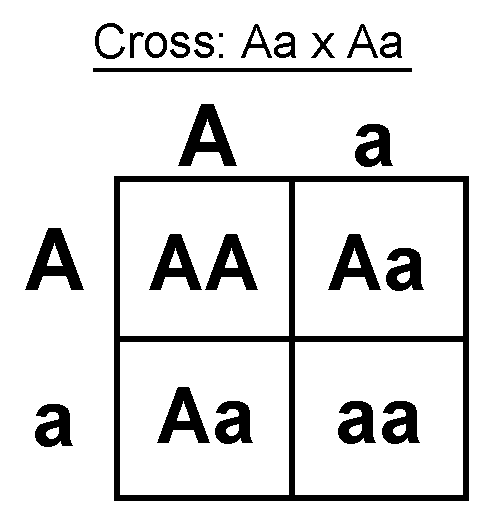
What percent of offspring will have be homozygous dominant?
25%
50%
75%
100%

What percent of the offspring will be hybrid?
25%
50%
75%
100%

This is an example of ---
Codominance
Incomplete Dominance

This is an example of
Codominance
Incomplete Dominance

Complete this Punnett square. What percentage of the offspring will be homozygous recessive?
25%
50%
75%
100%

What is the dominant trait?
yellow pea seeds
green pea seeds

Characteristics or features that can be passed from one generation to another are ---
heredity
traits
genes
nature
What is the process of making an identical copy of an organism?
Selective breeding
Genetic engineering
Cloning
Biomedical research
Some plants and animals reproduce asexually (budding, runners, etc. ), which is technically ---
Cloning
Selective breeding
Genetic engineering
Making changes in the DNA of one organism is ---
selective breeding
cloning
genetic engineering
A breeder of a champion German Shepard wants to make an exact copy of his champion dog. Which type of genetic technology can solve this problem?
Cloning
Genetic engineering
Selective breeding
Biomedical research
Why do farmers choose to use GM crops rather than regular crops?
They are safer because they have no disadvantages.
They are more productive (can grow more crops quickly or more efficiently).
They are less expensive.
They are less controversial.
If you want to make a GM crop that is purple, what is the first thing you need to do?
Find a plant that is naturally purple.
Paint a plant purple.
Use an enzyme to cut a gene out of a plant.
Use a virus to insert a gene into a plant.
What is one significant issue with many Genetically Modified Organisms?
They are too expensive to be useful.
They take a long time to make.
They may affect other organisms in their environment.
They might evolve more quickly.
What percent of the offspring will be purebred?
25%
50%
75%
100%


Which female in the second generation is a carrier?
II-1
II-3
II-5

On a pedigree, this symbol represents a ----
not affected male.
not affected female.
affected male.
affected female.

How are individuals III-2 and II-4 related?
Brother and sister
Dad and daughter
Uncle and niece
Grandfather and granddaughter
Which male has the trait because he received a trait from both of his parents?
II-2
II-4
III-1

