wayground logo

Free Printable Worksheets

Font size

S
M
L
XL
Worksheets

Waves High School

Total questions: 75

Worksheet time: 1hrs 27mins
Name
Class
Date
1.
Which type of wave has a wave perpedicular to the disturbance?
a)
surface
b)
mechanical
c)
transverse
d)
longitudinal
2.
Energy can be transferred from one medium to another through _________.
a)
vibrations
b)
stacking objects
c)
an ordered sequence
d)
colors
3.
Which is true of a mechanical wave?
a)
It must have a medium
b)
It must travel in empty space.
c)
It can travel in a vacuum.
d)
Both sound and light are examples.
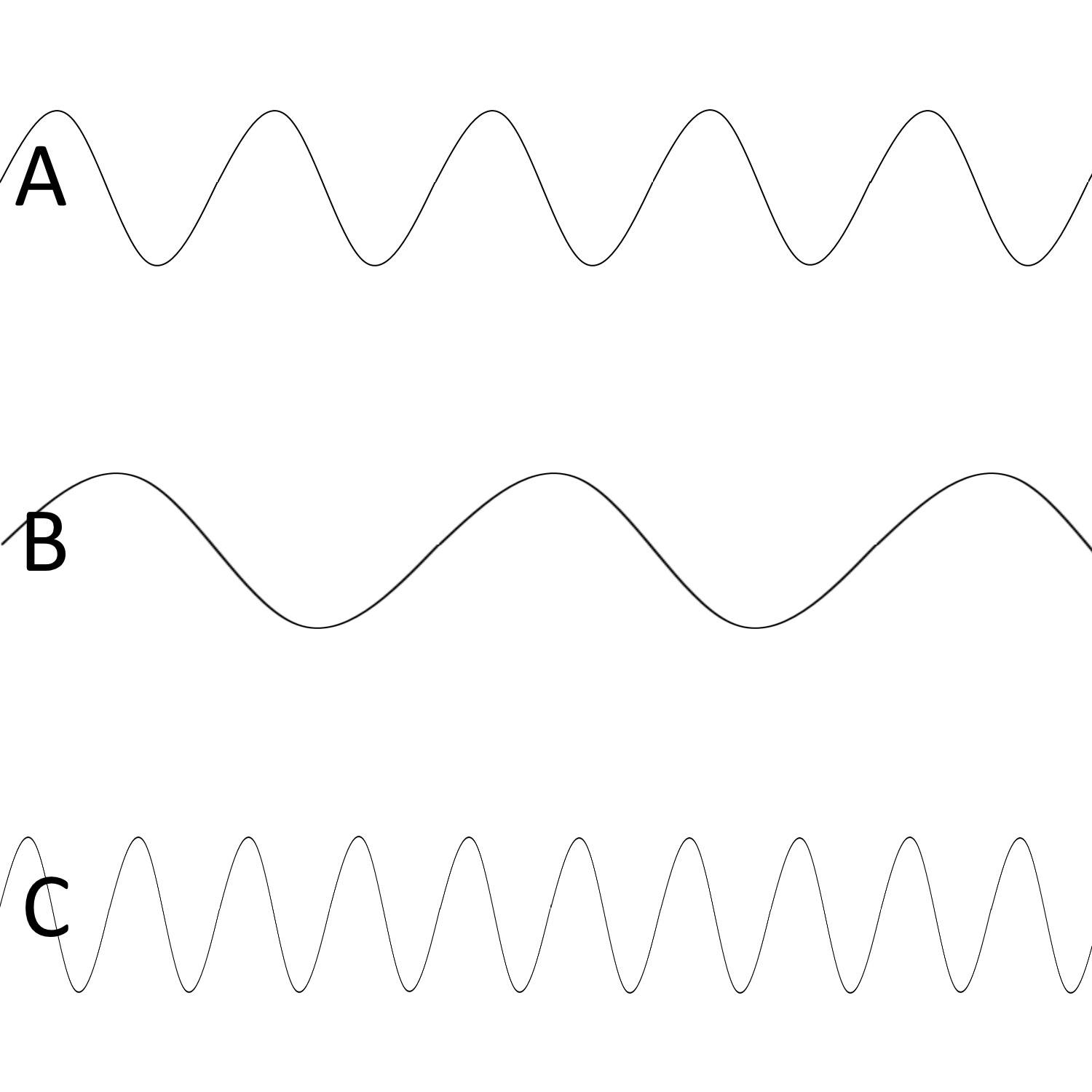
4.
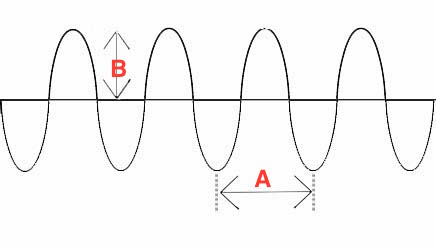
Which wave has the largest wavelength?
a)
A
b)
B
c)
C
d)
None (same wavelength)
5.
Which type of light has the largest wavelength of this group?
a)
X-rays
b)
Microwave
c)
Infrared
d)
Ultraviolet
6.
How are electromagnetic waves different from other waves? 
a)
They have very short wavelengths 
b)
They transmit energy instead of matter 
c)
They can travel through a vacuum 
d)
They can change direction by reflection 
7.
Carries energy from one place to another
a)
Waves
b)
Amplitude
c)
Frequency
d)
Crest
8.
Waves, including light waves and s waves, that moves perpendicular to the direction the wave is traveling
a)
Electromagnetic Spectrum
b)
Transverse Waves
c)
Medium
d)
Light Waves
9.
Top of the wave
a)
Wavelength
b)
Amplitude
c)
Trough
d)
Crest
10.
Bottom of the wave
a)
Crest
b)
Trough
c)
Frequency
d)
Wavelength
11.
The measurement of the distance the particles move from the resting point of the wave
a)
Wavelength
b)
Frequency
c)
Amplitude
d)
Crest
12.
The measurement from one point of the wave to the next identical part of the wave (for example, crest to crest or trough to trough)
a)
Crest
b)
Amplitude
c)
Frequency
d)
Wavelength
13.
The number of times a wave passes a certain point in a set period of time
a)
Frequency
b)
Amplitude
c)
Wavelength
d)
Amplength
14.
Transverse waves that have vibrating electric and magnetic fields that transfer energy from one place to another
a)
Amplitude
b)
Wavelength
c)
Electromagnetic Waves
d)
S Waves
15.
The matter (solid, liquid, or gas) through which waves can travel
a)
Medium
b)
Object
c)
Transverse Wave
d)
Wavelength
16.

What are waves used for?

a)

Transferring Energy

b)

Storing Energy

c)

Moving Objects

d)

Removing Energy

17.

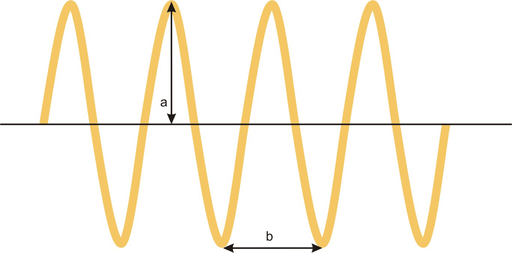
Which of the following is measured in a transverse wave from crest to crest?

a)

wavelength

b)

frequency

c)

amplitude

d)

trough

18.

Which transverse wave has the highest frequency?

a)

1

b)

2

c)

3

d)

4

19.

As the wavelength of the wave increases, the frequency -

a)

decreases

b)

increases

c)

fluxuates

d)

remains the same

20.

Which transverse wave has the highest frequency?

a)

1

b)

2

c)

3

d)

4

21.

The low point of a wave

a)

Crest

b)

Node

c)

Trough

d)

Wave

22.

the high point of a wave

a)

Crest

b)

Amplitude

c)

Trough

d)

Node

23.

A rate of something that repeats over and over.

a)

Pulse

b)

Wave

c)

Velocity

d)

Frequency

24.

A back-and-forth pattern of motion that transfers energy

a)

Wave

b)

Pulse

c)

Reflection

d)

Frequency

25.

A wave in which the movement of the wave’s medium is perpendicular to the movement of the wave traveling through the medium

a)

Transverse waves

b)

Compression waves

c)

Nodular Waves

d)

Ocean Waves

26.

Speed in a given direction

a)

Wavelength

b)

Frequency

c)

Velocity

d)

Waves per second

27.

When a wave strikes an object and bounces off of it

a)

Absorption

b)

Diffraction

c)

Refraction

d)

Reflection

28.
a)

absorption

b)

diffraction

c)

reflection

d)

refraction

e)

transmission

29.
a)

absorption

b)

diffraction

c)

reflection

d)

refraction

e)

transmission

30.
What is a medium?
a)
something between a small and a large?
b)
the substance through which a wave can travel
c)
a pattern of vibration that simulates when a wave is standing still
d)
the distance from any point on a wave to an identical point on the next wave
31.
When a wave passes from one medium to another, the ________ may change.
a)
speed
b)
frequency
c)
wavelength
d)
speed, frequency, and wavelength
32.
The Law of Reflection:
The angle of incidence is _________ the angle of reflection
a)
bigger than
b)
the same as
c)
smaller than
33.
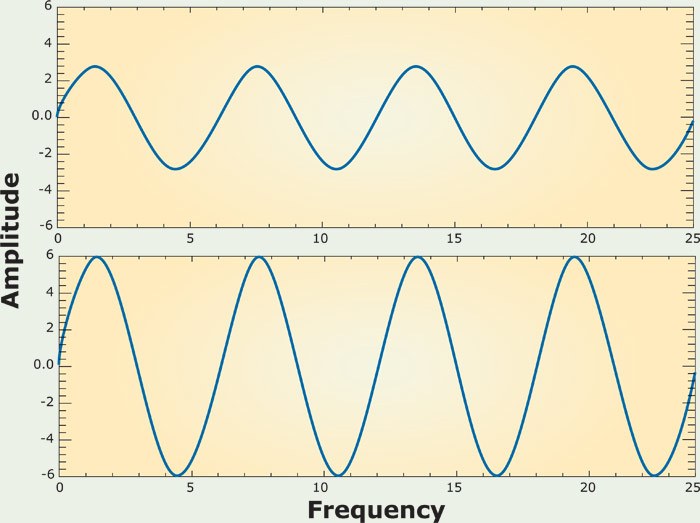
Which wave has a higher amplitude?
a)
The wave on top
b)
The wave on bottom
c)
They both have the same amplitude
34.
What letter demonstrates the amplitude of this wave?
a)
A
b)
B
c)
C
d)
D
35.
____________occurs when a wave bounces off a surface that it cannot pass through.
a)
Reflection
b)
Refraction
c)
Constructive Interference
d)
Destructive Interference
36.
__________ is number of waves in a give time.
a)
Wavelength
b)
Mechanical Waves
c)
Transverse
d)
Frequency
37.
What is a medium?
a)
something between a small and a large?
b)
the substance through which a wave can travel
c)
a pattern of vibration that simulates when a wave is standing still
d)
the distance from any point on a wave to an identical point on the next wave
38.
How many waves are in this wave chain?
a)
6
b)
3
c)
4
d)
5
39.
What does refract mean?
a)
To shrink
b)
To bend
c)
To widen
d)
To enlarge
40.
Which object would be the best at reflecting light waves?
a)
windows
b)
mirrors
c)
notebooks
d)
tables
41.
As light travels through a lens in causes an object to appear larger, this is due to which behavior?
a)
Transmission
b)
Reflection
c)
Absorption
d)
Refraction
42.
Which of the figures represents reflection?
a)
A
b)
B
c)
C
d)
D
43.
Which of the following represents refraction?
a)
A
b)
B
c)
C
d)
D
44.

When a wave moved around or through a hole in an object

a)

Transmission

b)

Diffraction

c)

Refraction

d)

Reflection

45.
a)

absorption

b)

diffraction

c)

reflection

d)

refraction

e)

transmission

46.
What is a medium?
a)
something between a small and a large?
b)
the substance through which a wave can travel
c)
a pattern of vibration that simulates when a wave is standing still
d)
the distance from any point on a wave to an identical point on the next wave
47.
The type of waves that require medium to pass:
a)
Mechanical Waves
b)
Electromagnetic Waves
48.

The direction of a compressional wave is

a)

Back and forth

b)

Up and down

c)

SIde to side

49.

Electromagnetic waves like light waves and x-rays are

a)

Compressional waves

b)

Transverse waves

50.
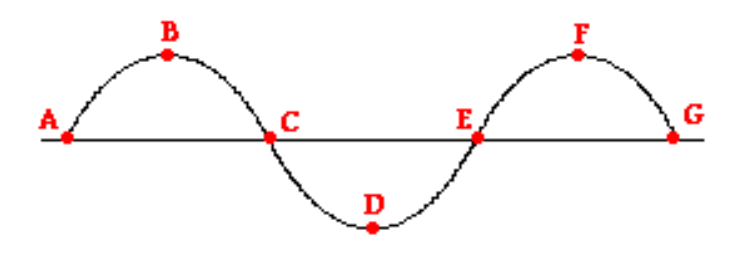
Which vocabulary term is used to identify the distance between points C & G?
a)
Amplitude
b)
Crest
c)
Frequency
d)
Wavelength
51.
The number of wavelengths that pass a point each per second is:
a)
frequency
b)
period
c)
longitudinal 
d)
transverse wave 
52.
What property of the wave is represented by the letter "B"?
a)
amplitude
b)
crest
c)
trough
d)
wavelength
53.
A high point on a transverse wave is called a ______.
a)
vibration
b)
crest
c)
trough
d)
rarefaction
54.
A low point on a transverse wave is called a ______.
a)
vibration
b)
crest
c)
trough
d)
rarefaction
55.
An area where the coils of a longitudinal wave are close together is called a ________.
a)
compression
b)
rarefaction
c)
vibration
d)
transportation
56.
A wave in which energy put into the wave moves in the same direction as the wave.
a)
Longitudinal Wave
b)
Transverse Wave
57.
How would you describe the movement of a transverse wave?
a)
Up and down
b)
Back and forth
c)
In zigzags
d)
Linear
58.
Which wave travels perpendicular in relation to a medium?
a)
Transverse
b)
Longitudinal
c)
Both
d)
Neither
59.
What do you call location B on the diagram?
a)
Rarefaction
b)
Compression
c)
Amplitude
d)
Wavelength
60.
What do you call location B?
a)
Crest
b)
Trough
c)
Amplitude
d)
Wavelength
61.
What do you call location D?
a)
Crest
b)
Trough
c)
Amplitude
d)
Wavelength
62.
What do you call location C?
a)
Crest
b)
Trough
c)
Amplitude
d)
Wavelength
63.
The image above shows a student using a Slinky to create a wave. The slinky is stretched at one end and the resulting wave travels back and forth. This is an example of a...
a)
Superposition Wave
b)
Refracted Wave
c)
Longitudinal Wave
d)
Transverse Wave
64.
What kind of wave is this?
a)
Transverse Wave
b)
Longitudinal Wave
65.
What kind of wave is this?
a)
Transverse
b)
Longitudinal
66.
Which letter(s) represent the crest of the wave?
a)
A
b)
B & D
c)
B & F
d)
F
67.
Which of the following can sound travel through?
a)
solid
b)
liquid
c)
gas
d)
all of the above
68.

Surface waves are which of the following?

a)

Parallel

b)

Perpendicular

c)

Both parallel and perpendicular

d)

Neither parallel or perpendicular

69.

Which of the following are ways that waves can travel- (select all that are correct)

a)

Compressional (longitutinal)

b)

Transverse

c)

Surface

d)

None of the above

70.

Which of the following is true about the way compressional waves travel?

a)

Parallel to the energy flow

b)

Perpendicular

c)

Parallel AND perpendicular

71.

Which of the following is true about the way transverse waves travel?

a)

Parallel to the energy flow

b)

Perpendicular

c)

Parallel AND perpendicular

72.

What is the wavelength of the wave pictured?

a)

3

b)

4

c)

6

d)

18

73.
what are the units for frequency?
a)
m
b)
Hz
c)
cm
d)
m/s
74.
Which property of these waves differs?
a)
Frequency
b)
Wavelength
c)
Amplitude
d)
Pitch
75.

Which of the following are ways that AMPLITUDE can be measured?

a)

Amps

b)

dB

c)

ounces

d)

meters