
Font size
 Worksheets
AP Chemistry Rate Mechanisms and Catalyst
Total questions: 49
Worksheet time: 12hrs 15mins
4 factors that affects reaction rate.
temperature
surface area
catalyst
the nature of reactant
Which of the following are true of reaction rates?
I. The overall rate law is determined by the fastest step of a reaction
II. The presence of a catalyst will increase the number of molecules entering the transition state
III. An increase in temperature will increase the rate of a reaction
IV. Increasing the concentration of reactants will increase the rate at which products yield
II+III+IV
I+IV
II + III
I+II+III
Which of the following plots will show a linear relationship for a second order reaction?
[A] vs time
1/[A] vs time
ln[A] vs time
[A]2 vs time

The iodide ion reacts with hypochlorite ion in the following way:
OCl- + I- ⟶ OI- + Cl-.
This rapid reaction gives the rate data shown. What is the rate law?
rate = [OCl-]2[I-]
rate = [OCl-][I-]2
rate = [OCl-][I-]
rate = [OCl-]
A reaction is found to be second order with respect to carbon monoxide. If the concentration of carbon monoxide is doubled, the rate of reaction __________.
doubles
remains unchanged
increases by a factor of 4
is reduced by a factor of 2
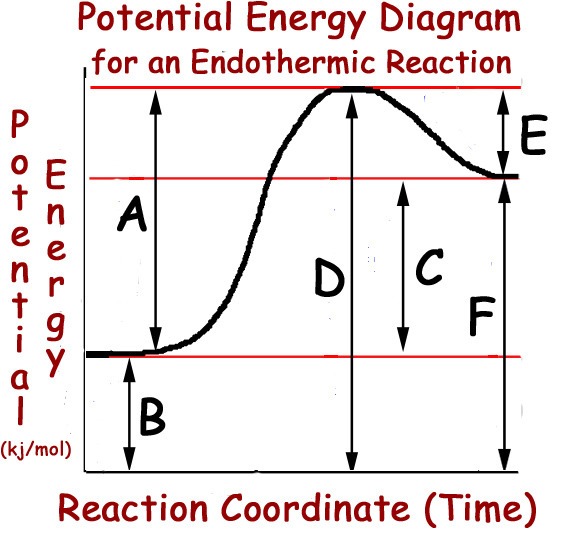
What letter represents the activation energy?
A
B
C
D

Which of the two graphs show a state of equilibrium being reached?
A
B
A and B
Neither.
Which of the following best describes why increasing temperature increase reaction rate?
Activation energy is reduced.
Collisions become more frequent.
Collisions become more energetic.
Collisions become more frequent and more energetic.

Which species is the catalyst in this reaction mechanism?
R
W
X
There is no catalyst.

What is the rate law for this mechanism?
rate = k[A][B]2
rate = [B][X]
rate = [A]0.5[B]1.5
rate = [W][Y][Z]
I. addition of a catalyst
II. grinding reactant lumps into a powder
III. increasing the concentration of reactants

Which of the following is an incorrect conclusion from the data presented?
i. the molecules not colliding with sufficient energy
ii. the concentration of reactants being low
iii. the reaction reaching equilibrium
iv. the reactants not colliding in the correct orientation
The rate expression for the reaction X (g) + 2Y (g) → 3Z (g) is
rate = k[X]0 [Y]2
By which factor will the rate of reaction increase when the concentrations of X and Y are both increased by a factor of 3?
6
9
18
27
Consider the following reaction between nitrogen monoxide and oxygen. 2NO(g)+O2(g)→2NO2(g) The reaction occurs in two steps:
Step 1: NO(g) + NO(g) ⇌ N2O2(g) fast
Step 2: N2O2(g) + O2(g) → 2NO2(g) slow
What is the rate expression for this reaction?
Rate =k[NO]2
Rate =k[NO][O2]
Rate =k[NO]2[O2]
Rate =k[NO][O2]2

Which graph best represents a second-order reaction?
A
B
C
D


How are the exponents n and m determined?


step 2: O3 + O → 2 O2
The oxygen atom (O) is considered to be a(n)...

(CH3)3CBr(aq) + OH-(aq) → (CH3)3COH(aq) + Br-(aq)
What will the initial rate (in mol/L*s) be in Experiment 4?


rate = k[CO]2[O2]2
rate = k[CO]2[O2]
rate = k[CO][O2]2
rate = k[CO][O2]1/2
Mechanisms in which one elementary step is followed by another are very common.
step 1: A + B → Q
step 2: B + Q → C
net reaction: A + 2B → C
Which of the following is false?

The graph shown depicts the relationship between concentration and time. What is the slope of this line?
-k
-1/k
k
ln[A]o

What is the rate law for this reaction?
rate = k[X]0
rate = k[X]
rate = k[X]2
rate = -k[X]2
Decreasing the particle size increases the reaction rate because
It makes particles move faster
It increases the likelihood of collisions with the correct geometry
It decreases the surface area available to react
more surface area allows an increase in the number of collisions
Rate=[A]2[B]1
Step 1: A + B--> AB slow
Step 2: AB + B -->AB2 fast
Overall: A + 2B AB2
The rate law expression must be Rate =______.
Step 1: O3 → O2 + O (fast)
Step 2: O3 + O → 2 O2 (slow)
What is the overall balanced equation?

