
NEW
Font size
S
M
L
XL
 Worksheets
NC Check In Earth Science
Total questions: 75
Worksheet time: 1hrs 28mins
Name
Class
Date
1.
Which statement supports the theory of evolution?
a)
All living cells come from previous cells.
b)
All plants and animals have DNA.
c)
Matter cannot be created or destroyed during chemical reactions.
d)
Fossils provide evidence that vertebrates share a common ancestor.
2.
Which example BEST represents an interconnection between an aquatic food web and a terrestrial food web?
a)
Fish eat insects that land on the surface of a pond.
b)
Snakes eat bird eggs.
c)
Bats eat mosquitos.
d)
Mountain lions catch and eat deer.
3.
What is one way the government of the United States attempts to reduce pollution in the oceans?
a)
create new desalination plants
b)
discontinue sewage treatment programs
c)
increase oil and gasoline production
d)
enforce laws limiting trash dumping
4.
Where is the majority of Earth's freshwater located?
a)
clouds
b)
Pacific Ocean
c)
polar ice caps
d)
rivers
5.
The population density of marine life is denser along the shorelines of the ocean than farther out in the deep waters of the ocean. Which statement provides the BEST reason for this situation?
a)
Ocean currents prevent many smaller marine organisms from living in deep water.
b)
The shallow waters have fewer predators.
c)
Coastal waters are less polluted than the deeper waters of the ocean.
d)
There are more nutrients in shallow waters.
6.
Which is an example of a physical change?
a)
boiling
b)
burning
c)
rotting
d)
rusting
7.
A scientist has a hypothesis that a large volcanic eruption caused a change in global temperature. Which information gained from ice cores is MOST useful in supporting the scientist's hypothesis?
a)
levels of dissolved oxygen
b)
identities of trace metals
c)
estimates of natural radioactivity
d)
amounts of atmospheric dust
8.
Which project is MOST LIKELY to interest a scientist working at a biotechnology company?
a)
study and reconstruction of fossilized bones
b)
conservation of key species within ecosystems
c)
development of genetically modified corn plants
d)
prevention of sewage leaking into water supplies
9.
Which source of water pollution includes oil and gasoline discharge from automobiles and storm sewer discharge?
a)
agriculture
b)
bacteria
c)
sedimentation
d)
urban runoff
10.
Which BEST describes a bio-indicator?
a)
a species that has a short life span
b)
a species that depends on specific conditions to survive
c)
a species that can adapt to a variety of conditions
d)
a species that has been introduced to an ecosystem
11.
What characteristic of aluminum allows it to be made into aluminum foil?
a)
It is dense.
b)
It is soluble.
c)
It is magnetic.
d)
It is malleable.
12.
Which pure substance is composed of more than one element?
a)
water
b)
carbon
c)
gold
d)
sodium
13.
After a chemical reaction occurs in an open test tube, measurements indicate that the mass of the reactants is greater than the mass of the products remaining in the test tube. What MOST LIKELY explains the measurements?
a)
A gas was produced.
b)
A solid was produced.
c)
The salinity of the reactants was high.
d)
The temperature of the reactants was low.
14.
A layer of marine fossils is discovered in a desert environment. Which hypothesis BEST explains the discovery?
a)
The area was once covered by water.
b)
Volcanic activity once occurred in the area.
c)
A catastrophic event once occurred in the area.
d)
Erosion turned most of the limestone in the area into sand.
15.
Which theory BEST describes how an asteroid striking Earth may have caused the extinction of dinosaurs?
a)
Heat from the asteroid caused massive fires that reduced the food supply.
b)
Dense clouds formed following the collision, causing a global drop in temperature.
c)
Land masses were altered by the collision, reducing the space where dinosaurs could roam for food.
d)
Glaciers melted rapidly from heat produced by the asteroid, causing floods that destroyed dinosaurs' habitats.
16.
Which statements BEST explains the reason muscle cells have more mitochondria than skin cells?
a)
Muscle cells use more energy than skin cells.
b)
Muscle cells have fewer proteins than skin cells.
c)
Muscle cells have a smaller nucleus than skin cells.
d)
Muscle cells have more excess water than skin cells.
17.
How are parasites and viruses similar?
a)
Both are contagious diseases.
b)
Both infect host organisms.
c)
Both reproduce using host cells.
d)
Both break down food using oxygen.
18.
Which describes a nonpoint source of pollution?
a)
accumulation of oil in a stream next to a gas station
b)
chemical spill in a river next to a manufacturing complex
c)
runoff from a road into a nearby stream
d)
liquid fertilizer flowing from a barrel into a stream
19.
Which statement BEST explains the reason some insects can walk across the surface of a lake?
a)
Water is a polar molecule, and its adhesiveness causes good capillary action.
b)
Water is a non-polar molecule, and its cohesiveness causes good capillary action.
c)
Water is a non-polar molecule, and its adhesiveness provides high surface tension.
d)
Water is a polar molecule, and its adhesiveness causes high surface tension.
20.
Which of these BEST illustrates natural selection?
a)
An organism with favorable genetic variation will tend to survive and breed successfully.
b)
A population monopolizes all of the resources in its habitat, forcing other species to migrate.
c)
A community whose members work together utilizes all existing resources and migratory routes.
d)
The largest organisms in a species receive the only breeding opportunities.
21.
Complete burning of plant material returns carbon primarily to the:
a)
herbivores
b)
water
c)
vegetation
d)
atmosphere
22.
Earth has undergone some catastrophic changes from time to time. Which of these MOST LIKELY explains why life on Earth continued following these catastrophes?
a)
Dominant species had a slow mutation rate.
b)
Many species filled the same niche.
c)
A strong species had many different characteristics.
d)
A wide diversity of species existed.
23.
A recreational lake experiences eutrophication because of excess nutrients.
Based on this information, how would the recreational lake
most likely appear?
Based on this information, how would the recreational lake
most likely appear?
a)
clear and blue
b)
oily and greasy
c)
murky and full of algae
d)
orange and rust-colored
24.
Which contributes most in supporting life on the deep ocean floor?
a)
cold water temperatures
b)
extreme water pressure
c)
hydrothermal vents
d)
lack of predators
25.
Which is a bioindicator?
a)
current
b)
insect
c)
rock
d)
water
26.
Which area of deep ocean research provides the most economic benefit?
a)
hydropower
b)
new habitats
c)
oil resources
d)
sea-floor spreading
27.
Which best describes the role of the water cycle?
a)
circulates existing water on Earth
b)
reduces pollution in most of the water
c)
increases usable supply of Earth’s water
28.
Which most likely causes land that water drains into to form a watershed?
a)
The ground is saturated or permeable.
b)
The ground is saturated or impermeable.
c)
The ground is unsaturated or permeable.
29.
The tendency of an element to react with other elements to produce compounds.
a)
Chemical change
b)
Neutrality
c)
Reactivity
d)
Valence
30.
A subatomic particle that has almost no mass and a negative charge.
a)
Electricity
b)
Proton
c)
Electron
d)
Neutron
31.
A positively charged subatomic particle located in the nucleus and has an atomic mass of 1.
a)
Neutron
b)
Valence
c)
Proton
d)
Electron
32.
The number of protons in the atoms of a particular element that is unique only to that element.
a)
Atomic Mas
b)
Atomic Number
c)
Proton Number
d)
Mole
33.
The number of negatively charged particles in the most outer shell.
a)
Valence Electrons
b)
Valence Neutron
c)
Valence Proton
d)
Valance Particles
34.
A chemical substance made up of two or more kinds of atoms bonded together.
a)
Mixture
b)
Solution
c)
Compound
d)
None of the above
35.
A pure substance containing only one type of atom.
a)
Element
b)
Simple Substance
c)
Single Substance
d)
Mixture
36.
Which is the most common contamination source for freshwater resources?
a)
runoff
b)
digging wells
c)
melting of glaciers
d)
lightning
37.

Which elements have the most similar chemical properties?
a)
K and Na
b)
K and Ca
c)
K and Cl
d)
K and S
38.
Which group of the periodic table is composed of inert (not reactive) gases?
a)
alkali metals
b)
alkaline earth metals
c)
halogens
d)
noble gases
39.
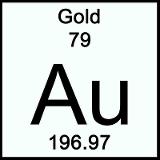
Which number is the atomic mass?
a)
79
b)
196.97
40.
Why is water classified as a compound?
a)
Because it is an element, which consists of only one type of atom.
b)
Because it is a substance, which can easily be separated.
c)
Because it is a substance composed of two or more kinds of atoms bonded together.
d)
Because it is an unevenly mixed solution, or a heterogeneous mixture.
41.
The mass of the products in a chemical reaction is the same as the mass of the reactants in the reaction. Which law best describes this statement?
a)
The Law of Conservation of Angular Momentum
b)
The Law of Superposition
c)
The Law of Conservation of Matter
d)
The Law of Entropy
42.
A technique that uses sound waves to measure the depth of the ocean floor is
a)
dredging
b)
sonar
c)
SCUBA
d)
weighted lines.
43.
Which of the following is an example of a connection between an ocean food web and a land food web?
a)
A polar bear eats a seal.
b)
A whale eats a cod.
c)
A small fish eats plankton.
d)
A cod eats a small fish.
44.
Sea-floor spreading occurs in places where two plates are
a)
converging
b)
diverging
c)
motionless
d)
breaking the surface.
45.
Benthos are organisms that live
a)
on the surface of water.
b)
throughout the water column.
c)
on the ocean floor.
d)
in shallow water.
46.
Which of the following organisms is an example of nekton?
a)
lobster
b)
dolphin
c)
clam
d)
sea star
47.
Many organisms that live in the rocky intertidal zone are adapted to cling to the rocks to withstand the
a)
pounding of the waves.
b)
changes in salinity.
c)
periods of being underwater and exposed to air.
d)
changes in density.
48.
As ocean water in a tide pool warms and evaporates, the remaining water becomes
a)
cooler
b)
saltier
c)
calmer
d)
darker
49.
A coastal inlet or bay in which freshwater from rivers mixes with salty ocean water is called a(n)
a)
transition zone.
b)
abyssal plain.
c)
estuary
d)
hydrothermal vent.
50.
Coastal wetlands that feature short, gnarled trees with arching prop roots are called
a)
mangrove forests.
b)
kelp forests.
c)
salt marshes.
d)
tide pools.
51.
The part of the ocean that extends from the low-tide line to the edge of the continental shelf is the
a)
neritic zone.
b)
open-ocean zone.
c)
intertidal zone.
d)
deep zone.
52.
The only part of the open ocean that receives enough sunlight to support the growth of algae is
a)
the intertidal zone.
b)
around hydrothermal vents.
c)
the deep zone.
d)
the surface zone.
53.
The organisms that form the base of most open-ocean food webs are
a)
fish
b)
coral
c)
plankton
d)
kelp
54.
The organisms that live around hydrothermal vents are supported by
a)
energy from sunlight.
b)
nutrients washed from the land.
c)
food made by algae.
d)
chemical nutrients from Earth’s interior.
55.
Which of the following is a living resource from the ocean?
a)
oil
b)
algae
c)
natural gas
d)
manganese nodules
56.
Most ocean pollution comes from
a)
below the surface.
b)
the air.
c)
the land.
d)
ocean organisms.
57.
Organisms in the deep ocean that produce their own light are called
a)
bioluminescent
b)
neritic
c)
benthic
d)
hydrothermal
58.
Which of the following features of the ocean floor forms where two plates diverge?
a)
seamount
b)
trench
c)
abyssal plain
d)
mid-ocean ridge
59.
The most common plant in a salt marsh is
a)
mangrove trees.
b)
cordgrass
c)
kelp
d)
algae
60.
Kelp forests grow in the
a)
intertidal zone.
b)
neritic zone.
c)
deep zone.
d)
surface zone.
61.
A nearly flat region of the ocean floor, covered with thick layers of sediment, is called a(n)
a)
seamount
b)
abyssal plain.
c)
continental slope.
d)
mid-ocean ridge.
62.
Which statement best explains how periods on the periodic table are arranged?
a)
increasing atomic number from left to right
b)
increasing number of neutrons from left to right
c)
decreasing number of electrons from left to right
d)
decreasing atomic mass number from left to right
63.
An ice cube is put into a heated pan. What will most likely happen to the molecules in the ice as the ice is heated?
a)
the molecules will begin to move slower
b)
the molecules begin to move faster
c)
the molecules will begin to increase in density
d)
the molecules will begin to condense in the air
64.
Which best explains why the total mass of the products would be less than the total weight of the reactants after a chemical reaction?
a)
a physical change occurred
b)
atoms involved in the reaction lost mass
c)
precipitates were created in the new solution
d)
gases were released to the atmosphere
65.
Which is an example of a renewable energy resource?
a)
biomass
b)
coal
c)
gas
d)
oil
66.
Which best determines the health of a lake used as a source of freshwater?
a)
its depth and width
b)
its temp and ph
c)
its location and depth
d)
its temp and depth
67.
A scientists finds bones of a dinosaur. What could help the scientist determine the approximate age of the dinosaur bones?
a)
the birds living in the area of the bones
b)
the weather conditions in the area of the bones
c)
the kinds of trees living in the area of the bones
d)
the index fossils in the area of the bones
68.
Which best describes how ice cores are important to the study of geologic history?
a)
they show unconformities, which signal changes in deposition
b)
they hold index fossils, which are used to date the different ice cores
c)
they contain evidence showing changes in the atmospheric composition
d)
they follow the Law of Superposition, which gives reasons for extinctions of species
69.
Which best determines the number of wolves that can live in an area?
a)
the amount of snow in the area each year
b)
the number of birds that live in the area
c)
the number of trees in the area
d)
the amount of food available in the area
70.

Where is the largest amount of energy found?
a)
hawk
b)
grass
c)
mouse
d)
grasshopper
71.
Tigers and household cats are members of the same family; however, they are vastly different. What is the cause of this difference?
a)
biochemical makeup
b)
behavioral makeup
c)
genetics
d)
habitat size
72.
Which is a possible disadvantage of using flowing water to produce electricity?
a)
ecosystem damage and loss of land
b)
reduced carbon dioxide emission
c)
only suitable for industrial use
d)
creates reservoirs
73.
Why is water form an aquifer more likely to be cleaner than water from other sources?
a)
because it forms where fresh and salt water meet
b)
because it receives water directly from precipitation
c)
because it rises to the surface near the ocean
d)
because pollutants are filtered by rock and soil deep within Earth
74.
Where do plants get most of the energy they need to live and grow?
a)
water
b)
soil
c)
air
d)
sunlight
75.
Which shows one example of a physical change and one example of a chemical change?
a)
boiling water and melting wax
b)
rusting iron and baking a cake
c)
dissolving powder and shredding paper
d)
freezing water and burning coal
Reset

