
 Worksheets
Physics Electrostatics
Total questions: 75
Worksheet time: 1hrs 13mins
An atom of oxygen has 8 protons and 10 electrons, this means the atom is ____________
positively charged because it has excess electrons
negatively charged because it has excess electrons
positively charged because it has a deficiency of electrons
negatively charged because it has a deficiency of electrons
After a balloon is rubbed against wool, the two objects will ________ each other because they have ___________ charges
attract; like
attract, opposite
repel; like
repel; opposite
Which statement is true of a positively charged object?
Positively charged objects do not contain any electrons.
Positively charged objects do not contain neutrons or electrons.
There is a lack of electrons on a positively charged object.
The protons and the electrons are both positively charged on such objects.
What is the end result of charging by contact?
Both object have the same charge, so they will attract one another
Both object have the same charge, so they will repel one another
Both object have the opposite charge, so they will attract one another
Both object have the opposite charge, so they will repel one another
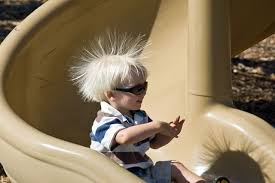
What method of static charging is shown in this picture
Contact
Friction
Grounding
Electron Shifting
Why does the child's hair stick up?
The boy is grounded since he's at the bottom of the slide
He gained a charge from the slide, and since he's not grounded, his hairs have the same charge so they repel one another
He gained a charge from the slide, and since he's not grounded, his hairs have opposite charges so they repel one another
When hair is neutral, some have a positive side and some have negative side, so they will attract to each other, making it stand up
What is the end result of charging by friction?
Both object have the same charge, so they will attract one another
Both object have the same charge, so they will repel one another
Both object have the opposite charge, so they will attract one another
Both object have the opposite charge, so they will repel one another
A balloon is rubbed against a student's hair and then touched to a wall. The balloon sticks to the wall due to
The balloon is charged neutral, so is the wall, so it attracts to the wall
The balloon is charged opposite the wall, so it attracts to the wall
The balloon has a charge, so it attracts the neutral wall
The wall grounds the balloon, so it sticks
If you have an electric force of 6 N and double the charge of both charges, what will be resulting force?
6 N
12 N
24 N
1.5 N
3 N
Which is NOT a similarity between gravitational force and electrical force?
They both depend on the distance
The both involve two objects (either charged or with mass)
They are both repulsive and attractive
They both significantly decrease with distance
If the distance between two charged particles is quadrupled (4 times larger), what will happen to the force between them?
It becomes four times larger
It becomes sixteen times larger
It becomes four times smaller
It becomes sixteen times smaller
When the distance between two charges is halved, the electrical force between the charges
quadruples
reduces to one fourth
halves
doubles
2 charged objects both feel a force of 200 N. If q1 becomes 3 times bigger, what is the new force
203
600
66.7
1800
2 charges feel a force of 40 N. if we cut the distance between them in half, what is the new force they feel
20
80
160
10
Coulomb's law is used to calculate
Magnetic dipole moment
Force between two charges
Energy of a conductor
Force due to gravity
The smallest possible amount of charge is
Charge on an electron
Charge on your blanket
Charge of a battery
Charge on a proton
........... contains protons and neutrons in its nucleus and electrons which revolving around.
Object
Atom
Charge
Electricity

unlike charges ............. each other.


The accumulation of excess electric charge on an object is called
Static electricity
Electric discharge
Resistance
Circuit

A metal spoon is an example of _____.
a conductor
an insulator


Which of the following equations represents Coulomb's Law?
F= kQ/d2
F = kQ1Q2/d2
F = Q1Q2/d2
F = kQ1Q2/d

If you increase the magnitude of two charges, what happens to the force between them?
The force is less than before
The force is more than before
The force remains unchanged
What is the difference between the Coulomb's force and gravitational force?
Gravitational force is greater than Coulomb's force
Coulomb's force is attractive, gravitational force is repulsive
Coulomb's force is bigger than gravitational force
Coulomb's force depends on the distance; gravitational force does not.
If you double both charges and double the distance between them, what happens to the force?
The force is less than before
The force is more than before
The force remains unchanged

How can an object become charged?
Conduction
Induction
Friction
All of the choices

If you halve the distance between two charges, what would the new force be?
2 times bigger than before
Half of the original force
The force would remain unchanged



