wayground logo

Free Printable Worksheets

Font size

S
M
L
XL
Worksheets

AP Chemistry Equilibrium

Total questions: 56

Worksheet time: 3hrs 55mins

Name
Class
Date
1.

Which molecule is acting as a base in the following reaction?

OH + NH4+ → H2O + NH3

a)

OH

b)

NH4+

c)

H2O

d)

NH3

2.

Which of the following is not a strong base?

a)

Ca(OH)2

b)

Fe(OH)3

c)

KOH

d)

NaOH

3.

Which of the following compounds is a strong acid?

I. HClO4 (aq)

II. H2SO4 (aq)

III. HNO3 (aq)

a)

I only

b)

II only

c)

II and III only

d)

I, II, and III

4.

What is the pH of a solution that has an [H+] of 2.5 × 10⁻⁵?

a)

4.60

b)

5.0

c)

2.5

d)

7

5.

What is the pOH of a solution where the [OH] is 7.3 × 10⁻² M?

a)

-1.14

b)

2.0

c)

1.14

d)

7.3

6.
What is the pOH of a solution that has a pH of 2?
a)
10
b)
12
c)
14
d)
1
7.

What is the pOH of a solution where the [H+] is 2.5 × 10⁻¹² M?

a)

11.6

b)

2.40

c)

12

d)

2.5

8.
What is the conjugate acid in the following equation?
a)
PO43- 
b)
HNO3 
c)
NO3- 
d)
HPO42-
9.
What is the conjugate base in the following reaction?
a)
HCO3- 
b)
HCl
c)
 H2CO3 
d)
Cl-
10.
Which accepts protons?
a)
Brønsted-Lowry Acids
b)
Brønsted-Lowry Bases
c)
Arrhenius Acids
d)
Arrhenius Bases
11.
When a hydrogen ion is released what does the solution become?
a)
Basic
b)
Acidic
c)
Amphoteric
d)
Proton
12.
When a hydroxide ion is released what does the solution become?
a)
Basic
b)
Acidic
c)
Amphoteric
d)
Proton
13.
Which of the following represents the chemical formula for hydronium?
a)
H2O
b)
H+
c)
H3O+
d)
OH-
14.

The pH of a solution is 8.43. What is the [H3O+]concentration?

a)

3.7 x 10 -9

b)

1.0 x 10-8.43

c)

2.7 x 10⁻⁶

d)

1.0 x 10⁻¹⁴

15.
Which of the following is a conjugate acid/base pair?
a)
HCl/OCl-
b)
H2SO4/SO42-
c)
NH4+/NH3
d)
H3O+/OH-
16.
When the chemical reaction A + B ↔ C+ D is at equilibrium,
a)
both the forward and reverse reactions have stopped.
b)
the sum of the concentrations of A and B equals the sum of the concentrations of C and D.
c)
all four concentrations are equal.
d)
neither the forward nor the reverse reactions have stopped.
17.
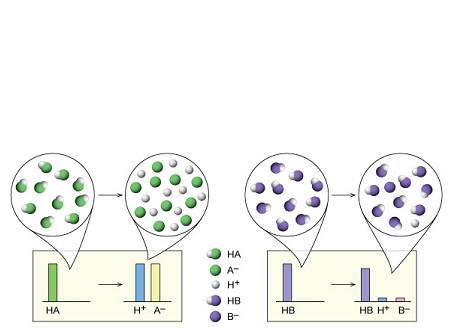
Which of the following correctly describes the strengths of the acids in solution?
a)
HA and HB are both examples of strong acids.
b)
HA and HB are both examples of weak acids.
c)
HA is an example of a strong acid, HB is an example of a weak acid.
d)
HA is an example of a weak acid, HB is an example of a strong acid. 
18.

Which of these is a strong acid?

a)

NH3

b)

CH3COOH

c)

HClO3

d)

HF

19.

A solution with a pOH of 4.23. Is this solution acidic or basic?

a)

Acidic

b)

Basic

c)

Neutral

20.

Water can act as both an acid and a base in an ionization reaction to form H+ and OH ions. What is this phenomenon called?

a)

neutralization

b)

auto-ionization

c)

base dissociation

d)

acid dissociation

21.
If 25 mL of a Ca(OH)2 solution is needed to neutralize 15 mL of 0.18 M HC2H3O2, what is the concentration of the Ca(OH)2 solution?
a)
0.216 M
b)
0.108 M
c)
0.3 M
d)
0.054 M
22.
This symbol indicates that a reaction is ____________
a)
reversible
b)
irreversible
23.

For the reaction...

SO2 + O2 <−> SO3

If the concentration of SO2 is increased, the system will shift ___________.

a)

left

b)

right

c)

left and right

d)

neither left nor right

24.

At what time (in seconds) is equilibrium established?

a)

0 seconds

b)

1 second

c)

5 seconds

d)

10 seconds

25.
Why is equilibrium called a dynamic state?
a)
Chemists try to convert as much reactants as possible into products.
b)
The reactions at equilibrium continue to take place once equilibrium is established.
c)
The products of a forward reaction are favored, so equilibrium lies to the right.
d)
All chemical reactions are considered to be reversible under suitable conditions.
26.
What is the Kc expression for this reaction?
   2 NO(g)  +  O2(g) ⇌  2 NO2(g)
a)
K= [NO2]2 / [NO][O2]
b)
K=  [NO][O2] / [NO2]2
c)
K= [NO][O2] [NO2]2
d)
K= [NO2]2 / [NO]2 +  [O2]
27.
An equilibrium constant with a large value, e.g. Kc = 1000, indicates…
a)
A very fast reaction
b)
Mostly products at equilibrium
c)
Mostly reactants at equilibrium
d)
Nothing useful at all
28.

Given the Kc for a forward reaction, how can you find Kc for the reverse reaction?

a)

Divide Kc by 1

b)

Divide 1 by Kc

c)

Square Kc

d)

Take the square root of Kc

29.
Which is the reactant - and why?
a)
A, as concentration decreases
b)
B, as concentration decreases
c)
A, as concentration increases
d)
B, as concentration increases
30.
At what time the reaction reached equilibrium?
a)
t1
b)
t2
c)
t3
d)
t4
31.
What are [A] and [B]?
a)
concentration of reactants
b)
concentration of products
c)
energy of reactants
d)
energy of products
32.
If the equilibrium constant is much less than one (K << 1) then
a)
Equilibrium is not established.
b)
Equilibrium lies to the right (products are favored)
c)
Equilibrium lies to the left (reactants are favored)
d)
Neither products or reactants are favored.
33.
What is the equilibrium expression for:
Fe3O4(s) + 4H2(g) <--> 3Fe(s) + 4H2O(g)
a)
([Fe]3[H2O]4 ) / ([Fe3O4][H2]4)
b)
([Fe3O4][H2]4)/ ([Fe]3[H2O]4)
c)
[H2O]4 / [H2]4
d)
([Fe][H2O]) / ([Fe3O4][H2])
34.
When Keq > 1, 
a)
There are more products than reactants when the reaction reached equilibrium.
b)
There are more reactant than products when the reaction reached equilibrium.
c)
The amount of reactants is equal to the amount of products.
35.

What is the main purpose of acid-base titrations?

a)

To test if reactants react.

b)

To calculate the concentration of unknown analyte.

c)

To calculate the concentration of known analyte.

d)

To test quality of reactants.

36.

What is the role of an indicator in a reaction?

a)

To help reactants react successfully.

b)

To bind to the analyte to form a products.

c)

To show when the reaction has reached or past the equivalence point.

d)

To provide a surface for the reaction to occur.

37.

What is an equivalence point?

a)

It is the point when enough analyte has been added.

b)

It is the point when the amount of added titrant is equal to the amount of analyte in the solution.

c)

It is the point when the volume of titrant is equivalent the volume of analyte.

d)

It is the point when the concentration of titrant added is equivalent to the volume of analyte.

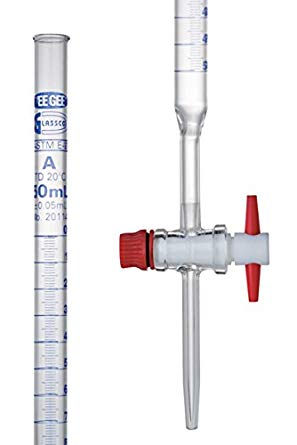
38.
what is the reading on this burette?
a)
4.40mL
b)
3.50mL
c)
3.60mL
d)
4.50mL
39.

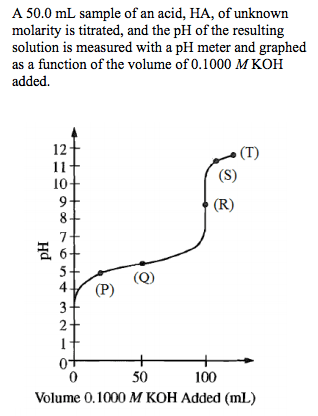
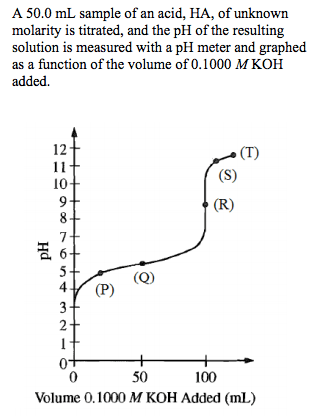
Which point on the titration curve corresponds to the point at which the moles of the added strong base are equal to the moles of the weak acid initially present?

a)

Q

b)

R

c)

S

d)

T

40.

At point P in the titration, which of the following species has the highest concentration?

a)

HA

b)

A

c)

H3O+

d)

OH

41.

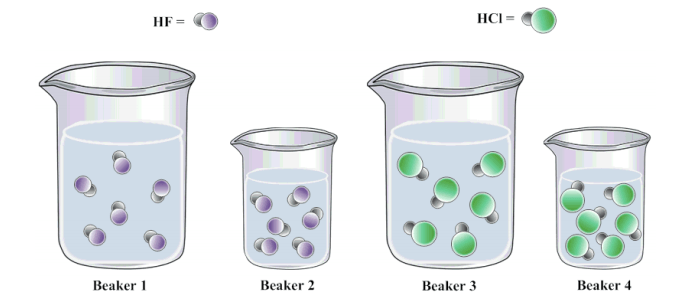
Equal moles of the indicated acids are dissolved in the amounts of water shown in the beakers below. In which solution will the percent ionization of the acid be the lowest?

a)

Beaker 1

b)

Beaker 2

c)

Beaker 3

d)

Beaker 4

42.

If the Erlenmeyer flask contains acidic solution and a few drops of phenolphthalein, its color will be

a)

pink

b)

blue

c)

red

d)

colorless

43.

B(aq) + HCl(aq) ↔ HB+(aq) + Cl-(aq)


The graph above shows the titration curve for an aqueous solution of a weak base, B, with HCl as the titrant. Based on the graph, which of the following best estimates the pKa of HB+?

a)

12.0

b)

10.8

c)

6.0

d)

1.8

44.

A student performs an acid-base titration and plots the experimental results in the graph above. Which of the following statements best explains the experimental findings?

a)

A strong acid was titrated with a strong base, as evidenced by the equivalence point at pH = 7.

b)

A strong acid was titrated with a strong base, as evidenced by the equivalence point at pH > 7.

c)

A weak acid was titrated with a strong base, as evidenced by the equivalence point at pH > 7.

d)

A weak acid was titrated with a weak base, as evidenced by the equivalence point at pH approximately 7.
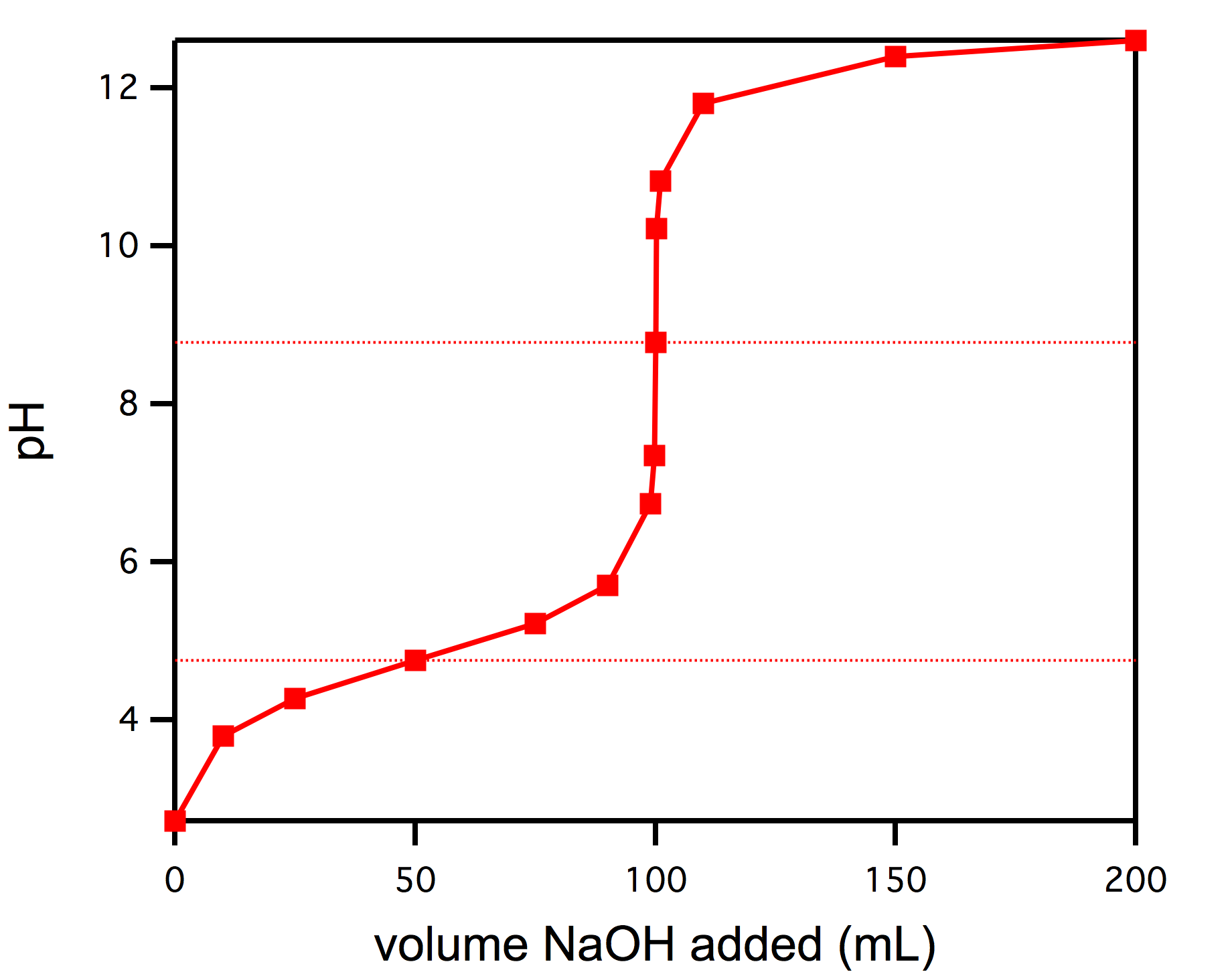
45.

What is the pH at the equivalence point.

a)

The pH is approximately 5

b)

The pH is approximately 6

c)

The pH is approximately 8

d)

The pH is approximately 9

46.
I have 25mL of 1M HCl which neutralises 20mL of NaOH. What is the concentration of the NaOH?
a)
0.8 M
b)
1 M
c)
1.25 M
47.

What is this piece of apparatus called

a)

Pipette

b)

Burette

c)

Janette

d)

Cuvette

48.

What is a buffer solution?

a)

A solution that is resistant to changes in pH

b)

A solution that accepts changes in pH

c)

Any solution containing an acid and a base

d)

None of these

49.

What is a buffer compromised of?

(CHECK ALL THAT APPLY)

a)

A weak acid and its conjugate base

b)

A weak base and its conjugate acid

c)

A strong base and its conjugate base

d)

A strong acid and its conjugate acid

50.
What are the products to a neutralization reaction?
a)
H2 + Ionic Salt
b)
H2O + Ionic Salt
c)
H3O+ + Ionic Salt
d)
OH- + Ionic Salt
51.

Complete the following reaction:

HCl + Mg(OH)2 -->

a)

MgCl2 + H2O

b)

Mg +H2O

c)

MgCl2 + H2

d)

MgCl2 + H2O + CO2

52.
What might happen if you mixed a strong acid with an equally strong base?
a)
You would see an explosive chemical reaction.
b)
The acid would destroy the base.
c)
The base would destroy the acid.
d)
You'd wind up with a pH-neutral substance.
53.
What are the products of the following reaction?
H2SO4  +  KOH  -->  
a)
HK  +  HSO4
b)
H2O  +  KSO4
c)
H2O  +  K2SO4
d)
H2  +  K2SO4
54.

Complete the following reaction:

H3PO4 + NaOH -->

a)

Na3PO4 + H2O

b)

Na +H2O

c)

Na3PO4 + H2

d)

Na3PO4 + H2O + CO2

55.
Strong acids and bases...
a)
do not break apart into ions (non-electrolyte)
b)
partially break apart into ions (weak electrolyte)
c)
completely break apart into ions (non-electrolyte)
d)
completely break apart into ions (strong electrolyte)
56.
What are the weak acids and bases?
a)
all acids and bases are weak
b)
if not classified as strong, the acid/base is considered weak
c)
all acids and bases are strong
d)
there are more strong acids and bases than there are weak acids/bases