wayground logo

Free Printable Worksheets

NEW

Font size

S
M
L
XL
Worksheets

Physical Science Semester Exam

Total questions: 60

Worksheet time: 1hrs 28mins

Name
Class
Date
1.

The rate at which an object’s velocity changes is called what?

a)

inertia

b)

actualization

c)

acceleration

d)

completion

2.
Pushing a child on a swing is easier than pushing an adult on the same swing, because the adult has more mass and requires more force to accelerate.
a)
Newton's 1st Law
b)
Newton's 2nd Law
c)
Newton's 3rd Law
3.
Accelerations are produced by
a)
forces.
b)
 velocities.
c)
 accelerations.
d)
 masses.
4.

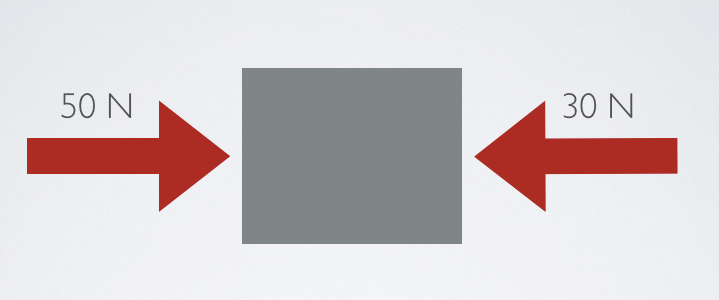
Which way will the box accelerate?

a)

To the right

b)

to the left

c)

The object will not accelerate

5.

A 20 kg bike accelerates at 10 m/s2. what was the force

a)

25 Newtons

b)

20 Newtons

c)

200 Newtons

d)

10 Newtons

6.

F=MA

An object of mass 10 kg is accelerated upward at 2 m/s2. What force is required?

a)

20 N

b)

2 N

c)

5 N

d)

0 N

7.
If an object was accelerating at 10 m/s^2, and a force of 10 newtons was required to accelerate it, what was the object's mass?
a)
1 kilogram
b)
10 kilograms
c)
2 kilograms
d)
5 kilograms
8.
How does acceleration of an object change in relation to its mass? It is
a)
directly proportional.
b)
Acceleration doesn't depend on mass at all. 
c)
c. inversely proportional.
9.
The acceleration produced by a net force on an object is
a)
inversely proportional to the mass of the object.
b)
directly proportional to the magnitude of the net force.
c)
in the same direction as the net force.
d)
 all of the above
10.

How will this object accelerate?

a)

It won't accelerate.

b)

It will accelerate to the right.

c)

It will accelerate to the left.

d)

It will accelerate in both directions.
11.

How will this object accelerating?

a)

It won't accelerate.

b)

It will accelerate to the right.

c)

It will accelerate to the left.

d)

It will accelerate up.

12.

Which way is the object accelerating?

a)

left

b)

right

c)

down

d)

up

13.
What two factors effect gravity?
a)
Weight and distance
b)
Length and distance
c)
Mass and distance
d)
Gravitational pull
14.
If distance increases, the force of gravity _____
a)
deacreases
b)
increases
c)
reciprocal
d)
TARGET
15.
What is weight?
a)
The force of gravity.
b)
How heavy something weighs?
c)
The same as mass.
d)
The pull of gravity.
16.

What is the resultant force on the block?

a)

400 N Up

b)

400 N Down

c)

- 400 N Down

d)

800 N Down

17.

Which of these blocks would be accelerated?

a)

Block 1

b)

Block 2

c)

Block 1 and 2

d)

Blocks 2 and 3

18.

Choose the image that has the most gravitational pull:

a)
b)
19.
A person would weigh less on on the Moon than on the Earth because . . .
a)
Moon has more mass, and therefore more gravity
b)
Moon has less mass, and therefore more gravity
c)
Moon has more mass, and therefore less gravity
d)
Moon has less mass and therefore less gravity
20.
What type of motion created the dot diagram for X?
a)
an object at rest
b)
an object moving with a constant velocity
c)
an object getting faster
d)
an object getting slower
21.
If the object was moving from right to left, what type of motion created the dot diagram for Z?
a)
an object at rest
b)
an object moving with a constant velocity
c)
an object getting faster
d)
an object getting slower
22.

Which diagram represents an object that is, at first, moving at a constant velocity and then accelerating to the right? (assume that all motions are going to the right)

a)

B

b)

C

c)

D

d)

E

e)

none of these

23.

Which is TRUE?

a)

the object had a backward constant speed

b)

the object never stopped

c)

the object sped up on the way back to the origin

d)

the object sped up in the forward direction

24.

Which is TRUE?

a)

A is slower than C

b)

B is the fastest

c)

C is slowing down

d)

all are going forward

25.
An object with a mass of 2000 kg at rest has what momentum?
a)
2000 kg m/sec
b)
0 kg m/sec
c)
2000 kg
d)
2000 m/sec
26.
A 10kg toy truck moves at +5m/s. It collides head-on with a 5kg toy car moving at -10 m/s. What is the total momentum of the system?
a)
0 kgm/s
b)
30 kgm/s
c)
50 kgm/s
d)
10 kgm/s
27.

If you double the velocity of an object, then its momentum will ______________.

a)

will double

b)

will half

c)

will quadruple (x4)

d)

will be quartered (x 1/4)

28.

The momentum of an object depends upon the object's ___________&_____________.

a)

size and shape

b)

mass and speed

c)

mass and veloctiy

d)

mass and energy

29.
Determine the momentum of 1000-kg car moving northward at 20 m/s......... 
a)
20000 N
b)
20000 Joules
c)
20000 Kg * m/s
d)
20000 kg * m/s north
30.
Cart A is pulled with a 2 Newton force for 2 seconds, and Cart B is pulled with a 1 Newton force for 3 seconds.  Which cart experiences the greatest impulse?
a)
Cart B
b)
Cart A
c)
they are the same
31.
In any collision (crash) the ______ is ALWAYS constant
a)
Total Momentum
b)
total speed
c)
total Velocity
d)
Energy
32.
A runner has a momentum of 720 kg m/s and is traveling at a velocity of 5 m/s. What is his mass?
a)
14.4 kg
b)
1400 kg
c)
144 kg
d)
360 kg
33.
The law of conservation of momentum states that, 
a)
p before is less than p after
b)
p before is the same as p after
c)
p before is more than p after
34.
The total momentum before a collision is _________ the total momentum after a collision.
a)
equal to 
b)
less than 
c)
more than
d)
It depends on the type of collision
35.
In this type of collision, objects tend to "stick" together.
a)
elastic
b)
inelastic 
c)
They "stick" together in both types of collisions
36.
The momentum of an object depends upon the object's ___________&_____________.  
a)
size and shape
b)
mass and speed
c)
mass and veloctiy
d)
mass and energy
37.
A 2.5 kg ball moving at 4.2 m/s collides with a 2.5 kg stationary ball. If the first ball is at rest after the collision, what is the velocity of the second ball? 
a)
2.1 m/s
b)
2.5 m/s
c)
4.2 m/s
d)
8.4 m/s
38.

Cart A has 2 kg x m/s of momentum. It runs into cart B and they stick together.


What happens to the total momentum?

a)

goes up

b)

stays the same

c)

goes down

d)

momentum schmomentum

39.

A 10kg toy truck moves at 5m/s east. It collides head-on with a 10kg toy car moving 10 m/s moving west. If the collision is elastic, what is the velocity of the toy car after the collision?

a)

10 m/s west

b)

10 m/s east

c)

5 m/s west

d)

5 m/s east

40.

A 10kg toy truck moves at 5m/s east. It collides head-on with a 10kg toy car moving at rest. If the collision is elastic, what is the velocity of the toy truck after the collision?

a)

5 m/s west

b)

5 m/s east

c)

0 m/s (rest)

41.
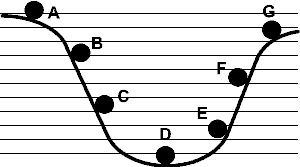
At which point is potential energy greatest?
a)
W
b)
X
c)
Y
d)
Z
42.

At which point is kinetic energy greatest?

a)

W

b)

X

c)

Y

d)

Z

43.

At which point is Total Mechanical energy greatest?

a)

W

b)

X

c)

Y

d)

Z

e)

All are equal

44.
A roller coaster has a mass of 250 kg, and is 50 meters above the ground, what is the potential energy?
a)
122,625 Joules
b)
5,600 Joules
c)
234,799 Joules
45.
A weight lifter lifts a set of 1250kg weights a vertical distance of 2m in a weight lifting contest. What Potential Energy do the weights now possess?
a)
12,789 Joules
b)
24,525 Joules
c)
4,500 Joules
46.
What is the KE of a 1.00 kg hammer swinging at 20.0 m/s?
a)
200 Joules
b)
1500 Joules
c)
950 Joules
47.
When a pendulum swings, at which point is potential energy at its greatest
a)
1
b)
2
c)
3
d)
4
48.
A ball is released from rest at position 1.  The diagram shows the ball in four positions as it rolls along a track from left to right. In which position does the ball have its minimum gravitational potential energy and maximum kinetic energy?
a)
1
b)
2
c)
3
d)
4
49.
gravitational potential energy is defined as
a)
the energy an object has due to its height above the ground
b)
the energy an object has due to its motion
c)
the energy a spring has due to its stretch
d)
the chemical energy stored in the molecules of atoms
50.
A 70 kg runner has a velocity of 5 m/s. Her kinetic energy is
a)
875 J
b)
175 J
c)
1750 J
d)
350 J
51.
When a pendulum swings, at which point is kinetic energy highest?
a)
1
b)
2
c)
3
d)
4
52.

Which point has the most potential energy?

a)

G

b)

F

c)

B

d)

A

53.
As a pendulum swings from its highest to lowest position, what happens to its kinetic and potential energy? 
a)
Both the potential energy and kinetic energy decrease
b)
The potential energy decreases while the kinetic energy increases 
c)
The kinetic energy decreases while the potential energy increases 
d)
Bothe the potential energy and kinetic energy increase 
54.
Energy due to motion is ____________ energy. 
a)
Potential 
b)
Energy
c)
Kinetic
d)
Friction
55.
Roger Federer’s tennis ball has a mass of 0.3 kg. If he holds the ball above the ground at a height of 2.0 m to serve, what is its gravitational potential energy (GPE)?
a)
5.88 J
b)
0.6 J
c)
6.67 J
d)
0.15 J
56.
A leopard with a mass of 55.00 kg climbs 12.0 m up a tree. What is its GPE?
a)
6,468 J
b)
660 J
c)
4.58 J
d)
0.22 J
57.
A 3 kg bowling ball is lifted 1.5 m off the ground. What is its GPE?
a)
4.5 J
b)
2 J
c)
44.1 J
d)
0.5 J
58.
A crate with mass of 15.3 kg is pulled 9.2 m up in order to place it on top of a shelf. Calculate the GPE of the crate.
a)
140.76 J
b)
1.66 J
c)
1,379.4 J
d)
5.89 J
59.

If the box has a mass of 12 kg, what is the acceleration of the box?

a)

0.109 m/s2

b)

9.16 m/s2

c)

1320 m/s2

d)

5400 m/s2

60.

Two football players run directly toward each other. Player 1 has a mass 75 kg and a speed of 6 m/s, and Player 2 has a mass 100 kg and a speed of 8 m/s. If they grab each other as they collide, the combined speed of the two players just after the collision would be:

a)

2 m/s

b)

3.4 m/s

c)

4.6 m/s

d)

7.1 m/s