Wayground logo

Free Printable Worksheets

Font size

S
M
L
XL
Worksheets

Gse S8p2

Total questions: 60

Worksheet time: 1hrs 24mins

Name
Class
Date
1.
Some students observing a classroom device being used, noticed the below energy transformations. 
Electrical → Mechanical → Sound
Which device were the students most likely observing?
a)
A triple beam balance measuring an object’s mass.
b)
A pencil sharpener plugged into a wall outlet.
c)
A projector displaying a diagram on the screen.
d)
A working flashlight used to light up a dark corner.
2.
Which of these is an example of light energy being transformed into chemical energy?
a)
A glow stick lights up when broken.
b)
Water heated by the sun evaporates.
c)
A plant makes sugar in the sunlight.
d)
A battery causes a buzzer to vibrate.
3.
Which kind of energy change occurs when a candle is burning?
a)
Chemical to light.
b)
Light to electrical.
c)
Solar to heat.
d)
Chemical to electrical.
4.
Which of the following best describes the energy transformations that occur when a flashlight that runs on batteries is turned on?
a)
chemical → light → electrical
b)
electrical → light → chemical
c)
light → electrical → chemical
d)
chemical → electrical → light
5.
The picture shows a microwave oven. As a microwave oven is operated, electrical energy is transformed into all of the following types of energy EXCEPT —
a)
Solar
b)
Light
c)
Thermal
d)
Mechanical
6.

What energy conversions take place when you vigorously rub your hands together?

a)

friction => heat

b)

chemical => thermal

c)

mechanical => thermal

d)

kinetic => chemical

7.

What type of energy is food energy stored in your muscles?

a)

mechanical

b)

nuclear

c)

thermal

d)

chemical

8.

Which type of energy propels a baseball after it has been struck by a bat?

a)

chemical

b)

thermal

c)

mechanical

d)

nuclear

9.

What is the correct energy chain from the sun to grass to cow?

a)

light and thermal => chemical => chemical

b)

light => heat => mechanical => chemical

c)

light => thermal => mechanical

d)

nuclear => chemical => potential

10.

Muscles operate to push the pedals on a bicycle causing the wheels to turn. What type of energy being represented?

a)

mechanical

b)

physical

c)

thermal

d)

chemical

11.

Strong wind spinning a wind turbine can generate which type of energy?

a)

mechanical

b)

electrical

c)

thermal

d)

chemical

12.

What energy transformation occurs in the chameleon as it quickly launches its tongue to catch an insect?

a)

Radiant --> Chemical

b)

Thermal --> Chemical

c)

Chemical --> Mechanical

d)

Mechanical --> Chemical

13.

What energy transformation occurs as howler monkeys loudly call to each other in the forest?

a)

Chemical --> Mechanical --> Sound

b)

Chemical --> Sound --> Thermal

c)

Sound --> Chemical --> Radiant

d)

Mechanical --> Chemical --> Sound

14.

What energy transformation occurs as as an elephant walks through the savanna?

a)

Thermal --> Chemical + Mechanical

b)

Mechanical --> Chemical + Thermal

c)

Radiant --> Chemical + Mechanical

d)

Chemical --> Mechanical + Thermal

15.
What is the energy transformation?
a)
Kinetic to Mechanical and Electrical
b)
Chemical to Thermal and Electromagnetic (light)
c)
Electromagnetic to Chemical and Electrical
d)
Kinetic to Sound and Chemical
16.
What is the energy transformation?
a)
Nuclear to Electrical
b)
Mechanical to Electrical
c)
Electrical to Thermal
d)
Kinetic to Sound
17.
What is the energy transformation?
a)
Electromagnetic to Electrical
b)
Mechanical to Electrical
c)
Electrical to Thermal
d)
Kinetic to Sound
18.
What is the energy transformation?
a)
Chemical to Electrical to Light
b)
Mechanical to Electrical to Light
c)
Electrical to Thermal to Mechanical
d)
Kinetic to Sound to Potential
19.
Which of the following devices transforms electrical energy into mechanical energy?
a)
An e-reader
b)
a fan
c)
a manual pencil sharpener
d)
ipod
20.
A television works by transforming electrical energy into what other kinds of energy?
a)
Light, thermal, and sound
b)
Thermal, chemical, and solar
c)
Sound, mechanical, and electrical
d)
Light, chemical, and mechanical
21.

Potential energy is stored energy. Objects that are higher up have more potential energy than objects that are lower (if both objects have the same mass). If two objects have different masses, the more massive objects has more potential energy (if they are are at the same height).

a)

I don't get it.

b)

GOT IT!

22.

Potential energy is...

a)

energy in motion

b)

stored energy

23.

What two factors affect an object's potential energy?

a)

area and volume

b)

area and height

c)

mass and height

d)

mass and velocity

24.

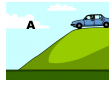
The least amount of potential energy is at

a)

a

b)

b

c)

c

d)

d

25.

The most potential energy is at

a)

a

b)

b

c)

c

d)

d

26.

Where would a person have to be located to have the minimum potential energy?

a)

up on the roof

b)

down in the basement

c)

in the middle

d)

outside

27.

Where would a person have to be located to have the maximum potential energy?

a)

up on the roof

b)

down in the basement

c)

in the middle

d)

outside

28.
Which object has more gravitational potential energy?
a)
the watch
b)
the pen
c)
the camera
d)
the mug
29.
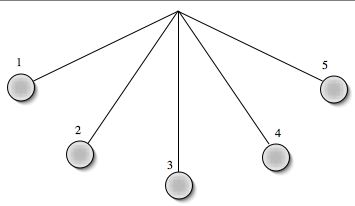
When a pendulum swings, at which point is potential energy at its greatest?
a)
1
b)
2
c)
3
d)
4
30.

Which object will have the largest value for its potential energy?
a)
b)
c)
d)
31.

The drop tower has more potential energy...

a)

at the top of the ride.

b)

at the bottom of the ride.

c)

Potential energy stays the same

d)

I need more information

32.
How far will an object move in 12 seconds if it is traveling at a velocity of 8 m/s?
a)
96 m
b)
0.7 m
c)
20 m
d)
4 m
33.
How long will it take a moving object traveling at a velocity of 6 m/s to move 30 meters?
a)
5 s
b)
180 s
c)
36 s
d)
24 s
34.
Calculate the KE of a moving 4 kilogram object traveling at a velocity of 3 m/s.
a)
18 J
b)
36 J
c)
12 J
d)
6 J
35.
How much KE does a moving 6 kilogram object have if it moves with a velocity of 3 m/s?
a)
27 J
b)
18 J
c)
9 J
d)
2 J
36.
A moving 10 kilogram object has 20 Joules of KE. What is its velocity?
a)
2 m/s
b)
4 m/s
c)
200 m/s
d)
10 m/s
37.
What is the mass of a moving object that has 100 Joules of KE and moves at a velocity of 2 m/s?
a)
50 kg
b)
200 kg
c)
25 kg
d)
100 kg
38.
As mass increases, KE ...
a)
increases
b)
decreases
c)
stays the same
39.
As the velocity of an object decreases its KE will...
a)
increase
b)
decrease
c)
stay the same
40.
Which has a greater impact on KE?
a)
mass
b)
velocity
41.
Why is it harder to stop a four-person bobsled than a three-person bobsled?
a)
the four-person sled has more KE
b)
the four-person sled has less KE
42.
The PE of a boulder on a hill will be ______ the KE of the boulder as it rolls down the hill.
a)
greater than
b)
less than
c)
the same as
43.
The Law of Conservation of Energy states that
a)
energy cannot be created nor destroyed, only transformed or transferred
b)
energy can be destroyed but not created
c)
energy can be created but not destroyed
44.
When one energy form is changed into another it is called a
a)
transformation
b)
transfer
c)
translocation
d)
transcription
45.
What is the velocity of a moving object that travels 12 meters in 3 seconds?
a)
4 m/s
b)
36 m/s
c)
15 m/s
d)
9 m/s
46.
The law of conservation of energy states that when one form of energy is converted into another,
a)
energy is destroyed in the process
b)
no energy is destroyed in the process
c)
energy is created in the process
d)
some amount of energy cannot be accounted for
47.
In energy transformations, "wasted energy" usually takes what form?
a)
heat
b)
chemical energy
c)
light
d)
sound waves
48.

Efficiency is calculated by useful energy output divided by total energy input, expressed as a percentage

a)

False

b)

True

49.

When is energy lost?

a)

During transformations only

b)

During transformations and transfers

c)

During transfers only

d)

During GPS outages

50.

Energy efficiency of incandescent lightbulbs is

a)

50%

b)

25%

c)

15%

d)

5%

51.

With wind-electric turbines, electric energy is turned into rotational energy.

a)

True

b)

False

52.

Energy efficiency of wind turbines is about

a)

90%

b)

75%

c)

40%

d)

12%

53.
Which type of alternative energy source is shown in this picture?
a)
Wind
b)
Solar
c)
Hydroelectric
d)
Geothermal
54.

What is the energy efficiency of hydroelectric dams?

a)

90%

b)

70%

c)

50%

d)

29%

55.
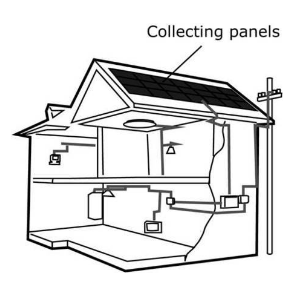
The house illustrated here uses panels on the roof to collect a natural resource and convert it into electricity that can be used.
Which alternative energy source does this house use?
a)
Water
b)
Wind
c)
Solar
d)
Geothermal
56.

How much light energy in converted to electrical energy in commercial solar panels?

a)

75%

b)

60%

c)

20%

d)

5%

57.
Which of the following is a fossil fuel?
a)
Wind
b)
Coal
c)
Solar
d)
Biomass
58.

What is the energy transformation in hydroelectric dams?

a)

Kinetic to electrical

b)

Kinetic to heat

c)

Electric to kinetic

d)

Sound to electric

59.

Around how much energy is lost in power lines and transformers?

a)

25%

b)

10%

c)

2%

d)

0.1%

60.

Just because we CAN do something ...

a)

We totally should!

b)

Doesn't mean it's a good idea ...

c)

We should never try!

d)

Where are those solar panels? I have a great idea where to put them!