wayground logo

Free Printable Worksheets

Font size

S
M
L
XL
Worksheets

GCSE - Magnetism

Total questions: 86

Worksheet time: 38mins
Name
Class
Date
1.
Current flows from …
a)
positive to negative
b)
negative to positve
c)
either
2.
Electrons flow from …
a)
negative to positive
b)
positive to negative
c)
either
3.
Magnetic field lines go from …
a)
north to south
b)
south to north
c)
either
d)
both
4.
Steel is magnetic
a)
Sometimes
b)
Always
c)
Never
5.
Copper is magnetic
a)
Never
b)
Sometimes
c)
Always
6.
Zinc is magnetic
a)
Never
b)
Sometimes
c)
Always
7.
Nickel is magnetic
a)
Always
b)
Sometimes
c)
Never
8.
How do you know a magnetic field is uniform?
4 lines
9.
What is required to produce an electromagnet?
a)
insulated wire
b)
soft iron core
c)
coil of insulated wire and soft iron core
d)
coil of insulated wire
10.
Which makes the strongest electromagnet?
a)
coil of insulated wire and soft iron core
b)
insulated wire
c)
coil of insulated wire
11.
How can you decrease the strength of an electromagnet?
a)
decrease number of coils
b)
increase number of coils
c)
increase length of wire
12.
How can you increase the strength of an electromagnet?
a)
increase current
b)
decrease current
c)
increase length of wire
13.
How can you increase the strength of an electromagnet?
a)
pack coils tighter together
b)
space coils further apart
c)
increase length of wire
14.
Outside of a magnet, magnetic field lines run …
a)
from north to south
b)
from south to north
c)
forwards
d)
backwards
e)
from positive to negative
15.
A hard magnetic material...
a)
can be magnetised
b)
cannot be magnetised
c)
retains its magnetism
d)
does not retain its magnetism
16.
A soft magnetic material …
a)
can be magnetised
b)
cannot be magnetised
c)
does not retain its magnetism
d)
retains its magnetism
17.
True or False: The Earth's magnetic and geographic poles are in the same location.
a)
False
b)
True
18.
When magnetic field lines are close together the field is …
a)
strong
b)
weak
c)
uniform
19.
When magnetic field lines are far apart the field is …
a)
weak
b)
strong
c)
uniform
20.
When magnetic field lines are parallel and evenly spaced the field is …
a)
uniform
b)
strong
c)
weak
21.
The field lines in a uniform field are …
a)
parallel
b)
evenly spaced
c)
curved
d)
close together
22.
FLHR stands for …
a)
Fleming's Left Hand Rule
b)
Flamingo Left Hand Rule
c)
Flagrant Liar Has Rabbit
d)
Flapping Lapwing Hates Robins
e)
Falsiloquence Lachrymiform Hagridden Radotage
23.
In FLHR, the index finger represents
a)
Field
b)
Current
c)
Motion
24.
In FLHR, the middle finger represents
a)
Current
b)
Field
c)
Motion
25.
In FLHR, the thumb represents
a)
Motion
b)
Field
c)
Current
26.
In FLHR, the index finger represents
a)
Field (N to S)
b)
Field (S to N)
c)
Current (+ to −)
d)
Current (− to +)
27.
In FLHR, the middle finger represents
a)
Current (+ to −)
b)
Current (− to +)
c)
Field (N to S)
d)
Field (S to N)
28.
Which is which? Passing a current through a wire to generate a magnetic field.
a)
Electromagnet
b)
Left Hand Rule
c)
Induction
29.
Which is which? A current-carrying wire experiences a force when in a magnetic field.
a)
Left Hand Rule
b)
Electromagnet
c)
Induction
30.
Which is which? A moving wire in a magnetic field has a current induced in it.
a)
Induction
b)
Left Hand Rule
c)
Electromagnet
31.
To induce a current, a wire must move __________ to magnetic field lines.
a)
perpendicular
b)
parallel
32.
To induce a current, a wire must _____ magnetic field lines.
a)
cut
b)
pass
c)
separate
d)
shorten
e)
meet
33.
Which type of electricity does a transformer work with?
a)
AC
b)
DC
c)
AC or DC
34.
A step-up transformer …
a)
increases voltage
b)
increases current
c)
increases power
35.
A step-down transformer …
a)
decreases voltage
b)
decreases current
c)
decreases power
36.
A step-up transformer …
a)
has more output coils than input coils
b)
has more input coils than output coils
37.
A step-down transformer …
a)
has more input coils than output coils
b)
has more output coils than input coils
38.
Why does a transformer produce a humming noise?
a)
Because it operates on alternating current
b)
Because there are bees trapped inside it
39.
What material would be most suitable for the core of a transformer?
a)
Soft iron
b)
Hard iron
c)
Steel
d)
Toffee
40.
Where are step-up transformers used?
a)
Between the power station and the national grid
b)
Between the national grid and homes
c)
Between pylons
41.
Where are step-down transformers used?
a)
Between the national grid and homes
b)
Between the power station and the national grid
c)
Between pylons
42.
How do transformers help prevent wasted power?
a)
They decrease current
b)
They decrease voltage
c)
They decrease resistance
d)
They decrease power
e)
They decrease distance
43.
If current is halved, how much power is wasted?
a)
¼ as much
b)
½ as much
c)
Four times as much
d)
Twice as much
e)
π as much
44.
If current is reduced, what happens to the power wasted?
a)
It reduces
b)
It increases
c)
It remains the same
45.
If voltage is reduced, what happens to the power wasted?
a)
It increases
b)
It reduces
c)
It remains the same
46.

If you put a magnet with two of the same poles near each other, they...

a)

attract (move closer)

b)

repel (move away)

47.

If you put a magnet with two different poles together, they...

a)

repel (move away)

b)

attract (move closer)

48.

When iron touches a magnet, it becomes a magnet too.

a)

True

b)

False

49.

Once a paperclip touches a magnet and becomes a magnet itself, does a paperclip STAY that way? Or does it stop being a magnet?

a)

stay that way forever

b)

stop being a magnet

c)

stay that way for a short time

50.

Magnetic materials that keep their magnetism are know as magnetically........... materials

a)

Soft

b)

Shiny

c)

Hard

d)

Dull

51.

Magnetic materials that lose their magnetism easily are know as magnetically........... materials

a)

Soft

b)

Shiny

c)

Hard

d)

Dull

52.

What is point x known as

(a)  

53.

The magnetic elements are

a)

Iron

b)

Nickel

c)

Steel

d)

Cobalt

54.

How would you describe the field in this image

(a)  

55.

At which point is the magnetic field the strongest?

a)

A

b)

B

c)

C

d)

D

56.

What is causing this persons hair to stand up and separate?

a)

Electric charges going from the dome to the person's hair are causing the hair to repel each other and separate.

b)

Electric charges going from the person's hair to the dome are causing it to repel.

c)

Their hair is always like that. Always has been.

d)

The wind

57.

What happens when you touch a metal doorknob after rubbing your shoes on the carpet?

a)

Our finger becomes negatively charged

b)

The doorknob sends a burst of electric current into your body

c)

The doorknob sends electrons into your finger

d)

Electrons from the carpet travel from our finger to the door knob

58.

What are the three parts of an Atom?

a)

Shells, Nucleus and Matter

b)

Hydrogen, Helium and Lithium

c)

Proton, Neutron and Electron

d)

Positive, Negative and Neutral

59.

What would happen if an atom lost an electron?

a)

It stays the same

b)

It becomes negatively charged

c)

It becomes positively charged

60.

The magnetic _____ around a bar magnet is shown above.

a)

Field

b)

Direction

c)

Flowers

d)

Legs

61.

The Earth itself produces its own magnetic field.

a)

True

b)

False

62.

In magnetic materials, all of the magnetic ________ are pointing in the same direction.

a)

Doors

b)

Domains

c)

Orbits

d)

Electrons

63.

A permanent magnet is a material that produces a ___________ field without any _____________ magnetic field being present.

a)

electronic, internal

b)

magnetic, internal

c)

magnetic, external

d)

electronic, external

64.

Certain materials respond to magnetic fields by becoming ___________ themselves. _____________ is one of these materials.

a)

magnetic, Plastic

b)

magnetic, Iron

c)

electronic, Iron

d)

magnetic, Wood

65.

A magnet is attracted to following materials :

a)

Steel

b)

plastic

c)

gold

d)

iron

e)

copper

66.

When lines of magnetic field are closer, the strength of magnetic field is ___________________

a)

weaker

b)

stronger

c)

change

d)

neutral

67.

Magnetic field line start from _______________ and end at _____________

a)

north pole, south pole

b)

south pole, north pole

c)

north pole, north pole

d)

south pole, south pole

68.

Choose THREE correct statements about electrostatic charges

a)

Electrical charges are produced through friction

b)

A substance loses an electron become negatively charged

c)

A substances loses and electron becomes positively charged

d)

The repulsion and attraction produce a force

e)

Two same charges attract each other

69.

Only ____________________ can move from one another object to another object when rubbed.

a)

neutron

b)

electron

c)

proton

70.

There are two types of electrical charges :

a)

positive charge

b)

negative charge

c)

neutral

d)

non-moving charge

71.
During a physics lab, a plastic strip was rubbed with cotton and became positively charged. The correct explanation for why the plastic strip becomes positively charged is that ...
a)
the plastic strip acquired extra protons from the cotton.
b)
the plastic strip acquired extra protons from the charging process 
c)
protons were created as the result of the charging process
d)
the plastic strip lost electrons to the cotton during the charging process 
72.
Insulators are different than conductors in that insulators ____.
a)
do not contain electrons or protons 
b)
 do not contain any charge
c)
have a weaker affinity for electrons 
d)
do not allow charge to freely move 
73.
Which of the following DOES NOT use electrostatics to work?
a)
Dryer sheets
b)
Electric Motor
c)
Photocopier
d)
Van de Graff Generator
74.
Which of these uses static electricity?
a)
Lightning
b)
Photocopiers
c)
Refueling aircraft
75.
What is the overall charge on this balloon? (They are the same so look at either one!)
a)
+3
b)
-6
c)
+6
d)
-3
76.

What is a use of electrostatic charging?

a)

Explosion of dust or fine powder in industry

b)

Electrostatic paint spraying

c)

Lightning charge build up

d)

Spark in operating theatre - explosion of oxygen

77.

What is a danger of electrostatic charging?

a)

Inkjet printers

b)

Refuelling cars or aircraft

c)

Photocopying

d)

Electrostatic removal of smoke from chimneys
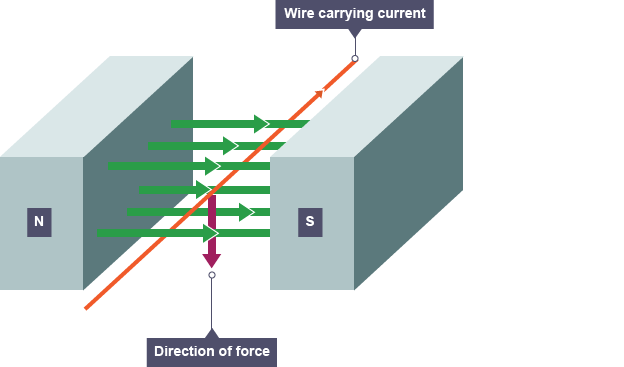
78.

Why might a current-carrying wire be placed between a magnetic field?

a)

To increase the current from the interaction of magnetic fields

b)

To increase the voltage from the interaction of magnetic fields

c)

To produce a force from the interaction of magnetic fields

79.

What does the thumb indicate in flemings left hand rule?

a)

Force

b)

Motion

c)

Current

d)

Magnetic field direction

80.

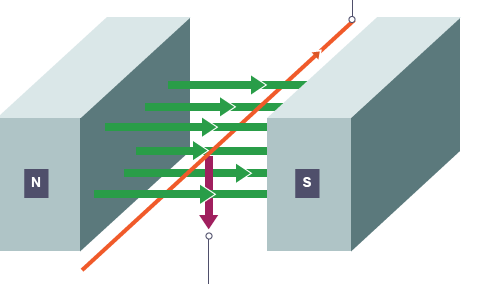
What direction is the force/motion in the following diagram?

a)

Perpendicular to the magnets

b)

Downwards

c)

Parallel and through the magnets

81.

What angle must there be between a magnetic field and a conductor in order for the maximum force to be exerted?

a)

180

b)

45

c)

90

d)

270

82.

Name one factor that does not affect the size of a force in on a current-carrying conductor placed in a magnetic field?

a)

Gravity

b)

Magnetic flux density/size of magnetic field

c)

Size of the current

d)

Length of the conductor

83.

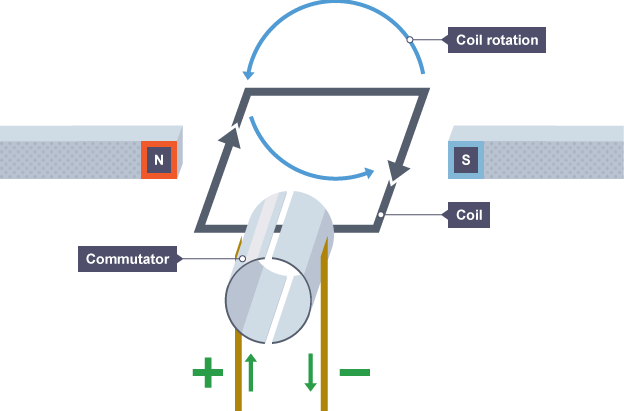
Name the effect that causes a coil of current-carrying wire in an electric motor to move.

a)

The electromagnetism effect

b)

The magnetic effect

c)

The motor effect

84.

Which rule can be used to work out which way a coil of wire rotates in a motor?

a)

Fleming's left-hand rule

b)

Fleming's right-hand rule

85.

Give two ways you can reverse the direction of a basic dc motor?

a)

Reverse the current

b)

Keep the current the same

c)

Reverse the magnetic field

d)

Keep the magnetic field the same

86.

How does a split ring commutator work?

a)

Swaps the contact evert full turn, so that the left-hand and right-hand arms of the coil always experience a force in the same direction.

b)

Swaps the contact evert half turn, so that the left-hand and right-hand arms of the coil do not experience a force in the same direction.

c)

Swaps the contact evert half turn, so that the left-hand and right-hand arms of the coil always experience a force in the same direction.