wayground logo

Free Printable Worksheets

Font size

S
M
L
XL
Worksheets

IPC Spring Review 2019

Total questions: 85

Worksheet time: 3hrs 47mins

Name
Class
Date
1.
Velocity is both ____ and _____. 
a)
speed , direction 
b)
direction, mass
c)
volume, density 
d)
direction, magnitude 
2.
Acceleration is a change in ________. 
a)
direction 
b)
speed 
c)
velocity 
d)
distance 
3.
You are walking in a straight line at a consistent speed. Do you have acceleration? 
a)
no
b)
yes 
4.
As you walk you make a right turn. Do you have acceleration? 
a)
yes 
b)
no
5.
What is the acceleration of a 50 kg object pushed with a force of 500 newtons? To solve this problem you must do - 
a)
500 ÷ 50
b)
50 ÷ 500
c)
500 x 50
6.
What is the acceleration of a 50 kg object pushed with a force of 500 newtons? The answer to this question is most likely (HINT: Look at the units!!!) - 
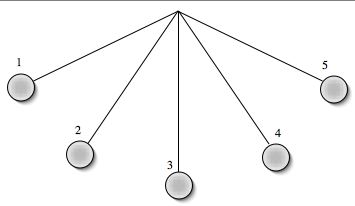
a)
10 N
b)
10 m/s2
c)
10 kg
7.
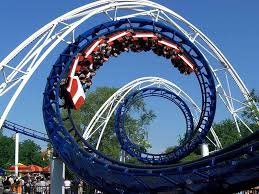
A roller coasters accelerates from an initial velocity of of 6.0 m/s to a final velocity of 70 m/s over 4 seconds.  What's the acceleration?
a)
24 m/s2
b)
18 m/s2
c)
16 m/s2
d)
16 m/s
8.
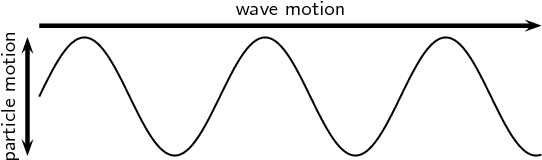
What kind of wave is pictured below?
a)
compressional wave
b)
transverse wave
c)
sound wave
d)
mechanical wave
9.
Waves are a transfer of what?
a)
Heat
b)
Light
c)
Energy
d)
Food
10.
The type of waves that require medium to pass:
a)
Mechanical Waves
b)
Electromagnetic Waves
11.

How do electromagnetic and mechanical waves compare?

a)

Mechanical waves can only travel through a vacuum, but electromagnetic waves can travel through a solid, liquid, or gas.

b)

Mechanical waves can travel through a solid, liquid, or gas, but electromagnetic waves can only travel through a gas.

c)

Mechanical waves can only travel through a solid, liquid, or gas, but electromagnetic waves can travel through a vacuum.

d)

Mechanical waves can travel through a solid, liquid, or gas, but electromagnetic waves can only travel through a solid.

12.

A sound wave is an example of what type of wave?

a)

electromagnetic wave

b)

mechanical wave

13.
How long did it take this object to travel 10 m?
a)
0 s
b)
10 s
c)
15 s
d)
20 s
14.
At 60 seconds, how far had this object traveled? 
a)
0 m
b)
10 m
c)
20 m
d)
40 m
15.
Warming hand over a radiator.
a)
Conduction
b)
Convection
c)
Radiation
16.
Snowman melting in the sun.
a)
Conduction
b)
Convection
c)
Radiation
17.
Warmth from the fireplace circulating through the house.
a)
Conduction
b)
Convection
c)
Radiation
18.
The kind of heat transfer that travels through space in electromagnetic waves is ______________________.
a)
insulation.
b)
Radiation
c)
Conduction
d)
Convection
19.
___________________ is the type of heat transfer that occurs in fluids, such as warm air rising and cold air sinking; creating wind.
a)
Convection
b)
Conduction
c)
Radiation
d)
insulation.
20.
Two objects at different temperatures are in contact. Which of the following happens to their thermal energy?
a)
Their thermal energies remain the same.
b)
Thermal energy passes from the cooler object to the warmer object
c)
Thermal energy passes from the warmer object to the cooler object.
d)
Thermal energy passes back and forth equally between the two objects.
21.
The handle of a metal spoon warms up when it is placed in a hot bowl of soup because of
a)
Convection
b)
Conduction
c)
Radiation
d)
insulation.
22.

Which best describes the process of convection?

a)

Convection is the primary way heat travels through rays.

b)

Convection is the primary way heat travels through solids and liquids.

c)

Convection is the primary way heat travels through appliances.

d)

Convection is the primary way heat travels through liquids and gasses only.

23.
__________ is stored energy. 
a)
Potential
b)
Kinetic
c)
None of the above 
d)
All of the above 
24.
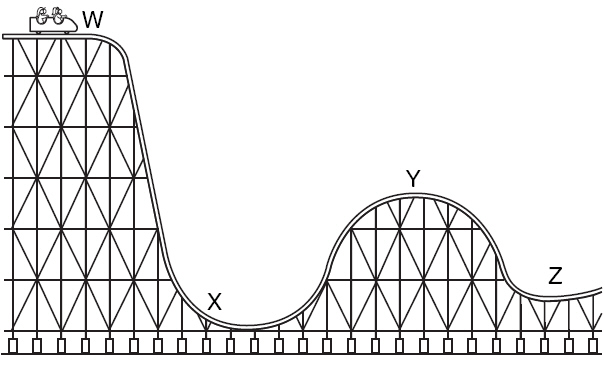
At which point is potential energy greatest?
a)
W
b)
X
c)
Y
d)
Z
25.
Gravitational potential energy depends on the ________ and ________ of the object. 
a)
Height and mass
b)
Friction and movement
c)
Mass and Movement
d)
Height and Friction 
26.
What is happening at A?
a)
Stationary
b)
Accelerating
c)
Slower steady speed; moving away from the starting position
d)
Steady speed; returning to start position
27.
Which runner won the race?
a)
A
b)
B
c)
C
28.

How far will an object move in 12 seconds if it is traveling at a velocity of 8 m/s? Remember s = d/t

a)

96 m

b)

0.7 m

c)

20 m

d)

4 m

29.
When one energy form is changed into another it is called a
a)
transformation
b)
transfer
c)
translocation
d)
transcription
30.

At which point is potential energy greatest?

a)

W

b)

X

c)

Y

d)

Z

31.

At which point is the kinetic energy the greatest?

a)

W

b)

X

c)

Y

d)

Z

32.

What position has the least amount of potential energy?

a)

W

b)

X

c)

Y

d)

Z

33.

Energy in motion is _______.

a)

potential

b)

kinetic

c)

force

34.
A battery converts what type of energy to another?
a)
sound to kinetic
b)
light to heat
c)
mechanical to electrical
d)
chemical to electrical
35.

What is magnetic force?

a)

A force exerted by electrically charged particles

b)

A force exerted by magnets that can be felt by objects near a magnet

c)

A force exerted by magnets that makes an object become electrically charged

d)

A force exerted by a magnet only when it physically touches an object

36.

Particles with opposite charges ____________ and particles with same (or like) charges ____________.

a)

attract, repel

b)

repel, repel

c)

attract, attract

d)

repel, attract

37.

________________ are the attractive and repulsive forces between two poles.

a)

Magnetic forces

b)

Electric forces

c)

Magnetic charges

d)

Electric charges

38.
The momentum of an object depends upon the object's ___________&_____________.  
a)
size and shape
b)
mass and speed
c)
mass and veloctiy
d)
mass and energy
39.
The equation to calculate momentum is
a)
p=mv
b)
p=1/2mv2
c)
p=mgh
d)
p=mg
40.
Which has more momentum: a car stopped at a red light or a bike moving at 15 mph?
a)
car
b)
bike
c)
they are equal
d)
cannot determine using the info provided
41.
Which of the following has the greatest momentum? 
a)
a scurrying cockroach
b)
a parked semi-truck
c)
more information is needed
42.

Which object listed below has the greatest momentum? Hint: Use the equation : p = mv

a)

A 0.05 kg object rolling at 0.2 m/s.

b)

A 0.15 kg object rolling at 2 m/s.

c)

A 0.15 kg object rolling at 1 m/s

d)

A 0.4 kg object rolling at 2 m/s.

43.

What is the unit of Electrical Power?

a)

Joule

b)

Watt

c)

Where

d)

Amp

44.
Electrical power can be calculated using
a)
Resistance x Voltage
b)
Voltage x Current 
c)
Voltage ÷ Current
45.
The voltage supplied to a circuit is 17 V and the current running through is 10 A. What is the power generated?
a)
170 W
b)
170 A
c)
1.7 V
d)
1.7 W
46.
What will be the current drawn by an electric bulb of 1000 W when it is connected to a source of 220 V?
Remember: I = P/V
a)
4.55 A
b)
28800 J or 28.8 KJ
c)
80 W
d)
200 W
47.
A person not paying attention while skateboarding hits a rock. The skateboard stops...they don't.
a)
The Law of Inertia (1st law)
b)
The Law of Acceleration (2nd law)
c)
The Law of Conservation of Momentum
d)
Action Reaction Law (3rd law)
48.
What is Newton's First Law
a)
F=ma
b)
Every action has an equal and opposite reaction
c)
An object at rest stays at rest, an object in motion stays in motion. 
d)
Friction 
49.
A person is pushed forward into their seatbelt when a car stops
a)
1st
b)
 2nd
c)
2 and 3
d)
3rd 
50.
Newton's third law states that any action will have a(n) _______ and ______ reaction
a)
Equal and similar
b)
Equal and opposite
c)
Equal and different
d)
Greater and opposite
51.
You hit a wall with a stick.  The equal but opposite reaction is _____
a)
the wall pushes against you
b)
the stick pushes against you
c)
you push against the stick
d)
the wall pushes against the stick
52.
How often a wave occurs is the wave's __________________
a)
crest
b)
frequency
c)
wavelength
d)
resting point
53.
The distance between 2 corresponding parts of a wave  (example- crest to crest) is its _____________________
a)
trough
b)
frequency
c)
amplitude
d)
wavelength
54.
What is the speed of a wave that has a wavelength of 2 and a frequency of 2.5?
a)
2.5 m/s
b)
5 m/s
c)
4.5 m/s
d)
6 m/s
55.

As the water in a cup is heated and changes temperature, what else changes?

a)

the kinetic energy of the molecules

b)

the potential energy of the molecules

c)

the charge of the cup

d)

the mass of each water molecule.

56.
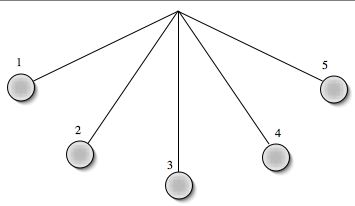
When a pendulum swings, at which point is potential energy at its greatest?
a)
1
b)
2
c)
3
d)
4
57.
When a pendulum swings, at which point is kinetic energy highest?
a)
1
b)
2
c)
3
d)
4
58.

What happens to kinetic energy and gravitational potential energy to a ball in free fall?

a)

Kinetic energy and gravitational potential energy both increase.

b)

Kinetic energy and gravitational potential energy both decrease.

c)

Kinetic energy increases and gravitational potential energy decreases.

59.

as the mass of an object increases, the pull of gravity...

a)

Increases

b)

Decreases

c)

Stays the same

60.

Why do we have a stronger gravitational attraction with Earth than the Sun?

a)

the sun has a larger mass

b)

the Earth has a larger mass

c)

we are closer to center of sun

d)

we are closer to center of Earth

61.
What does the strength of gravity between two objects depend upon?
a)
Mass & distance
b)
Mass & weight
c)
Gravity & inertia
d)
Inertia & mass
62.

Which of the diagrams shows the least gravitational force?

a)

I

b)

II

c)

III

d)

IV

63.

Which of the diagrams shows the greatest gravitational force?

a)

I

b)

II

c)

III

d)

IV

64.

When an astronaut is on a spacewalk and is moving away from the space shuttle, how is the force of gravity between the two objects affected?

a)

it increases

b)

it decreases

c)

it increases for the astronaut and decreases for the space shuttle

d)

it decreases for the astronaut and increases for the space shuttle

65.

Which of the following is true about gravitational forces?

a)

Gravitational forces are larger between objects that have small masses.

b)

Gravitational forces are smaller between objects that have large masses.

c)

Gravitational forces decrease as the distance between two objects decreases.

d)

Gravitational forces increase as the distance between two objects decreases.

66.
What will happen when these magnets are brought close together?
a)
They will attract each other.
b)
They will repel each other.
c)
Both magnets will turn to the left
d)
Both magnets will turn to the right
67.
The closer the charges, the ___________ the force between them
a)
closer
b)
further
c)
stronger
d)
weaker
68.

What property affects both magnetic and electrical forces between two objects?

a)

Distance between objects

b)

Total mass of the objects

c)

Charge of each of the objects

d)

The chemical composition of the objects

69.

Two factors that determine work are

a)

force

b)

acceleration

c)

mass

d)

distance

e)

velocity

70.

units of force are

a)

newtons

b)

grams

c)

joules

d)

meters

71.

units for work are

a)

newtons

b)

joules

c)

meters

d)

seconds

72.

if you push a cart with a force of 60 N for 2 m... how much work have you done

a)

120 J

b)

30 J

c)

120 N

d)

30 N

73.
What is the formula for work?
a)
Force = work x distance
b)
Distance = force x work
c)
Work = force x distance
d)
Work = force x mass
74.
Velocity is both ____ and _____. 
a)
speed , direction 
b)
direction, mass
c)
volume, density 
d)
direction, magnitude 
75.
You are walking in a straight line at a consistent speed. Do you have acceleration? 
a)
no
b)
yes 
76.
As you walk you make a right turn. Do you have acceleration? 
a)
yes 
b)
no
77.
You are walking and start to slow down. Do you have acceleration? 
a)
yes
b)
no 
78.
A negative acceleration means that your object is _____. 
a)
Going to Wal-mart 
b)
running for president 
c)
speeding up 
d)
slowing down 
79.

Why does a car accelerate as it takes a curve at a constant speed?

a)

Its direction changes

b)

It doesn't

c)

It slows down

d)

Its speeds up

80.

Which of these is NOT acceleration?

a)

Taking a curve at a constant speed.

b)

Slowing down.

c)

Starting from rest

d)

Moving at a constant speed in one direction

81.

Some animals use sound bouncing off objects to navigate and hunt.

a)

frequency

b)

ecolocation

c)

vibration

82.

Name the energy conversion: Lighting a campfire with a match

a)

Chemical to thermal

b)

Gravitational potential to kinetic

c)

Kinetic to potential

d)

Chemical to mechanical

83.

Name the energy conversion: A skier skis down a slope

a)

Chemical to thermal

b)

Potential to kinetic

c)

Kinetic to potential

d)

Chemical to mechanical

84.

Name the energy conversion: A roller coaster slows down as it climbs a hill

a)

Chemical to thermal

b)

Potential to kinetic

c)

Kinetic to potential

d)

Chemical to mechanical

85.

Name the energy conversion: A ball rolls from top to the bottom of an inclined ramp

a)

Chemical to thermal

b)

Potential to kinetic

c)

Kinetic to potential

d)

Chemical to mechanical