
 Worksheets
Nursing Practice Quiz
Total questions: 73
Worksheet time: 37mins
What is the purpose of integrating previous and newly gained knowledge into nursing practice?
To enhance patient comfort
To drive the development of clinical judgment
To reduce paperwork
To improve hospital infrastructure
What should be identified to understand the nursing process?
The steps of the nursing process
The types of medications
The hospital layout
The patient diet plan
What is the purpose of using nursing diagnosis in practice?
To determine hospital budgets
To improve patient diagnosis accuracy
To enhance staff communication
To streamline administrative tasks
What should be discussed to understand priority setting in nursing?
Criteria used in priority setting
Types of medical equipment
Hospital cleaning schedules
Patient meal preferences
What is important to list when writing a goal statement in nursing?
Guidelines for writing a goal statement
Patient's favorite activities
Hospital visiting hours
Types of hospital rooms
Which of the following is a concept related to Clinical Judgment?
Cognitive Load
Competency
Critical Thinking
Situational Awareness
What does Clinical Reasoning encompass?
Situational Awareness
Cognitive Load
Competency
Critical Thinking
Which term is associated with understanding and processing information in a clinical setting?
Clinical Judgment
Cognitive Load
Competency
Critical Thinking
What does critical thinking involve?
The ability to memorize facts
The ability to think, analyze, synthesize, reason, consider options, and problem solve
The ability to follow instructions without question
The ability to work independently without collaboration
Which skills are essential for critical thinking?
Creativity, intuition, logic, and analytic skills
Memorization, repetition, and obedience
Speed, efficiency, and multitasking
Physical strength and endurance
What does critical thinking involve in a clinical setting?
Clinical reasoning, decision making, and clinical judgement
Following orders without question
Memorizing medical terms
Performing tasks quickly
How can critical thinking be applied according to the text?
Through observation, experience, reflection, reasoning, or communication
By memorizing information
By ignoring feedback
By working alone
Diagram showing the cycle of critical thinking: Analyze, Synthesize, Reason, Consider your options, Problem Solve
Analyze, Synthesize, Reason, Consider your options, Problem Solve
Analyze, Consider your options, Reason, Synthesize, Problem Solve
Synthesize, Analyze, Problem Solve, Consider your options, Reason
Reason, Analyze, Synthesize, Problem Solve, Consider your options
What is the primary purpose of clinical reasoning in nursing?
To memorize medical terms
To gather information and arrive at a conclusion
To perform surgical procedures
To administer medication
Which type of clinical reasoning involves backward reasoning to apply accepted knowledge?
Inductive Reasoning
Deductive Reasoning
Intuitive Reasoning
Analytical Reasoning
What does inductive reasoning in clinical reasoning require?
Memorization of facts
Observations and drawing a conclusion
Following strict protocols
Ignoring patient history
Clinical reasoning is grounded in which of the following?
Random guesses
Specific knowledge, skills, and experiences
Personal opinions
General assumptions
What is the result or observed outcome of critical thinking and decision making?
Clinical judgment
Nursing process
Hypothesis generation
Reflective practice
According to AACN (2021), what skill is involved in clinical judgment?
Recognizing cues, generating hypotheses, taking action, and evaluating outcomes
Memorizing facts, following protocols, and documenting procedures
Delegating tasks, managing resources, and supervising staff
Conducting research, analyzing data, and publishing findings
What does clinical judgment mirror according to the document?
The Nursing Process
The Scientific Method
The Diagnostic Procedure
The Educational Framework
What is a key aspect of situational awareness?
Ignoring subtle cues in assessment findings
Recognizing the implications of assessments
Avoiding changes in protocol
Disregarding patient deterioration
When should a team be notified to implement a protocol in situational awareness?
When there are no changes in assessment findings
When a patient is stable
When it relates to the current situation
When there are no red flags
What does situational awareness involve regarding patient condition?
Ignoring patient deterioration
Knowing when a patient is deteriorating
Assuming all patients are stable
Overlooking assessment findings
Which of the following is a protocol used to facilitate situational awareness in healthcare?
Glasgow Coma Scale
Morse Fall Scale
Apgar Score
Barthel Index
What does MEWS stand for in the context of early warning systems in healthcare?
Modified Early Warning System
Medical Emergency Warning System
Medical Evaluation Warning System
Modified Emergency Warning System
What is one of the indicators that the EHR will flag as abnormal, requiring attention?
Change in diet
Change in vital signs
Change in medication
Change in room temperature
Which of the following is a question you should ask yourself to make clinical judgments in nursing?
What did you eat?
What did you observe?
What time is it?
What is your favorite color?
What is the first step in Scientific Problem Solving according to the nursing process?
Hypothesis testing
Collect the data
Plan of action
Evaluation & conclusion
Which type of thinking is described as fast, automatic, and emotional?
Rational Thinking
Logical Thinking
Intuitive Thinking
Analytical Thinking
What does the Trial and Error method involve in problem-solving for nurses?
Testing a number of solutions until you find what works
Following a strict protocol without deviation
Using only scientific methods
Avoiding any form of experimentation
What does it mean when the nursing process is described as "systematic"?
It involves random activities.
It is part of an ordered sequence of activities.
It is unpredictable.
It is based on intuition.
Which characteristic of the nursing process emphasizes the importance of human interaction?
Systematic
Dynamic
Interpersonal
Outcome oriented
What does "outcome oriented" mean in the context of the nursing process?
Nurses work alone to achieve goals.
Nurses and patients work together to identify outcomes.
Outcomes are predetermined by doctors.
Outcomes are not important.
What is meant by the nursing process being "universally applicable"?
It is only applicable in hospitals.
It is a framework for all nursing activities.
It is only used in emergency situations.
It is specific to certain diseases.
What does the acronym ADPIE stand for in the Nursing Process?
Assessment, Diagnosis, Planning, Implementation, Evaluation
Analysis, Design, Planning, Implementation, Execution
Assessment, Design, Planning, Implementation, Evaluation
Analysis, Diagnosis, Planning, Implementation, Execution
Which phase of the Nursing Process involves detecting and noting cues such as signs, symptoms, and risks?
Planning
Assessment
Implementation
Evaluation
In the Nursing Process, which phase includes analyzing, synthesizing, and interpreting data?
Evaluation
Implementation
Diagnosis
Planning
What is one of the purposes of a formal care plan in nursing?
To increase patient medication dosage
To individualize care that maximizes outcome achievement
To reduce the number of nursing staff
To eliminate patient records
How does a formal care plan help in communication?
It facilitates communication among nursing personnel and colleagues
It restricts communication to only doctors
It eliminates the need for communication
It only allows communication through written reports
Which of the following is a benefit of promoting continuity of care?
It increases the cost of care
It promotes high-quality, cost-effective care
It reduces patient satisfaction
It complicates the care process
What role does a formal care plan play in evaluating patient response?
It ignores patient feedback
It evaluates patient response to nursing care
It only focuses on financial aspects
It delays patient evaluation
Why is creating a record important in a formal care plan?
It is used for evaluation, research, reimbursement, and legal reasons
It is only for decoration
It is to confuse the nursing staff
It is to increase paperwork
How does a formal care plan contribute to a nurse's professional development?
It limits learning opportunities
It promotes nurse’s professional development
It discourages further education
It focuses only on administrative tasks
What is the primary source of information in the assessing process?
The patient's family
The patient's medical records
The patient
The healthcare team
Which of the following is NOT part of the assessing process?
Preparing for data collection
Diagnosing
Collecting data
Validating data
What is the foundation of the entire nursing process?
Initial and ongoing assessment of the patient
Final evaluation of the patient
Medication administration
Patient discharge planning
Which of the following is a key component of assessing nursing and medical concerns?
Randomly checking patient records
Systematically and comprehensively assessing
Ignoring patient history
Focusing only on physical symptoms
What is important for determining the credibility of information sources in nursing?
Detecting bias
Assuming all sources are credible
Using outdated information
Relying solely on patient statements
What does distinguishing normal from abnormal findings help identify?
The best treatment plan
The risks for abnormal findings
The patient's family history
The patient's dietary preferences
What is involved in making judgments about the significance of data?
Ignoring irrelevant data
Distinguishing relevant from irrelevant data
Collecting as much data as possible
Focusing only on numerical data
What is crucial for identifying assumptions and inconsistencies in nursing?
Checking accuracy and reliability
Assuming all data is correct
Ignoring missing information
Focusing only on positive outcomes
What is the first step in promoting sound clinical reasoning and judgment in nursing assessments?
Prioritizing data collection
Gathering as much data as possible
Identifying the purpose of the assessment
Developing a care plan
Why is it important to prioritize information in nursing assessments?
To collect more data
To address the most important information first
To develop a care plan
To understand patient history
What does a complete nursing assessment involve?
Identifying only the most obvious symptoms
Collecting data without a specific purpose
Identifying all patient data needed to understand a health problem
Focusing only on the patient's current condition
In the context of nursing assessments, why is knowing that a patient has lost weight not fully meaningful?
It is a common occurrence
It requires understanding if the weight loss was intentional or unintentional
It is not related to health problems
It does not affect the care plan
What is included in a comprehensive health assessment?
Patient's current health problems, past history, family history, review of body systems, and health patterns
Only the patient's current health problems
Only the patient's family history
Only the patient's past history
When is an initial assessment typically completed?
Before the patient is admitted
Shortly after the patient is admitted
During the patient's discharge
Only in emergency situations
What is the purpose of a focused assessment?
To identify life-threatening problems
To gain the most important information first
To identify new or overlooked problems
To compare current status to baseline data
What type of assessment is done to identify life-threatening problems?
Comprehensive health assessment
Initial assessment
Emergency assessment
Time-lapsed assessment
What is the purpose of a time-lapsed assessment?
To establish a complete database for problem identification
To compare a patient's current status to baseline data obtained earlier
To gain the most important information first
To identify new or overlooked problems
What is an example of objective data?
Pain experience
Feeling dizzy
Elevated temperature
Feeling anxious
Which of the following is considered subjective data?
Skin moisture
Vomiting
Feeling anxious
Elevated temperature
What does the "O" in OLD CART & ICE stand for?
Onset
Outcome
Observation
Objective
In the OLD CART & ICE framework, what does "C" represent in the second part?
Characteristics
Coping Strategies
Causes
Conditions
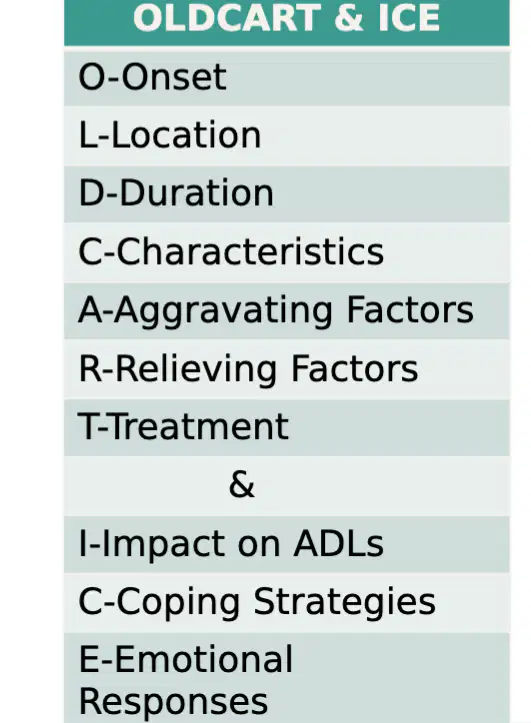
Table showing OLD CART & ICE framework with categories like Onset, Location, Duration, etc.
A table with categories like Onset, Location, Duration, etc.
A chart with categories like Onset, Location, Duration, etc.
A diagram with categories like Onset, Location, Duration, etc.
A graph with categories like Onset, Location, Duration, etc.
Which of the following is a source of data for patient assessment?
Weather reports
Patient record
Stock market analysis
Travel itinerary
What type of reports are considered a source of data in patient assessment?
Reports of laboratory and other diagnostic studies
Reports of travel expenses
Reports of social media activity
Reports of movie reviews
Who among the following can provide significant data for patient assessment?
Family and significant others
Sports commentators
Fashion designers
Travel agents
What language do nurses use to describe the early analysis of data?
Signs and symptoms
Cues and inferences
Diagnoses and treatments
Observations and conclusions
What is a cue in the context of nursing assessment?
A final diagnosis
A judgment about a patient's condition
An indication that something may be wrong
A treatment plan
What is an inference in the context of nursing assessment?
A direct observation
A judgment about a cue
A patient's symptom
A medical test result
What is the primary purpose of validating assessment data?
To increase data complexity
To confirm or verify data
To introduce bias in data
To misinterpret data
Which of the following is NOT a step in the process of validating assessment data?
Identify cues
Make inferences about the cues
Validate cues and inferences
Ignore the cues

