
 Worksheets
PHYSICS | Topic 4 Review #2
Total questions: 113
Worksheet time: 2hrs 51mins
According to the kinetic molecular theory, gas particles are in constant ________.
solid
liquid
motion
rest
What is the relationship between temperature and kinetic energy according to the kinetic molecular theory?
According to the kinetic molecular theory, temperature is directly proportional to the average kinetic energy of the particles in a substance.
Temperature is inversely proportional to the average kinetic energy of the particles in a substance.
There is no relationship between temperature and kinetic energy according to the kinetic molecular theory.
Temperature and kinetic energy have an exponential relationship according to the kinetic molecular theory.
When the volume of a gas decreases, what happens to its pressure according to the kinetic molecular theory?
Pressure becomes solid
Pressure increases
Pressure remains the same
Pressure decreases
According to the kinetic molecular theory, what happens to the pressure of a gas when its temperature increases?
The pressure of a gas becomes solid when its temperature increases.
The pressure of a gas decreases when its temperature increases.
The pressure of a gas increases when its temperature increases.
The pressure of a gas remains the same when its temperature increases.
What is the average kinetic energy of gas particles directly proportional to according to the kinetic molecular theory?
volume
temperature
mass
pressure
According to the kinetic molecular theory, what happens to the speed of gas particles when the temperature increases?
The speed of gas particles increases.
The speed of gas particles becomes zero.
The speed of gas particles remains the same.
The speed of gas particles decreases.
According to the kinetic molecular theory, gas particles are in constant ________.
solid
liquid
motion
rest
What is the relationship between temperature and kinetic energy according to the kinetic molecular theory?
According to the kinetic molecular theory, temperature is directly proportional to the average kinetic energy of the particles in a substance.
Temperature is inversely proportional to the average kinetic energy of the particles in a substance.
There is no relationship between temperature and kinetic energy according to the kinetic molecular theory.
Temperature and kinetic energy have an exponential relationship according to the kinetic molecular theory.
When the volume of a gas decreases, what happens to its pressure according to the kinetic molecular theory?
Pressure becomes solid
Pressure increases
Pressure remains the same
Pressure decreases
According to the kinetic molecular theory, what happens to the pressure of a gas when its temperature increases?
The pressure of a gas becomes solid when its temperature increases.
The pressure of a gas decreases when its temperature increases.
The pressure of a gas increases when its temperature increases.
The pressure of a gas remains the same when its temperature increases.
What is the average kinetic energy of gas particles directly proportional to according to the kinetic molecular theory?
volume
temperature
mass
pressure
According to the kinetic molecular theory, what happens to the speed of gas particles when the temperature increases?
The speed of gas particles increases.
The speed of gas particles becomes zero.
The speed of gas particles remains the same.
The speed of gas particles decreases.
What is the relationship between the volume of a gas and its pressure according to the kinetic molecular theory?
According to the kinetic molecular theory, the relationship between the volume of a gas and its pressure is random, meaning that there is no specific pattern between the two.
According to the kinetic molecular theory, the relationship between the volume of a gas and its pressure is directly proportional, meaning that as the volume decreases, the pressure decreases, and vice versa.
According to the kinetic molecular theory, the relationship between the volume of a gas and its pressure is inversely proportional, meaning that as the volume decreases, the pressure increases, and vice versa.
According to the kinetic molecular theory, the relationship between the volume of a gas and its pressure is not related, as they are independent of each other.
What is the effect of increasing the number of gas particles on the pressure of a gas according to the kinetic molecular theory?
Pressure of the gas remains the same
Pressure of the gas decreases
Pressure of the gas becomes solid
Pressure of the gas increases
What is the effect of increasing the number of gas particles on the pressure of a gas according to the kinetic molecular theory?
Pressure of the gas remains the same
Pressure of the gas decreases
Pressure of the gas becomes solid
Pressure of the gas increases
The ice cube melted.


Pressure is
defined as the mass that an object exerts when at rest.
not a measurable in gases.
defined as the number of moles of substance divided by the mass of the substance.
created by the force of the gas particles impacting the walls of the container.
Absolute zero is
0 K
where there is no molecular movement
the coldest temperature possible
all of these


Pressure is
defined as the mass that an object exerts when at rest.
not a measurable in gases.
defined as the number of moles of substance divided by the mass of the substance.
created by the force of the gas particles impacting the walls of the container.
Absolute zero is
0 K
where there is no molecular movement
the coldest temperature possible
all of these

During A to B what phase of matter is the substance?
Solid
Liquid
Gas
Plasma
From C to D, what phase of matter is the substance?
Solid
Liquid
Gas
Plasma
From D to E, a liquid is being changed to a gas. Is heat being added or taken away during this time?
Added
Taken away
From E to F, what phase of matter is the substance?
Solid
Liquid
Gas
Plasma

During which phase of matter are the particles the closest together?
Solid
Liquid
Gas
During which phase of matter do the particles have the most energy?
Solid
Liquid
Gas
During which phase of matter do the particles have the least energy?
Solid
Liquid
Gas

Where is melting occurring?
A
B
D
E
Where is vaporization occurring?
A
B
D
E

Is the substance gaining or losing energy? (Diagram D)
Gaining
Losing

A substance's heating curve is shown in the graph. What is its boiling point? (Diagram B)
100 C
60 C
80 C
20 C

Which line segment demonstrates vaporization/boiling occurring? (Diagram E)
B-C
C-D
D-E
E-F

Letter "C" represents which state of matter on the phase change diagram shown.
Solid
Liquid
Gas

Is energy being added or removed in the following phase change diagram?
energy is being added
energy is being removed
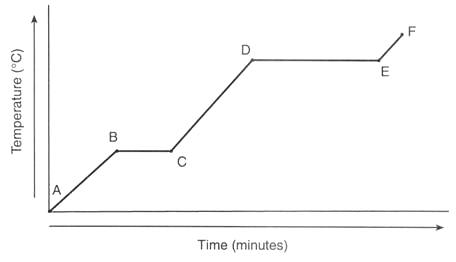
Between which points is the temperature of the substance remaining constant? (Diagram F)
A-B only.
A-B, C-D, E-F
B-C only.
B-C, D-E

Which letter represents particles in solid form?
A
B
C
D
E

Which letter represents where the freezing point is occurring?
A
B
C
D
E

What is happening at letter D? If you are LOSING energy
Evaporation of a liquid
Condensation of a gas
Boiling of a liquid
Melting of a solid
Between which points is the temperature range increase causing the molecules to FLOW over one another?
A-B only.
(solid)
E-F
(gas)
C-D only.
(liquid)
B-C, D-E
(phase changes)
The melting and freezing point of water is 0 ℃.
true
false
What happens to molecules when the temperature drops or lowers?
The molecules get closer together
The molecules start moving faster.
The molecules stop moving.
The molecules become smaller.

When enough energy is added to cause a gas to change into the plasma phase that process is called __________________
Recombination
Ionization
Vaporization
Deposition
When enough energy is lost to cause a plasma to change into the gas phase that process is called __________________
Recombination
Ionization
Vaporization
Deposition


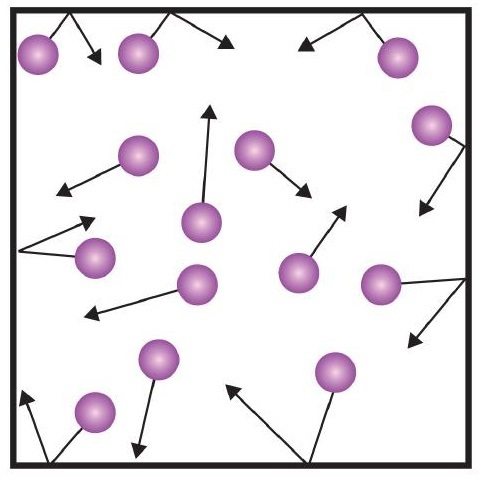
The image is most likely which phase of a substance?
Solid
Liquid
Gas
Plasma

