Wayground logo

Free Printable Worksheets

Font size

S
M
L
XL
Worksheets

untitled

Total questions: 42

Worksheet time: 33mins

Name
Class
Date
1.

If a mineral can SCRATCH another one, it is -

a)

harder than the mineral

b)

weaker than the mineral

c)

the same mineral

2.

Calcite can scratch -

a)

Apatite

b)

Fluorite

c)

Talc

3.

Diamond is the hardest mineral.

a)

True

b)

False

4.

What type of property test is a mineralogist conducting when she rubs a mineral over a mirror, tile, or hard surface?

a)

Streak Test

b)

Luster Test

c)

Appearance Test

d)

Cracking Test

5.
What are the 3 major types of rocks?
a)
Igneous, Metamorphic, Sedimentary
b)
Metamorphic, Igneous, Cementation
c)
Brown, Red, Gray
d)
Streak, Hardness, Breakage
6.

Rocks formed by heat and pressure beneath the Earth's surface are...

a)

igneous

b)

metamorphic

c)

sedimentary

d)

magma

7.

Two types of igneous rocks are:

a)

Interior and exterior

b)

Intrusive and extrusive

c)

Inside and outside

d)

Enter and exit

8.
A solid material that is made up of one or more minerals.
a)
mineral
b)
rock
c)
fossil
d)
soil
9.
Rock formed from materials that have settles into layers from weathering
a)
igneous rock
b)
sedimentary rock
c)
metamorphic rock
10.
An object that is solid, formed in nature, and has never been alive
a)
sand castle
b)
mineral
c)
plant
11.
What is the small broken down pieces of rock called?
a)
dirt
b)
grime
c)
sediment
d)
popcorn
12.
A shiny material is described as having a __________________ luster
a)
metallic
b)
nonmetallic
13.
What is the LEAST useful way to identify a mineral?
a)
luster
b)
streak
c)
color
d)
density
14.
When sediments are pressed together tightly, this is called ____________.
a)
Compaction
b)
Cementation
c)
Weathering
d)
Erosion
15.
The process by which metamorphic rocks are formed...
a)
heat and pressure
b)
erosion and deposition
c)
melting and cooling
16.
_______ rock forms from magma/lava
a)
Metamorphic
b)
Sedimentary
c)
Igneous
17.

What causes igneous rocks to form

a)

pressure

b)

cooling magma and lava

c)

compaction

d)

cementation

18.

A rock made of magma that cools inside the Earth and contains large crystals?

a)

Igneous

b)

Sedimentary

c)

Metamorphic

d)

Magma

19.

How can a Metamorphic rock become an Igneous rock?

a)

Weathering and Erosion

b)

Compaction and Cementation

c)

Heat and Pressurew

d)

Melting and cooling

20.
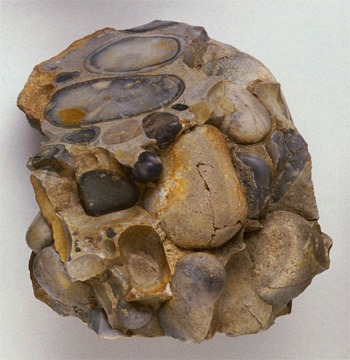
This rock was formed by smaller pieces of rock that settled at the bottom of a lake millions of years ago. What type of rock is this?
a)
Sedimentary
b)
Igneous
c)
Metamorphic
21.

Which of the following is a characteristic of all minerals?

a)

Crystalline structure

b)

Fills the shape of its container

c)

Usually organic

d)

Random chemical composition

22.

Which of the following is NOT a way to identify a mineral?

a)

Streak

b)

Denisty

c)

Luster

d)

Crumble

23.

What is fracture?

a)

Ability to reflect light

b)

A break in parallel planes

c)

Uneven break

24.

Igneous rocks are formed from geysers in the Earth's crust.

a)

True

b)

False

25.

Two types of igneous rocks are:

a)

Interior and exterior

b)

Intrusive and extrusive

c)

Inside and outside

d)

Enter and exit

26.

Lava is found...

a)

after a volcano erupts.

b)

on the inside of a volcano.

c)

both inside and outside a volcano.

27.

The process for sedimentary rocks DO NOT include:

a)

Cementation

b)

Cooling

c)

Deposition

d)

Erosion

28.

Which is a type of sedimentary rock:

a)

inorganic

b)

intrusive

c)

clastic

d)

mineral

29.

Fossils are a form of:

a)

mineral

b)

igneous rock

c)

sedimentary rock

30.
Means that a mineral cannot come from something that was once living.
a)
Inorganic
b)
Organic
c)
Naturally Occurring
d)
Not Living
31.
This is measured on  the Mohs Scale.
a)
Cleavage
b)
Density
c)
Hardness
d)
Luster
32.
The _________ of a mineral is a physical property that is easy to observe.
a)
Chemical Composition
b)
Color
c)
Hardness
d)
Streak
33.
_______ is found by rubbing the mineral against an unglazed tile called a plate.
a)
Cleavage
b)
Color
c)
Luster
d)
Streak
34.
This is how a mineral reflects light.
a)
Cleavage
b)
Density
c)
Hardness
d)
Luster
35.
_______ is a property that describes a mineral  that splits evenly along flat surfaces.
a)
Cleavage
b)
Fracture
c)
Inorganic
d)
Organic
36.
The three major rock groups are:
a)
Inorganic, Metamorphic, and  Sedimentary
b)
Inorganic, Metamorphosis, and Sediment
c)
Igneous, Metamorphic, and Sediment
d)
Igneous, Metamorphic, and Sedimentary
37.
This rock  is formed from molten rock (magma/lava) that has cooled.
a)
Igneous
b)
Inorganic
c)
Metamorphic
d)
Sedimentary
38.
This rock is formed by extreme heat and/or pressure that alters the chemical composition into a new form of rock.
a)
Inorganic
b)
Igneous
c)
Metamorphic
d)
Sedimentary
39.
This rock is formed by erosion (continuously broken down into small fragments) and  then is compressed and  cemented together.
a)
Inorganic
b)
Igneous
c)
Metamorphic
d)
Sedimentary
40.
When identifying minerals, _______ can be tested by scratching the surface with different materials such as your fingernail or a coin.
a)
Cleavage
b)
Density
c)
Hardness
d)
Streak
41.

Extrusive igneous rocks have ​ (a)   crystals because they form ​ (b)   .

Choose from the below words
small
quickly
slowly
large

42-51.

Answer the questions below after watching the video

42.

How long ago did the formation of rocks on Earth begin?

a)

5.5 billion years ago

b)

6.5 billion years ago

c)

3.5 billion years ago

d)

4.5 billion years ago

43.

What are the building blocks of all matter?

a)

Crystals

b)

Minerals

c)

Molecules

d)

Atoms

44.

What type of rock is formed when magma cools and solidifies?

a)

Sedimentary rock

b)

Limestone

c)

Metamorphic rock

d)

Igneous rock

45.

Which type of igneous rock is commonly found on Earth's continents?

a)

Marble

b)

Sandstone

c)

Granite

d)

Basalt

46.

What process breaks down rocks into small fragments over time?

a)

Crystallization

b)

Sedimentation

c)

Weathering

d)

Erosion

47.

What type of rock can form from the remains of marine organisms?

a)

Igneous rock

b)

Metamorphic rock

c)

Sedimentary rock

d)

Basalt

48.

What is the process called where the continents and oceanic crust move?

a)

Weathering

b)

Erosion

c)

Sedimentation

d)

Plate tectonics

49.

Which rock is an example of a metamorphic rock?

a)

Basalt

b)

Granite

c)

Slate

d)

Sandstone

50.

What helps geologists distinguish between different types of rocks?

a)

The color and arrangement of its minerals

b)

Both A and B

c)

The size and shape of the rock

d)

None of the above

51.

What can geologists read like the pages of a history book?

a)

Mineral structures

b)

Crystals

c)

Layers of rocks

d)

Fossils