
Font size
 Worksheets
SCIENCE - GRADE 6 - PART 3
Total questions: 96
Worksheet time: 48mins
The rain starts to fall frequently. Farmers begin to plant their crops. People prefer to wear thick clothes and eat warm foods. What season do these events indicate?
spring season
winter season
dry season
wet season
Which season is characterized by frequent rainfall?
dry season
wet season
fall season
. winter season
Which is characterized by infrequent rainfall and warm temperature?
wet season
fall season
dry season
winter season
Which are the causes of seasons being experienced by people on certain parts of the Earth?
the Earth’s rotation and shape
the Earth’s revolution and tilt on its axis
the Earth’s rotation and gravity
the continents and water bodies surrounding the place
This prevailing wind is warm and moist. It blows from the southwest portion of the country and brings moderate to heavy rains along the western section of the Philippines. What is it?
Trade winds
Hanging Amihan
Hanging Habagat
Northeast Monsoon
The prevailing wind that blows from the northeast portion of the country and causes slight to moderate rainfall in the eastern regions is called _________.
Trade winds
Hanging Amihan
Hanging Habagat
Northeast Monsoon
Which season takes place in the Philippines from December to May?
dry season
wet season
cold season
summer season
Which is also known as Hanging Amihan?
Eastwest Monsoon
Northeast Monsoon
Southwest Monsoon
Northsouth Monsoon
Which season in the Philippines is the best time for farmers to dry their crops?
dry season
wet season
spring season
autumn season
Which is influenced by the Northeast Monsoon?
wet season
dry season
winter season
summer season
The season in the Philippines that takes place during the months June to November and is characterized by frequent rainfall is called _________.
wet season
dry season
winter season
summer season
Which can be experienced during wet season?
warm temperature
hot cloudless days
shortage of water supply
heavy rainfall and frequent typhoons
Earth's axis is tilt.
29.5 degrees
24.5 degrees
23.5 degrees
26.4 degrees
Which brings warm and moist in the country that makes rains heavier and typhoons stronger?
Cold fronts
Trade winds
Northeast Monsoon
Southwest Monsoon
The Philippines experiences two seasons only because it is located near the _________.
equator
temperate region
tropic of cancer
tropic of capricorn
Frequent and heavy rainfall during wet season sometimes results to _________.
prevailing winds
water shortage
flood
seasons
When the North Pole tilts towards the sun, it is __________ season in most parts of the Northern Hemisphere.
winter
spring
summer
fall
When the North Pole tilts away from the sun, it is _____________season in most parts of the Northern Hemisphere.
winter
spring
summer
fall
TRUE OR FALSE
The seasons in the Northern Hemisphere are the opposite of those in the Southern Hemisphere.
True
False
TRUE OR FALSE
The Philippines has two seasons only, namely, wet season and dry season. The seasons in the country are caused by its location on the equator and prevailing winds.
True
False
TRUE OR FALSE
An axis is an imaginary line where the Earth spins. It is tilted 23.5 degrees and it extends from the North Pole to the South Pole.
True
False
Which of the following is the effect of the Earth’s tilt and revolution?
movement of wind
occurrence of tides
occurrence of seasons
movement of water in seas
Which of the following statements is true?
The Earth rotates on its axis once every 12 hours
The Earth rotates on its axis once every 24 hours.
The Earth rotates on its axis once every 365 hours.
The Earth rotates on its axis once every 365 days.
Which of these is the pathway of the Earth around the sun?
Axis
Orbit
Ring
Space
Which statement about the Earth is false?
The Earth spins on its axis.
The Earth revolves around the sun.
The sun revolves around the Earth.
The Earth travels on its orbit around the sun.
How many days would it take for the Earth to complete one revolution?
7 days
30 days
188 days
365 ¼ days
Which of these is the imaginary line where the Earth spins to complete one day?
Axis
Orbit
Poles
Latitude
Which of the following refers to the spinning movement of the Earth on its axis?
Tilting
Sliding
Rotation
Revolution
Which statement is true about the Earth’s movement?
Revolution causes day and night.
The Earth rotates in a counterclockwise direction.
Seasonal changes are effects of the Earth’s rotation.
Movement of water in the seas and oceans is an effect of the Earth’s revolution.
Which statement is false about the Earth’s orbit?
Earth’s orbit is slanted 23.5 degrees.
An orbit is a circular path around the sun.
An orbit is an imaginary route of the Earth around the sun.
As the Earth spins on its axis, it also travels around its orbit.
Which of the following occur due to the rotation of the Earth on its axis?
All parts of the Earth experience daytime
All parts of the Earth experience nighttime.
Part of the Earth facing the sun experience daytime while the part facing away experience nighttime.
Part of the Earth facing the sun experience nighttime while the part facing away experience daytime.
I look like your planet but I am small. What am I?
globe
moon
sun
pluto
The movement of the Earth on its axis is called _______________. It causes day and night.
Coriolis Effect
Rotation
Revolution
Attraction
The deflection of the air as a result of Earth’s rotation is called ____________.
Coriolis Effect
Rotation
Revolution
Attraction
A _____________ is a representation of our planet.
The green areas represent land, while the blue areas represent water.
Treasure Map
Cartographic Sketch
Solar System
Globe
What is the shape of the Earth?
round
oblique sphere
sphere
oblate spheroid
Typhoons in the Northern Hemispheres spin in ___________ direction.
clockwise
counter clockwise
vertically
horizontally
Typhoons in the Southern Hemispheres spin in ___________ direction.
clockwise
counter clockwise
vertically
horizontally
A belt of calm air and sea occurring in both the northern and southern hemispheres between the trade winds and the westerlies.
subpolar lows
horse latitudes
doldrums
trade winds
An equatorial region of the Atlantic Ocean with calms, sudden storms, and light unpredictable winds.
subpolar lows
horse latitudes
doldrums
trade winds
A wind blowing steadily towards the equator from the northeast in the northern hemisphere or the southeast in the southern hemisphere, especially at sea.
subpolar lows
horse latitudes
doldrums
trade winds
A region of low air pressure that occurs in the subpolar regions of the Earth.
subpolar lows
horse latitudes
doldrums
trade winds
The complete travel time of the Earth’s revolution.
lightyear
a season
day
year
Imaginary path that guides the Earth around the sun.
Axis
Imaginary straight line where the Earth spins
Axis
The spinning movement of the earth on its axis.
Axis
Rotation
Revolution
The journey of the Earth around the sun.
Axis
Rotation
Revolution
As the tilted Earth revolves around the __________, unequal distribution of light happens. This causes the change of season.
moon
sun
constellations
asteroid belt
Which of these is the effect of Earth’s revolution around the sun?
direction of the wind changes
direction of the typhoons changes
direction of the ocean current changes
positions of the constellations changes
Which of the following is the evidence that the Earth is revolving around the sun?
The climate condition remains the same.
Tides in the ocean and seas changes.
The position of clouds in the sky changes.
The position of constellations changes as seen from Earth.
How do you call the short climatic changes caused by the Earth’s revolution around the sun?
Coriolis
Monsoon
Season
Weather
Which of these statements is true?
Axis is the path of Earth around the sun.
Poles contribute to the unequal distribution of heat from the sun.
The Earth’s tilted orbit causes unequal distribution of heat from the sun.
The Earth’s tilted axis causes unequal distribution of heat from the sun.
Which of the following statements describe the outer planets?
They are large and made of rocks.
They are small and made of ice and gas.
They are large and made up mostly of gas.
They are solid and made up of rocks and metals.
Which of the following planets has the highest average surface temperature?
Mars
Venus
Jupiter
Mercury
How are Earth and Venus similar to each other?
Venus and Earth are Jovian planets.
Venus and Earth have almost the same size.
Venus and Earth have almost the same temperature.
Venus and Earth have the same distance from the Sun.
Which of the terrestrial planets is the biggest?
Mars
Earth
Venus
Mercury
Which of the following planets is farthest from the Sun?
Venus
Jupiter
Uranus
Neptune
Which among the four is the smallest?
Saturn
Jupiter
Uranus
Neptune
Which planet is the largest?
Mars
Earth
Jupiter
Uranus
Which of the following statements describes the inner planets?
They are small and made of ice and gas.
They are large and made up mostly of gas.
They are large and made of gases and metal.
They are solid and made up of rocks and metals.
Inner planets having solid surfaces.
These planets are small and mostly made up of rock and metal.
Gas giants
Jovian planets
Terrestrial planets
Heavenly bodies
Outer planets that are made up of hydrogen and helium and they have small rocky core.
Gas giants
Jovian planets
Terrestrial planets
Heavenly bodies
True or False
The terrestrial planets have common features such as mountains and volcanoes.
True
False
Separates inner planets from outer planets
Asteroid belt
Earth's orbit
Gas giants
Kuiper belt
The terrestrial or inner planets have solid surfaces. These planets are small and mostly made up of rock and metal. They have silicate mantle surrounding a metallic core composed mostly of ____.
silver
lithium
copper
iron
Which of these statements is true?
The Earth is orbited by planets and their moons, asteroids, comets and other heavenly bodies.
Of the four gas giants Neptune has the most prominent ring.
The ice giants have interior composition of compounds like water, methane and ammonia.
Mars has eight moons, Mercury and Venus has none.
The blue planet made up of methane.
Uranus
Jupiter
Neptune
Mercury
Which of the following are the inner planets of the solar system?
Mercury, Venus, Earth, Mars
Sun, Mercury, Jupiter, Saturn
Neptune, Uranus, Earth, Mars
Jupiter, Saturn, Uranus, Neptune
Which of the four planets has the hottest temperature?
Venus
Earth
Mars
Jupiter
Which of the following is the smallest planet in the solar system?
Earth
Jupiter
Neptune
Mercury
How does a solar system model help us?
They show which planet are rocky
They show how to go to other planets.
They show which planets are colorful.
They show the relative size and distance of the planets.
It is located at approximately 66.5 degrees north of the equator. It is the beginning area where the sun will not rise during winter solstice and will not set during summer solstice.
Arctic Circle
Antarctic Circle
Tropic of Cancer
Tropic of Capricorn
It is located at approximately 66.5 degrees south of the equator. No permanent residents are found within the boundaries of this latitude.
Arctic Circle
Antarctic Circle
Tropic of Cancer
Tropic of Capricorn
It is located at approximately 23.5 degrees south of the equator. This line marks the point farthest to the south at which the sun is hanging directly upward at noon.
Arctic Circle
Antarctic Circle
Tropic of Cancer
Tropic of Capricorn
It is located at approximately 23.5 degrees north of the equator. This line marks the point farthest to the north at which the sun is hanging directly upward at noon.
Arctic Circle
Antarctic Circle
Tropic of Cancer
Tropic of Capricorn
This line of 0 degrees latitude is the starting point when referring to other points towards North or South pole of the globe.
South Pole
North Pole
International Dateline
Equator
For the Northern Hemisphere, the position of the Earth where the North Pole is tilted most directly towards the Sun represents the ____________.
Summer Solstice
Winter Solstice
Autumnal Equinox
Spring Equinox
In the Northern Hemisphere, the position of the Earth representing ____________ is when the North Pole is tilted away from the Sun.
Summer Solstice
Winter Solstice
Autumnal Equinox
Spring Equinox
In the Northern Hemisphere, the position of the Earth that represents the ____________ is when the Earth's axis is tilted neither towards nor away from the Sun.
Summer Solstice
Winter Solstice
Autumnal Equinox
Spring Equinox
In the Northern Hemisphere, the position of the Earth representing the ___________________is typically where the Earth's axis is tilted neither towards nor away from the sun.
Summer Solstice
Winter Solstice
Autumnal Equinox
Spring Equinox
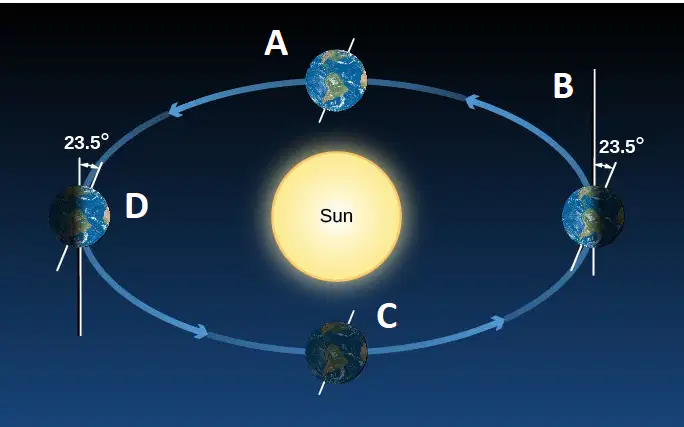
In the Northern Hemisphere, the position of the Earth representing the Summer Solstice is when the North is tilted most directly towards the Sun. which position represents Summer Solstice?
A
B
C
D
The longest day of the year occurs at what position?
Summer Solstice
Winter Solstice
Spring Equinox
Autumnal Equinox
In the Northern Hemisphere, the position of the Earth that represents Winter Solstice is when the North is tilted furthest away from the Sun. Which position represents Summer Solstice?
A
B
C
D
In the Northern Hemisphere, the position of the Earth that represents the Spring Equinox (or Vernal Equinox) is when the Earth's axis is tilted neither towards nor away from the Sun, (tilted right facing the sun on diagrams). Which position represents Spring Equinox?
A
B
C
D
In the Northern Hemisphere, the position of the Earth that represents the Autumnal Equinox is when the Earth's axis is tilted neither towards nor away from the Sun, (tilted left when facing the sun on diagrams). Which position represents Autumnal Equinox?
A
B
C
D
The equator divides the Earth into Northern and Southern ______________,
hemispheres
equinoxes
phases
seasons
On two days a year both hemispheres receive equal hours of day and night. These are called _________________.
hemispheres
equinoxes
phases
seasons
Is when the sun is at its greatest distance from the equator.
solstice
equinox
hemispheres
seasons
Which of the following BEST describe the tilt of the earth during the spring and fall equinoxes?
The earth is tilted toward the sun.
The earth is tilted away from the sun
The earth is not tilted during spring and fal
The earth is titled neither toward or away from the sun.
Which diagram shows the illumination of the earth in North Pole during the first day of summer?
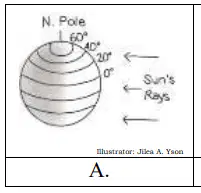


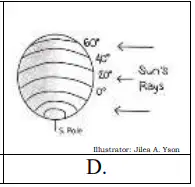
It is the reason that causes the length of daylight to change.
It depends on the shape of the planet.
It is based on how far the sun rays reach.
It is based on the tilt of the sun beside the planet.
It depends on the tilt of the earth as it moves around the sun.
A series of steps designed to help you solve problems and answer questions
experiment
hypothesis
observation
scientific method
What is the process of obtaining information using your senses?
inquiry
conclusion
observation
scientific method
What variable can be changed or manipulated?
dependent variable
experimental variable
independent variable
uncontrolled variable
What do you call an idea or explanation that you test through study and experimentation?
question
hypothesis
conclusion
observation
Which refers to scientific procedure undertaken by scientists to test a hypothesis and make a discovery or demonstrate a known fact?
theory
inference
conclusion
experiment

