
 Worksheets
6th Grade 2nd Trimester Exam Review
Total questions: 87
Worksheet time: 2hrs 39mins
Areas along coastlines, such as Florida, often do not experience winters as severe as areas inland, even though some of these coastal areas lie further north. Why do coastal areas tend to have milder winter weather patterns?
Cold ocean currents only flow east to west and cannot reach inland areas.
Warm ocean currents only flow east to west and cannot reach inland areas.
Cold ocean waters cool the air above them, the cool air flows over coastal areas, but cannot reach the areas inland.
Warm ocean waters heat the air above them, the warm air flows over coastal areas, but cannot reach areas inland.
Amy and Scott are preparing a presentation on the climate in Florida. Which of the following statements would BEST support the idea that Florida has a subtropical climate?
Florida had record high temperatures this past month.
Florida received 7 inches of rain this weekend.
Florida’s location near the equator makes it cooler than most of the United States.
Florida has a long pattern of experiencing hot, humid summers and mild to cool winters.
During the spring, Florida’s weather becomes rainy and warm. Florida’s spring rains are an example of which part of the water cycle?
Condensation
Evaporation
Precipitation
Runoff
The surface of the oceans is warmer than the deeper ocean waters. Which of these is a direct result of the uneven heating of water in the oceans due to solar energy?
Ocean currents
Icebergs in the ocean
Salt in the ocean
Ocean tides
Solar energy does not warm Earth’s surface evenly. For example, during the day, land areas warm up faster than nearby bodies of water. How does this uneven warming affect the movement of air over land and water?
The cooler, denser air above the water flows toward the warmer, less dense air above the land, causing a sea breeze.
The warmer, less dense air above the water flows toward the cooler, denser air above the land, causing a land breeze.
The cooler air over the water would absorb water vapor and rise, resulting in rainy conditions over the shoreline.
The warmer air over the land would transfer energy to the cooler air by conduction, leading to a uniform air temperature.
During a summer day on the beach, the sand and the air temperature feel warmer than the ocean water. At night, why would the ocean water be warmer than the air?
As a cool breeze blows off the water onto the land, the water warms up.
The heat from the air transfers to the water during the night, making the water warmer.
Air changes temperature faster than water, so the water is warmer and the air is much cooler than it was during the day.
Air stays warmer longer than water, so your body is warm when you jump into the water.
El Niño is a weather event that causes significant changes in weather worldwide. During an El Niño event, the polar jet stream shifts northward. Which change will an El Niño event most likely cause?
Colder temperatures in the southern United States
Drier than usual weather in the northern United States
Drier than usual weather in the southern United States
Warmer than usual temperatures in the northern United States
The temperature inside a classroom is measured to be 26°C. Which of the following temperatures could result from heat being transferred into the room?
30 °C
10 °C
5 °C
0 °C
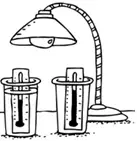
Jonathan performed an experiment using a heating lamp, a cup of water (A), an empty cup (B), and two thermometers. After 40 minutes, he observed the temperature inside each cup. Based on the illustration, what do you think Jonathan observed at the end of his experiment?
The temperature measured in Cup A is higher than Cup B.
The temperature measured in Cup A is lower than Cup B.
The temperatures in Cup A and Cup B are the same.
The temperatures in Cup A and Cup B did not change.
The transfer of energy as heat occurs all around us. When a warmer stream flows into a cooler lake, which of the following happens?
The stream water absorbs cold from the lake water.
The lake water transfers heat to the stream water.
The stream water transfers heat to the lake water.
The lake water absorbs cold from the stream water.
A large piece of a glacier broke off into the ocean. What is expected to happen to the ocean water? Which of the following heat transfers would you predict will occur?
Heat will flow from the water to the ice.
Heat will flow from the ice to the water.
Cold will flow from the water to the ice.
Cold will flow from the ice to the water.
Convection is one way in which energy is transferred in the form of heat throughout Earth’s atmosphere. Which statement below is the best example of energy transferred by convection?
Energy is transferred from lower levels of the atmosphere to higher levels of the atmosphere.
Energy is transferred from the surface of soil to the air molecules in contact with the soil.
Energy is transferred from the ocean in the trenches to the sand on beaches.
Energy is transferred from the Sun to Earth through space.
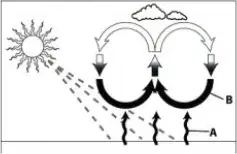
The diagram below shows how air near Earth's surface is warmed when it comes in contact with the warm surface of the Earth. Which mechanism shows the transfer of thermal energy from Earth's surface to the air as shown by the label A?
Convection
Conduction
Reflection
Diffraction
Plants play a vital role in the water cycle. Which part of the water cycle is most dependent on the action of plants?
Condensation
Evaporation
Runoff
Transpiration
Airplane flight paths often take advantage of the jet stream. What are jet streams?
Steady, warm breezes
Large air masses that flow over Earth's surface
Narrow bands of strong winds high in the atmosphere
Cold, moist air sinking in the atmosphere
Scientists use many types of models. Which model below would be most useful for predicting a hurricane’s track?
A map
A graph
A 3-D representation
A computer simulation
Desertification leads to desert-like conditions in the landscape. Which of the following human activities would best prevent desertification?
Build more roads
Plant more trees
Increase urban development
Use more water for agriculture
In some parts of the world, yearly flooding is expected. Floods also occur unexpectedly during severe weather and can cause great damage. What changes in the water cycle would most likely result in severe flooding?
decreased evaporation and decreased condensation
increased evaporation and increased condensation
decreased precipitation and decreased runoff
increased precipitation and increased runoff
When an area becomes very dry for a long period of time, it is said to be experiencing a drought. Which change in the water cycle is the most likely cause of a drought?
a decrease in the amount of precipitation
a decrease in the amount of runoff
a decrease in the rate of condensation
a decrease in the rate of evaporation
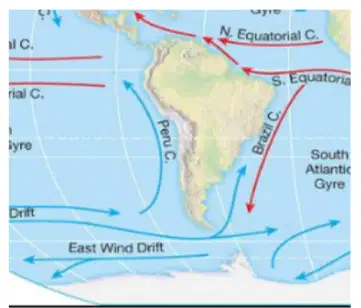
Using the picture below, how will the ocean current going up the coast of Peru change the climate compared to the ocean current going down the coast of Brazil on the other side of the continent? (The Peru Current is cold.)
Peru will have a warmer climate than Brazil because the ocean current will make the air warm.
Brazil will have a warmer climate than Peru because the ocean current is coming from the equator and makes the air warm.
Peru will have a similar climate to Brazil because the ocean currents are both warm, causing the air to be warm.
Brazil will have a colder climate than Peru because the ocean current is bringing cold water, which will make the air cold.
Which of the following is a benefit of upwelling?
Cold water is brought to the surface of the ocean from winds blowing surface water.
Water is being filtered throughout the ocean to make it cleaner.
Nutrient-rich water is brought to the surface from deep ocean currents.
New species of marine life are brought to the surface from deep ocean currents.
Which of the following is NOT a result of the Coriolis effect?
Cyclones rotate clockwise in the Southern Hemisphere.
Winds from the poles are deflected to the east due to the rotation of the Earth.
Ocean gyres form spinning counterclockwise in the Northern Hemisphere.
Deep ocean currents bring cold, nutrient-rich water to the surface.
Which of the following is an effect of the Earth being unevenly heated?
I. Wind from the Earth’s poles is deflected to the east.
II. Global winds are generated by warm air rising and cold air sinking.
III. Ocean currents are produced by warm water flowing towards cold water areas.
IV. The Earth has some areas of high air pressure (the poles) while other areas have low air pressure (warmer tropical areas).
Weather predictions take in many different kinds of data on the atmosphere and oceans to predict the weather based on current weather conditions. What kind of model is most likely being used for weather predictions?
mathematical models
conceptual models
physical models
visual models
Any form of water that falls from clouds is called
dew
evaporation
condensation
precipitation
The prevailing westerlies, the major wind belts over the continental United States, generally push air masses from
east to west
west to east
north to south
south to north
A funnel-shaped cloud that touches Earth’s surface is called a
hurricane
cyclone
tornado
thunderhead
Hurricanes typically form over
cold ocean water
tropical rain forests
warm ocean water
very dry land masses
The average, year-after-year conditions of temperature, precipitation, winds, and cloud in an area are known as its
climate
weather
global warming
seasons
The farther you live from an ocean, the more likely your climate will be a
marine climate
tropical climate
continental climate
subtropical climate
The seasons are caused by
Earth’s varying distance from the sun
Earth’s changing rate of rotation
the tilt of Earth’s axis as Earth revolves around the sun
shifting climates on Earth’s surface
Climates are classified according to two major factors
elevation and precipitation
latitude and temperature
elevation and latitude
precipitation and temperature
Increased carbon dioxide may cause global warming by
allowing more sunlight into the atmosphere
reflecting more sunlight from clouds
reducing the amount of oxygen in the air
trapping more heat in the atmosphere

The place where two plates come together is known as a _______
transform boundary.
divergent boundary.
convergent boundary.
rift valley.
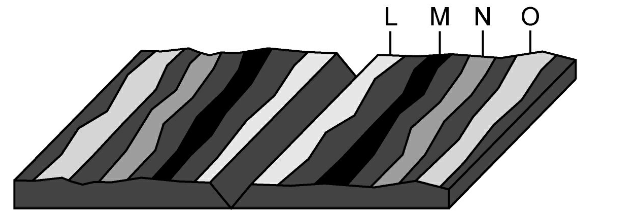
Where would the oldest rock be found?
L
M
N
O
When two continental crusts push together at a convergent boundary, what do they create?
earthquakes
valleys
sea-floor spreading
mountains
Why isn't one of the plates subducted when two continental crusts converge?
The density is the same.
One is more dense than the other.
Their speeds are the same.
One is less dense that the other.

What type of event will occur at this boundary?
Earthquake
Volcano Eruption
Tornado
Mountain Building

What geologic process formed the Himalayas?
two continental plates converging
an earthquake in a subduction zone
a tectonic plate moving over a hot spot
movement at a transform fault boundary
Which type of crust is more dense?
oceanic
continental
What occurs at a convergent boundary where an oceanic crust and continental crust come together?
sea-floor spreading
volcanoes
no subduction
A place where two plates slip past each other, moving in opposite directions, is known as a _______
transform boundary
divergent boundary.
convergent boundary.
rift valley.
What causes wind?
differences in air pressure
differences in gravity
difference in oxygen
differences in the thermosphere
What causes differences in air pressure?
even heating of the Earth
Even cooling of the earth
uneven heating of the earth
global warming

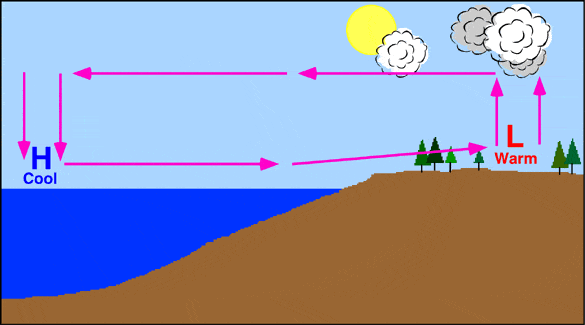
Air at the poles is colder and denser so it_______________.
rises
circulates
stagnates
sinks
In the Northern Hemisphere, winds traveling north appear to curve east because of the:
trade winds
convection currents
Coriolis effect
polar easterlies

Why is it hotter at the equator then it is at the poles?
Because of Earth's shape, the equator gets more direct sunlight than the poles.
Because of Earth's shape, the poles get more direct sunlight than the equator.
Because of Earth's shape, the equator is much darker than the poles.
The large mounds of moving water in the oceans are called?
Jet Streams
Doldrums
Gyres
Hemispheres
The most known surface ocean current is the?
Gulf Stream
Jet Stream
Global Conveyor Belt
Doldrums
Which of the following are causes of Ocean Currents? (Select all that apply)
Global Winds
Differences in amount of water
Differences in density
Speed of the water
Direction the water is moving

Which statement about water pollution is TRUE?
Pollution only affects surface water.
Pollution cannot be dissolved in water.
Pollution affects both surface and groundwater.
Pollution cannot travel through soil to groundwater.

The use of pesticides and fertilizers is carefully monitored because of the effect they can have on the environment. Which of the following is a possible negative effect of the use of these chemical on the environment?
These chemicals are expensive to produce.
Runoff carries these chemicals into lakes and streams.
Storage space for these chemicals is limited.
Theses chemicals cannot be purchased in large bulk.

Rapid growth of algae in a pond is often the result of -
loss of habitat due to commercial building.
flooding that causes water levels to rise.
excess nutrients from fertilizer runoff.
clogged river tributaries entering a lake.
Farms are great! But they do impact the ecosystem. Which of these are negative impacts of poor farming techniques?
Habitat Loss for wild animals
Fertilizer runoff leading to Eutrophication in lakes and rivers
More food for wild animals
More food for humans
Soil Erosion

the general terms for the MOVEMENT of sediment by wind, water, glaciers
weathering
erosion
deposition

the BREAKDOWN of rock into smaller pieces of the same rock without any change in its composition

the process of WEARING DOWN by friction - like sand blasting
exfoliation
abrasion
erosion
deposition

the process in which sediment particles are picked up and MOVED from one place to another

the part of the erosion process in which sediment travels to a new location and is laid down or DROPPED OFF


A mountain formed by lava and ash - quick change.
Sand Dune
Glacier
Volcano
Delta
The chemical and physical processes that break down rock at Earth's surface.
sediment
deposition
weathering
What are the four layers of the Earth from inside to the outside?
Crust, Outer core, mantle, inner core
Inner core, outer core, mantle, crust
crust, mantle, outer core, inner core
Mantle, outer core, inner core, crust
Which is the largest layer of the earth?
crust
mantle
inner core
outer core
Which layer contain convection currents?
mantle
crust
outer core
inner core

This image shows a model of a _____ wave.
P wave
S wave
V wave
None of the above.
Using our knowledge of how waves behave on the surface of the earth, we can indirectly determine the inner structure of our planet.
True
False
Which is the best description of the characteristics of the asthenosphere?
Solid, but flowing
Liquid, but dense
Hot, but solid metal
Brittle, but shifting
What is a convergent boundary?
When plate tectonics collide or crash into each other
When plate tectonics divide or move away from eachother
When plate tectonics slide past each other
When plate tectonics stay still
Most earthquakes happen along _________________.
the coast
faults
the desert
mountain ranges
Most volcanoes are located...
in the middle of the United States
at the edges of the tectonic plates
on Mars
Some benefits of volcanic eruptions include (pick all that apply)
new land formations
new ocean marine life
fertilized soil
This type of volcano has steep slopes, has explosive eruptions of gas and ash. Most volcanoes are this type.
Composite volcano
Shield volcano
Cinder Cone volcano
Ash volcanoe
_________________________ and temperature are the main ways to describe daily weather AND climate.
weather
equinox
precipitation
rotation
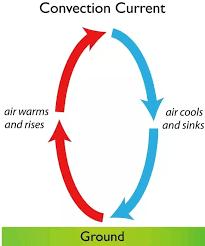
Which of the following is an example of convection?
A hair dryer is drying up your hair.
When the AC or heater changes the temperature.
When a car engine turns hot after being turned on.
When you are making soup and the water is rising and lowering.


