Wayground logo

Free Printable Worksheets

Font size

S
M
L
XL
Worksheets

Ecology review

Total questions: 72

Worksheet time: 2hrs 3mins
Name
Class
Date
1.
Which of the following best describes an ecosystem?
a)
all the living organisms in an area and their physical surroundings
b)
a region with a distinct climate
c)
all the living organisms of the same species throughout the world
d)
all the living organisms in an area
2.
The arrows in a food chain or web represents what?
a)
They point to the organism that is being eaten.
b)
It shows how sunlight flows within an ecosystem.
c)
They show what direction the energy is flowing between organisms. 
d)
They represent how water is transferred within a habitat.
3.
An organism that uses an outside source of energy like the sun to create energy-rich food molecules.
a)
Consumer
b)
Producer
c)
Decomposer
d)
Parasite 
4.

The plants are considered a

a)

primary consumer

b)

secondary consumer

c)

herbivore

d)

producer

5.

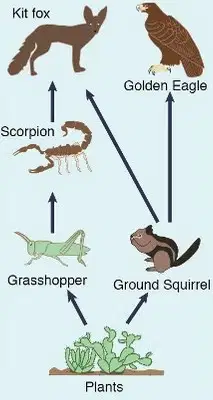
Which trophic level is the scorpion? SELECT ALL THAT APPLY

a)

Producer

b)

Primary consumer

c)

Secondary consumer

d)

Tertiary consumer

6.

Which trophic level is the kit fox?

a)

producer

b)

primary consumer

c)

secondary consumer

d)

tertiary consumer

7.

All the different populations that live together in an area is the definition of ____________.

a)

Ecosystem

b)

Community

c)

Population

d)

Organism

8.

Trophic Levels show the

a)

what grade each organism has achieved in the ecosystem

b)

position that an organism occupies in a food chain - what it eats, and what eats it

c)

part of the triangle the organism likes the most

d)

elevation the organism likes to live in

9.

The trophic pyramid is a triangular shape because

a)

90% of energy is lost to heat, movement, and survival, and only 10% of energy goes to the next level

b)

People see the top of the pyramid so it is important to know the keystone species.

c)

10% of energy is lost to heat, movement, and survival, and only 90% of energy goes to the next level

d)

the top of the pyramid is the pinnacle organism of an ecosystem

10.

Producers obtain their energy by

a)

the process of hunting for prey

b)

the process of eating plants

c)

the process of photosynthesis to make their own food from sunlight

d)

the process of breaking down once living things

11.

Photosysnthesis and respiration are important because

a)

they make mutualism possible

b)

they are the building blocks of life

c)

they are the 6 characteristics of life

d)

they cycle matter and energy between autotrophs and heterotrophs

12.

The carnivore level in this diagram are also known as

a)

Producers

b)

Primary consumers

c)

Secondary consumers

d)

Tertiary consumers

13.

The herbivore level in this diagram are also known as

a)

Producers

b)

Primary consumers

c)

Secondary consumers

d)

Tertiary consumers

14.

The food web shows

a)

many possible interactions and feeding relationships beween the organsims in the ecosystem

b)

a nice picture of what lives in the ecosystem

c)

the symbiotic relationships

d)

the keystone species

15.

Which level would have the most biomass?

a)

Producers

b)

Primary consumers - herbivores

c)

Secondary consumers- carnivores

d)

Quaternary consumers- Apex Predators

16.

Which level would have the least biomass?

a)

Producers

b)

Primary consumers - herbivores

c)

Secondary consumers- carnivores

d)

Quaternary consumers- Apex Predators

17.

What is the difference between a Trophic Pyramid and Food Web?

a)

A Trophic Pyramid shows the energy & mass available, but the food web shows directly who eats who.

b)

A food web shows the mass & energy available, but the Trophic Pyramid shows directly who eats who.

c)

A food web is so pretty to look at.

d)

A trophic pyramid is so beautiful.

18.

Trophic Levels show the

a)

what grade each organism has achieved in the ecosystem

b)

position that an organism occupies in a food chain - what it eats, and what eats it

c)

part of the triangle the organism likes the most

d)

elevation the organism likes to live in
19.
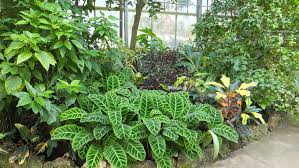
A producer is a (n) ______________.
a)
heterotroph
b)
omnitroph
c)
autotroph
d)
oscartroph
20.
All food chains begin with a ____________.
a)
primary consumer
b)
secondary consumer
c)
producers
d)
scavengers
21.
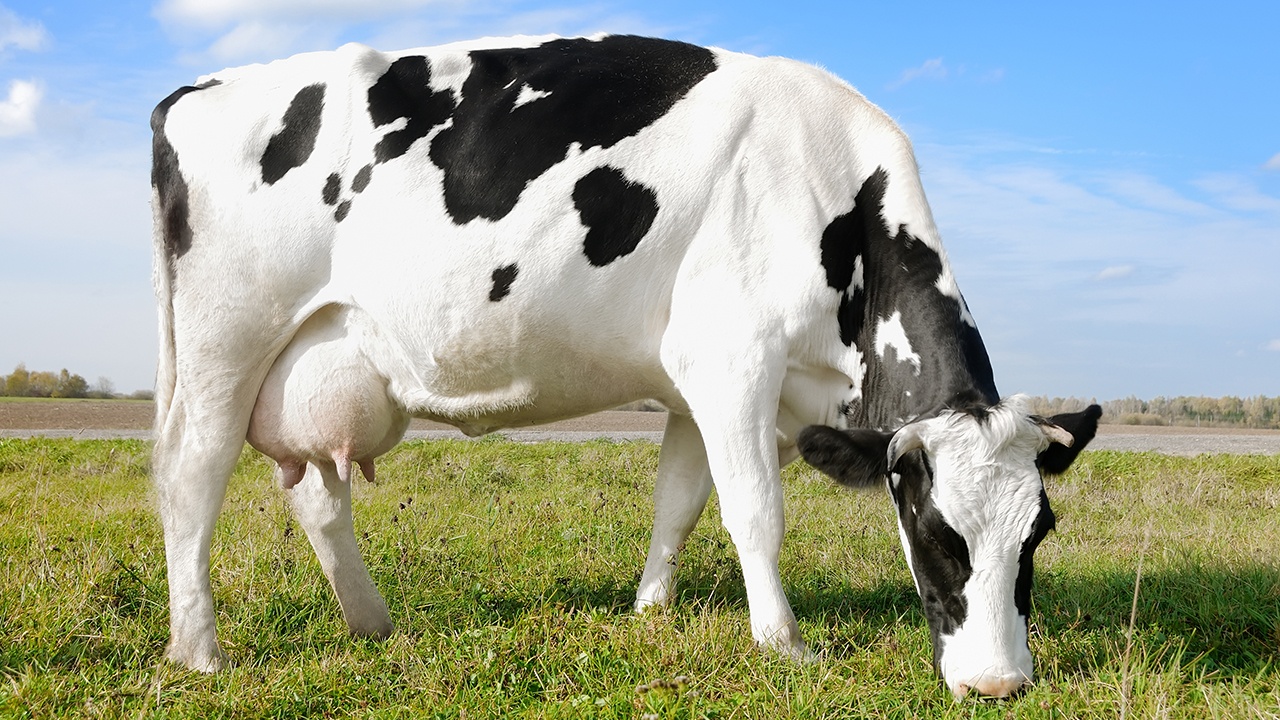
The image provided is an example of a:
a)
Producer
b)
Heterotroph
c)
Consumer
d)
Decomposer
22.
The image provided is an example of a(n):
a)
Autotroph
b)
Carnivore
c)
Herbivore
d)
Decomposer
23.
Green plants are
a)
producers
b)
consumers
c)
herbivores
d)
omnivores
24.
What is the original source of almost all energy in most ecosystems?
a)
carbohydrates
b)
sunlight
c)
water
d)
carbon
25.
The energy at each trophic level in the pryamid of energy decreases by a factor of ____.
a)
10
b)
1
c)
100
d)
2
26.

An ecosystem includes

a)

All living factors

b)

All nonliving factors

c)

All nonliving and living factors

d)

All biomass anywhere

27.

Herbivores get their energy from

a)

eating other animals

b)

eating plants

c)

using sunlight to make their own food

d)

breaking down once living things

28.

Heterotroph means

a)

the organisms get their energy from eating other organisms

b)

the organisms make their own food from photosynthesis

c)

the organims get energy from breaking down once living things

29.

Autotroph means

a)

the organism can make its own food from photosynthesis

b)

the organsim gets its energy from eating other organisms

c)

the organism gets energy from breaking down once living things

30.

The food web shows

a)

many possible interactions and feeding relationships beween the organsims in the ecosystem

b)

a nice picture of what lives in the ecosystem

c)

the symbiotic relationships

d)

the keystone species

31.
Barnacles create home sites by attaching themselves to whales. This relationship neither harms nor benefits the whales. 
a)
parasitism
b)
commensalism
c)
mutualism
32.
Yucca flowers are pollinated by yucca moths. The moths lay their eggs in the flowers where the larvae hatch and eat some of the developing seeds. Both species benefit. 
a)
parasitism
b)
commensalism
c)
mutualism
33.
Mistletoe extracts water and nutrients from a spruce tree. The spruce tree is harmed. 
a)
parasitism
b)
commensalism
c)
mutualism
34.
 The stork uses it saw-like bill to cut up the dead animals it eats. As a result, the dead animal carcass is accessible to some bees for food and egg laying. The relationship neither harms nor benefits the stork.
a)
parasitism
b)
commensalism
c)
mutualism
35.

Which of the following shows the symbiotic relationship between the Rodent and the Bird?

a)

Mutualism

b)

Commensalism

c)

Competition

36.

Hermit Crabs live in shells made and then abandoned by snails.

a)

Commensalism

b)

Parasitism

c)

Competition

37.
Two male Giraffes are fighting over the last green leaf of a tree that is dying.  
a)
Competition
b)
Mutualsim
c)
Predation
d)
Commensalism
38.
a relationship that occurs when two or more organims of the same species need the same resource at the same time
a)
competition
b)
symbiosis
c)
predation
39.
In a parasitic relationship, one organism is ___________ and one organism is benefiting. 
a)
helped
b)
harmed
c)
not effected
d)
happy
40.
In a mutual relationship, both organisms are ________________. 
a)
hurt
b)
not effected
c)
harmed
d)
benefiting 
41.
Commensalism is where one organism is benefiting and the other organism is _____________________. 
a)
not effected
b)
helped
c)
harmed
d)
hurt
42.
1.  A bee and a flower work together to benefit each other. This is an example of _________________. The bee helps the flower by pollinating it and the flower helps the bee by providing it with nectar. 
a)
commensal relationship 
b)
parasitic relationship 
c)
mutual relationship 
43.
A tick is a parasite to a horse. Which statement best describes the relationship between the tick and the horse? 
a)
a.  The tick helps the horse get food. 
b)
a.  The tick harms the horse by feeding on its blood. 
c)
a.  The horse harms the tick by feeding on its blood. 
d)
The tick does not affect the horse. 
44.
 Mrs. Bush’s cat has fleas. A flea is a parasite that gets its energy from Dante’s blood. How are the flea and the cat affected in this relationship? 
a)
Both organisms are helped.
b)
Both organisms are not affected.
c)
One organism is helped and one organism is not effected.
d)
One organism is helped and another organism is harmed. 
45.
Which is an example of commensalism?
a)
Two different kinds of organisms harming each other. 
b)
Two different kinds of organisms are neither helping nor harming each other. 
c)
One kind of organism is being helped, but the other one is not harmed or helped. 
d)
One kind of organism is being helped, but the other is harmed. 
46.
Which interaction benefits both organisms?
a)
A flea living on a dog
b)
A bee pollinating a flower
c)
A tapeworm living inside an animal
d)
A mosquito biting a person
47.
Tapeworms live in the intestines of dogs and absorb nutrients from food the dog eats. Which best describes the outcome of this relationship?
a)
The dog and tapeworm both become ill. 
b)
The dog becomes ill, and the tapeworm benefits. 
c)
The tapeworm and dog helpe ach other survive. 
d)
The tapeworm helps the dog survive. 
48.
A mite lives in the base of the eyelashes of people who use mascara. It feeds on the mascara; it does not seem to harm people. What type of symbiotic relationship is this?
a)
mutualism
b)
commensalism
c)
parasitism
d)
predation
49.
A coyote captures, kills, and eats a rabbit. What type of symbiotic relationship is this?
a)
mutualism
b)
commensalism
c)
parasitism
d)
predation
50.
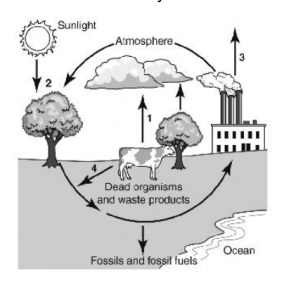
What is happening at 1?
a)
respiration: releasing CO2
b)
decomposing CO2 in the soil
c)
photosynthesis: absorbing CO2
d)
turning CO2 from the atmosphere into organic molecules
51.
Which cycle is this?
a)

Carbon

b)

Nitrogen

c)

Phosphorus

d)

Water

52.

What process converts nitrogen gas into a biologically useful (fixed) form?

a)

Respiration

b)

Assimilation

c)

Denitrification

d)

Nitrogen fixation

53.
A gas produced by animals during respiration that plants use for photosynthesis.
a)
Oxygen
b)
Carbon Dioxide
c)
Photosynthesis
d)
Radiation
54.

Based on the diagram, which two populations best represent trophic levels that RECIEVE the LEAST amount the total energy provided to the ecosystem by the grass?

a)

Crickets and sparrows

b)

Toads and spiders

c)

Rabbits and mice

d)

Hognose snakes and owls

55.

Overfishing is causing the decline of fish populations, such as Eastern Atlantic bluefin tuna in the Mediterranean. Eastern Atlantic bluefin tuna are caught faster than they can reproduce. Which statement describes the most likely effect that overfishing will have on this ecosystem?

a)

Overfishing makes the ecosystem more stable by increasing competition for limited resources.

b)

Overfishing decreases the stability of the ecosystem by disrupting food chains.

c)

Overfishing has no effect on ecosystem's stability because it affects one species out of many.

d)

Overfishing increase ecosystem stability by allowing prey populations to overproduce.

56.

The life cycle of a frog is illustrated in the diagram.

Which statement best explains how the cell cycle is important to the life cycle of the frog?

a)

It enables frogs to produce tadpoles that are clones.

b)

It allows frogs to grow, develop, and reproduce.

c)

It prevents overproduction of frog offspring.

d)

It ensures the best adapted frogs survive and pass on traits to offspring.

57.

Match the following

a)

autotroph

1.

make its own food

b)

prey

2.

animal that is killed for food

c)

predator

3.

animal that hunts and kills

d)

heterotroph

4.

consumes organism for energy

e)

symbiotic relationships

5.

relationships that help both parties

58.
Which organisms have the most available energy in an energy pyramid?
a)
Producer
b)
Consumer
c)
Decomposer
d)
Scavenger
59.
If there are 1000 Kcal of energy available in the producers, how much energy is available to the herbivores?
a)
10 Kcal
b)
1 Kcal
c)
100 Kcal
d)
1000 Kcal
60.
After decomposers return the nitrogen into the soil, what transforms a small amount of nitrogen into nitrogen gas?
a)
Bacteria
b)
Carbon
c)
Phosphorus
d)
proteins
61.
Which of the following is a consequence of excess carbon building up in Earth’s atmosphere?
a)
The amount of breathable oxygen available to living things decreases
b)
Global temperatures change, affecting normal weather patterns.
c)
The amount of solar energy reaching the earth’s surface decreases.
d)
Global air pressure increases making it more difficult for plants and animals to breathe.
62.
What are the two important jobs of a decomposer in an ecosystem?
a)
Keep waste from piling up and give carnivores energy
b)
Put energy back in the food chain and keep waste from piling up
c)
Put energy back in the food chain and compete against herbivores for food
d)
Supply the oxygen needed for plants to make food and keep waste from piling up
63.

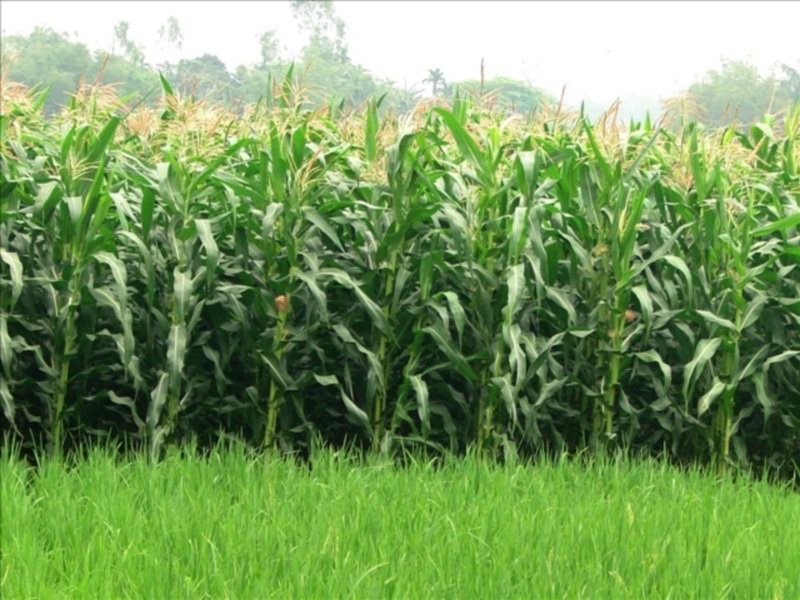
How much of the initial energy from the maize is available to the lizard?

a)

0.1%

b)

90%

c)

10%

d)

1%

64.

How much energy does the secondary consumer get if the producer has 6,700 kilocal?

a)

67,000 kilocals

b)

6,700 kilocals

c)

670 kilocals

d)

67 kilocals

65.

cell - tissue - _______ - organ system - organism

a)

ecosystem

b)

organ

c)

molecule

d)

atom

66.
In the energy pyramid here, which organisms have the most energy available?
a)
Producers
b)
Carnivores
c)
Herbivores
d)
Top Predator
67.
The fox in this food web would be considered a:
a)
Tertiary Consumer
b)
Producer
c)
Secondary Consumer
d)
Primary Consumer
68.
Red-billed oxpeckers are birds that feed on parasites found on an impala. The impala gets rid of parasites and the red-billed oxpeckers get a yummy dinner. This is an example of _______.
a)
commensalism
b)
mutualism
c)
neutralism
d)
competition
69.

A new predator of rabbits has been introduced within an ecosystem. This new predator runs faster than the native predators of rabbits.

Which statement describes what will most likely occur in the rabbit population due to the introduction of the predator?

a)

The rabbits will mutate their genes and express genes that increase their speed.

b)

Slower rabbits will develop stronger legs and pass this trait to their offspring.

c)

Rabbits will mate and produce offspring with a different species that has faster runners.

d)

Faster rabbits will survive and reproduce increasing the average speed of the rabbit population.

70.
Which of the following would be the most likely effect, if there were a sudden increase in the cricket population?
a)
There would be a decrease in the small bird population.
b)
There would be a decrease in the grass/flowers population.
c)
There would be a decrease in the mice population.
d)
There would be an increase in the grass/flowers population.
71.

This diagram demonstrates why the ocean is a large carbon sink.

An increase in the amount of carbon dioxide in the atmosphere can cause atmospheric temperatures to increase. Which statement explains how this could affect the ocean as a carbon sink?

a)

Less atmospheric carbon dioxide would be available to phytoplankton.

b)

Dissolved carbon dioxide gas in the ocean would increase because surface winds would cause a deeper circulation pattern, making more room for the gas.

c)

Less carbon dioxide gas would be contained in the ocean because increasing precipitation would dilute the carbon entering the ocean.

d)

Less carbon dioxide would be dissolved in the ocean because increasing atmospheric temperatures would cause ocean temperatures to increase.

72.

A partial meadow food web is shown.

Based on this food web, which organisms are direct sources of energy for secondary consumers?

a)

Aphid Bird Rabbit

b)

Ladybug Fox Dragonfly

c)

Frog Butterfly Berries

d)

Mouse Snake Hawk