
 Worksheets
Factors Affecting Reaction Rates
Total questions: 60
Worksheet time: 1hrs 28mins
The catalyst alters the rate of a chemical reaction by,
providing an alternative pathway with a lower Ea
changing the products formed in the direction of the reaction
providing a surface on which the molecules react
increasing the frequencies of collisions between molecules
Which of the following are true of reaction rates?
I. The overall rate law is determined by the fastest step of a reaction
II. The presence of a catalyst will increase the number of molecules entering the transition state
III. An increase in temperature will increase the rate of a reaction
IV. Decreasing the concentration of reactants will increase the rate at which products yield
II+III+IV
I+IV
II + III
I+II+III
Which factors increase the rate of a reaction?
increasing temperature
increasing concentration
increasing surface area
all of the above
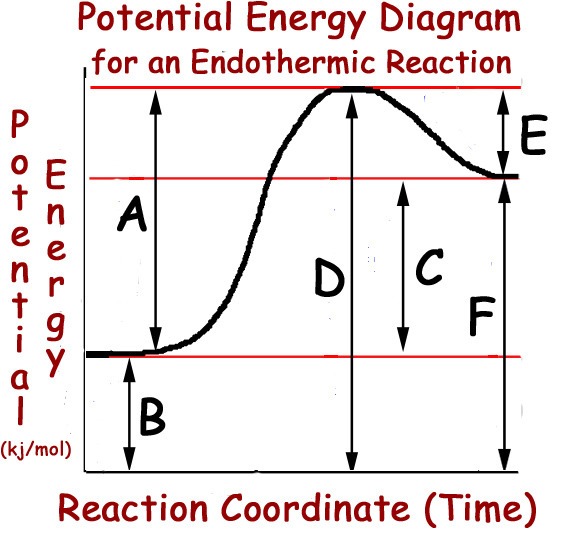
What letter represents the activation energy?
A
B
C
D
Based on the collision model, the atoms in the top of potential energy ‘’hill’’ are called
Top of hill
Activation energy
Transition state
Steric factor
Which of the following best describes why increasing temperature increase reaction rate?
Activation energy is reduced.
Collisions become more frequent.
Collisions become more energetic.
Collisions become more frequent and more energetic.
Which of the following statements about the catalyst is true?
A catalyst accelerates the rate of reaction by bringing down the activation energy.
A catalyst does not participate in reaction mechanism.
A catalyst makes the reaction feasible by making ∆G more negative.
A catalyst makes equilibrium constant more favorable for forward reaction.

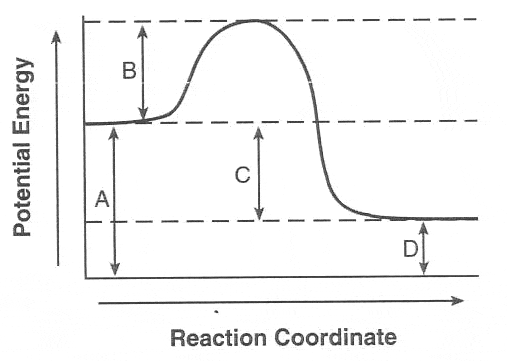
An endothermic reaction with high activation energy for the forward reaction is given by the diagram.
A
B
C
D
4 factors that affects reaction rate.
temperature
surface area
presence of catalyst
Chemical nature of reactant
In solid form


An addition of a catalyst to the following reaction would have what effect?
A would be increased
B would be increased
C would be decreased
No change
Which sample of HCl(aq) reacts at the fastest rate with a 1.0-gram sample of iron filings?
10 mL of 1 M HCl(aq) at 10°C
10 mL of 1 M HCl(aq) at 25°C
10 mL of 3 M HCl(aq) at 10°C
10 mL of 3 M HCl(aq) at 25°C

During a laboratory activity to investigate reaction rate, a student reacts 1.0-gram samples of solid zinc with 10.0-milliliter samples of HCl(aq). The table below shows information about the variables in five experiments the student performed. Which two experiments can be used to investigate the effect of the concentration of HCl(aq) on the reaction rate?
1 and 3
1 and 5
4 and 2
4 and 3
For a given chemical reaction, the addition of a catalyst provides a different reaction pathway that
decreases the reaction rate and has a higher activation energy
decreases the reaction rate and has a lower activation energy
increases the reaction rate and has a higher activation energy
increases the reaction rate and has a lower activation energy

Each of four test tubes contains a different concentration of HCl(aq) at 25°C. A 1-gram cube of Zn is added to each test tube. In which test tube is the reaction occurring at the fastest rate?
1
2
3
4
A 5.0-gram sample of zinc and a 50.-milliliter sample of hydrochloric acid are used in a chemical reaction. Which combination of these samples has the fastest reaction rate?
a zinc strip and 1.0 M HCl(aq)
a zinc strip and 3.0 M HCl(aq)
zinc powder and 1.0 M HCl(aq)
zinc powder and 3.0 M HCl(aq)
Adding a catalyst to a chemical reaction results in
a decrease in activation energy and a decrease in the reaction rate
a decrease in activation energy and an increase in the reaction rate
an increase in activation energy and a decrease in the reaction rate
an increase in activation energy and an increase in the reaction rate
Which conditions will increase the rate of a chemical reaction?
decreased temperature and decreased concentration of reactants
decreased temperature and increased concentration of reactants
increased temperature and decreased concentration of reactants
increased temperature and increased concentration of reactants
Given the reaction at equilibrium: N2(g) + 3H2(g) ⇌ 2NH3(g). Increasing the concentration of N2(g) will increase the forward reaction rate due to
an increase in the number of effective collisions
a decrease in the number of effective collisions
a decrease in the activation energy
an increase in the activation energy
A 1-cubic-centimeter cube of sodium reacts more rapidly in water at 25°C than does a 1-cubic-centimeter cube of calcium at 25°C. The difference in rate of reaction is most closely associated with the different
surface area of the metal cubes
nature of the metals
density of the metals
concentration of the metals
A chemical reaction occurs when reactant particles
are separated by great distances
have no attractive forces between them
collide with proper energy and proper orientation
convert chemical energy into nuclear energy
A reaction is most likely to occur when the colliding particles have proper orientation and
mass
volume
half-life
energy
An effective collision between reactant particles requires the particles to have the proper
charge and mass
charge and orientation
energy and mass
energy and orientation
What is required for a chemical reaction to occur?
standard temperature and pressure
a catalyst added to the reaction system
effective collisions between reactant particles
an equal number of moles of reactants and products
A chemical reaction between iron atoms and oxygen molecules can only occur if
the particles are heated
the atmospheric pressure decreases
there is a catalyst present
there are effective collisions between the particles
As the concentration of reacting particles increases, the rate of reaction generally
decreases
increases
remains the same
Increasing the temperature increases the rate of a reaction by
lowering the activation energy
increasing the activation energy
lowering the frequency of effective collisions between reacting molecules
increasing the frequency of effective collisions between reacting molecules
Given the balanced equation representing a reaction:
2HCl(aq) + Na2S2O3(aq) → S(s) + H2SO3(aq) + 2NaCl(aq)
Decreasing the concentration of Na2S2O3(aq) decreases the rate of reaction because the:
activation energy decreases
activation energy increases
frequency of effective collisions decreases
frequency of effective collisions increases
What is the relationship between rate of reaction and temperature?
No relationship
Directly proportional
Inversely proportional
Jointly proportional
Given the reaction inside a container of CO2(g) + H2O(g) → H2CO3(aq).
What will happen if the pressure of the container is increased?
The rate increases
The rate decreases
The rate will remain the same
It has no effect
What is the relationship between rate of reaction and concentration of reactants?
No relationship
Directly proportional
Inversely proportional
Jointly proportional
How does the presence of catalyst increase reaction rate?
It lowers down activation energy
It increases collision of particles
It increases the energy of the reactant
It increases activation energy
change in time, Δ tchange in concentration, Δ[conc] = ?
Rate of reaction
constant, k
rate law
reaction order
The following are the terms used to describe the relationship between the rate of a chemical reaction and the concentration of its reactants EXCEPT
Rate laws
Differential rate laws
Rate equations
Chemical kinetics
The rate constant of a reaction is 5.8 × 10 M-1s-1. The order of the reaction is...
0th order
1st order
2nd order
3rd order

The plot shows the decomposition of H2O2.
What is the order of the reaction?
0th order
1st order
2nd order
3rd order
The half-life of a first-order reaction...
is constant
is the time necessary for the reactant concentration to drop
to half its original value
does not depend on the initial reactant concentration
All of the choices are correct
What is the half-life (t1/2) of a reactant with a decay constant (λ) of 0.693?
1
2
3
4

The following data were measured for the reaction
BF3(g) + NH3(g) ⟶ F3BNH3(g)
What is the rate law for the reaction?
rate = k[NH3]
rate = k[BF3]2[NH3]
rate = k[BF3][NH3]
rate = k[BF3][NH3]2
Given the following rate law,
rate = k[A]2[B]
if [A] were doubled, what must happen to [B] to keep the rate constant?
[B] must quadruple
[B] must double
[B] must be havled
[B] must be quartered
The catalyst alters the rate of a chemical reaction by,
providing an alternative pathway with a lower Ea
changing the products formed in the direction of the reaction
providing a surface on which the molecules react
increasing the frequencies of collisions between molecules
Which of the following are true of reaction rates?
I. The overall rate law is determined by the fastest step of a reaction
II. The presence of a catalyst will increase the number of molecules entering the transition state
III. An increase in temperature will increase the rate of a reaction
IV. Increasing the concentration of reactants will increase the rate at which products yield
II+III+IV
I+IV
II + III
I+II+III

The iodide ion reacts with hypochlorite ion in the following way:
OCl- + I- ⟶ OI- + Cl-.
This rapid reaction gives the rate data shown. What is the rate law?
rate = [OCl-]2[I-]
rate = [OCl-][I-]2
rate = [OCl-][I-]
rate = [OCl-]
Units of rate is _______-
M/s
mol/s
m.s
s/M

