
Font size
 Worksheets
Cells/Living Organisms 6.13 A&B
Total questions: 45
Worksheet time: 50mins
All living organisms are made up of ----
one or more cells
bacteria
one or more organs
oxygen

Living or nonliving?
living
nonliving

Living or nonliving?
living
nonliving
Which statement was NOT included in cell theory?
All living things are composed of cells.
Living cells come only from other living cells.
Each cell contains a cell membrane, cytoplasm, nucleus, mitochondria, and endoplasmic reticulum.
Cells are the smallest structure of living things that can perform the functions necessary for life.
Which instrument is credited for helping scientists develop cell theory?


This early cell theory scientist looked in a microscope and discovered "animalcules" in the gunk from his teeth and pond water.
Schleiden
Leeowenhoek
Hooke
Virchow
Schwann
Who discovered and named cells while looking at cork?
Captain Hook
Robert Hooke
Matthais Schleiden
Rudolf Virchow
What was Schleiden convinced of?
All plants are made of cells
All animals are made of cells
All cells are prokaryotic
None of the above
Who noted that all animals are made of cells and helped write the first two parts of cell theory?
Rudolf Virchow
Anton van Leeuwenhoek
Theodor Schwann
Robert Hooke
Who discovered that all cells come from other living cells and had research that lead to the last major principle of cell theory?
Matthias Schleiden
Theodore Schwann
Robert Hooke
Rudolf Virchow

Robert Hooke, Anton van Leeuwenhoek, Theodor Schwann, Rudolf Virchow, and Matthias Schliden were all responsible for what theory?
The Theory of Gravity
The Theory of Relativity
The Cell Theory
The Theory of Continental Drift
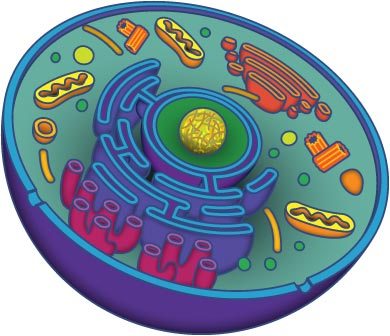
All living things are made up of...
cells
tissues
organ
organ systems
What is the basic structural and functional unit of all living things?
atom
cell
bacteria
animalcules
All cells -----
come from other dead cells
come from other living cells
crystallize out of the air

Which living organisms are prokaryotes and NOT eukaryotes? p.23-24
Bacteria
Protists (some kelp)
Humans/Animals
Plants
Fungi (mushrooms)

This picture shows
A prokaryotic cell
A eukaryotic cell

This picture shows
A prokaryotic cell
A eukaryotic cell
Which statements are true about eukaryotic cells
Eukaryotic cells are larger and more complex than prokaryotic cells
Eukaryotic cells make up humans, animals, fungi, and plants
Eukaryotic cells have a nuclear membrane/lining around their genetic material/DNA
Eukaryotic cells make up bacteria
Which statement is true about prokaryotic cells
Prokaryotes are single celled organisms and include bacteria, paramecium and amoebas.
Prokaryotes are multicellular organisms and include humans, plants, and fungi.
What 3 characteristics do eukaryotic and prokaryotic cells share? p.23-24
Both have a nucleus where genetic material/DNA is found
Both have genetic material/DNA
Both make up living organisms
Both are types of cells
Bacteria are classified as ....
Prokaryotic Cells
Eukaryotic Cells
Which type of cells have no membrane bound organelles?
Prokaryotic Cells
Eukaryotic Cells
Which type of cells have no nucleus?
Prokaryotic Cells
Eukaryotic Cells
Plants, animals, fungi and protist are classified as...
Prokaryotic Cells
Eukaryotic Cells
Unicellular organisms that have no nucleus are ...
Prokaryotic Cells
Eukaryotic Cells
Your body cells are...
Prokaryotic Cells
Eukaryotic Cells
Organisms made of more than one cell are...
unicellular
noncellular
manicellular
multicellular
Organisms made of only one cell are...
unicellular
noncellular
manicellular
multicellular
What is a nucleus?
gel-like substance that holds the organelles
the part of the plant cell that captures sunlight
membrane bound organelle that holds the DNA
the outside of the cell that protects it
An amoeba is unicellular but has a nucleus. How would it be classified?
Eukaryotic Cell
Prokaryotic Cell
What is DNA?
the genetic material or directions for the cell
the outside barrier of the cell
gel-like substance that holds the organelles
the part of the cell that captures energy
What is the basic structural and functional unit of life?
bacteria
cells
matter
cytoplasm
Complete the Cell Theory statement. All cells come from ...
atoms
spontaneous generation
nothing
pre-existing cells
Complete the Cell Theory statement. All living things are made of...
only one cell
no cells
many cells
one or more cells
What do ALL CELLS have?
DNA, cell membrane, cytoplasm, organelles
cell wall, organelles, mitochondria, nucleus
nucleus, cell membrane, cell wall, cytoplasm
flagella, cytoplasm, cell membrane, organelles
What do you call organisms that can make their own food?
heterotophs
autotrophs
trophies

Organisms that cannot make their own food and must get energy from eating other organisms are called...
autotrophs
heterotrophs
plants
An organism that cannot produce its own food, instead taking nutrition from other sources.
food chain
autophonic
photosynthesis
heterotroph
autotroph
The process by which green plants and some other organisms use sunlight to synthesize foods from carbon dioxide and water.
food chain
autophonic
photosynthesis
heterotrop
autotroph
Select the AUTOTROPHS


BUNNY
AUTOTROPH
HETEROTROPH
AUTOPHOTOTROPH
NONE OF THE ABOVE

