Font size
 Worksheets
STEM SCIENCE STUDY GUIDE-1
Total questions: 70
Worksheet time: 50mins
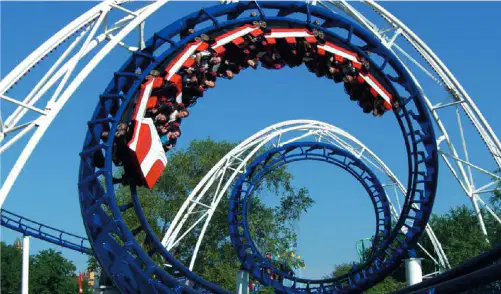
Why doesn’t a roller coaster lose energy when it goes up and down the track?
The energy disappears.
The energy changes form but stays the same amount.
The energy increases every time.
The roller coaster creates new energy.
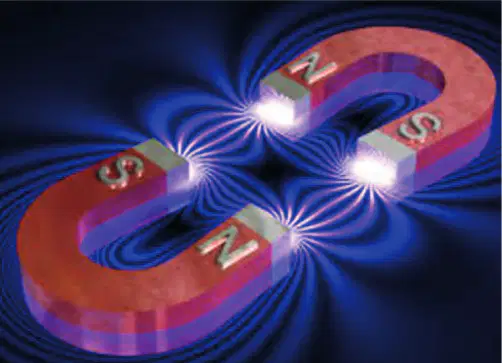
What happens when you cut a bar magnet in half?
It becomes two smaller magnets.
It loses its magnetism.
Only one piece is magnetic.
It stops working completely.
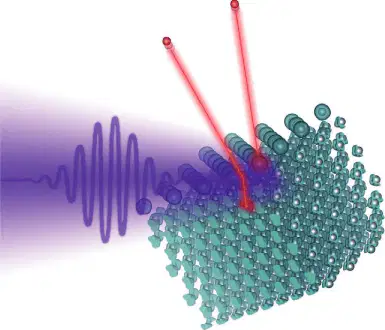
What did the photoelectric effect show about light?
Light can eject electrons from a surface.
Light always behaves like a wave.
Light can be split into colors.
Light has no effect on materials.
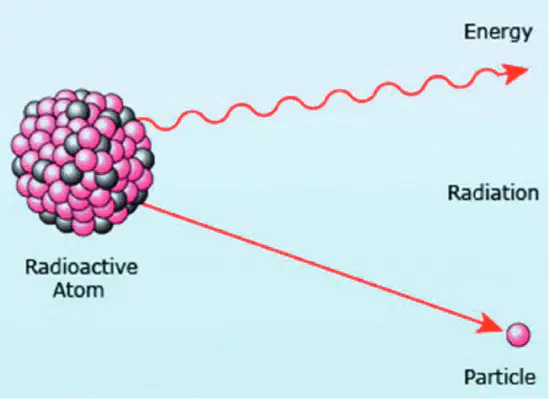
A radioactive isotope has a half-life of 10 years. If you start with 80 g, how much is left after 30 years?
40 g
20 g
10 g
5 g
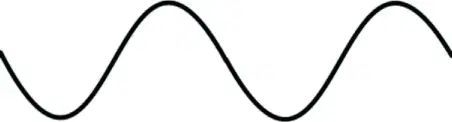
What happens to the wavelength when the frequency of a wave increases?
A) It gets longer.
B) It gets shorter.
C) It stays the same.
D) It doubles.
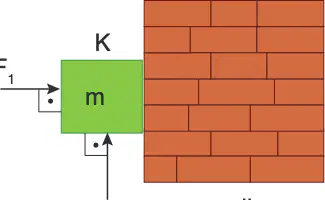
An object K with mass m is in equilibrium against a vertical wall with friction, as shown in the figure. Which of the following factors, when increased individually, can cause the frictional force acting on K to increase?
I
II
II and III
I, II, and III
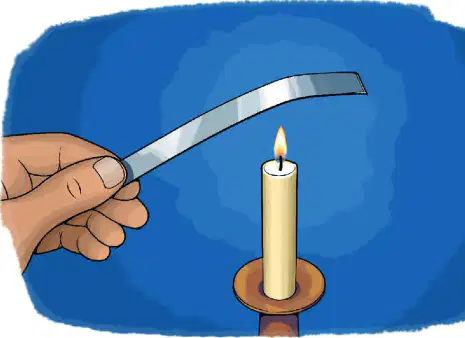
How much energy is needed to heat 500 g of metal from 20°C to 100°C? (The specific heat is 0.9 J/g°C)
180 J
360 J
36000 J
72000 J
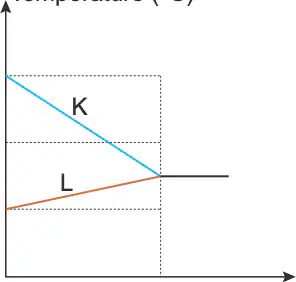
Two objects, K and L, are placed in a thermally insulated environment where they exchange heat only with each other. At t=0, their initial temperatures are 120°C and 40°C, respectively. Which of the following statements about K and L are definitely correct? I. The specific heat capacity of L is greater than that of K. II. The heat capacity of L is greater than that of K. III. The internal energy changes of K and L during the (0–t) interval are equal.
I
II
I and II
I and III
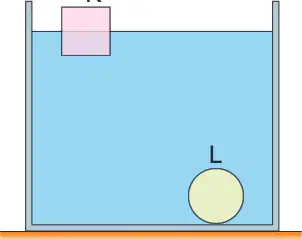
The vertical cross-section of the container is shown in the figure. Inside the container, two solid objects K and L, each weighing 10 N and insoluble in the liquid, are slowly released from the liquid surface. • The K object floats on the liquid surface. • The L object touches the bottom of the container and remains in equilibrium. Which of the following could represent the magnitudes of the buoyant forces acting on K (F_K) and L (F_L)?
F_K = 10 N and F_L = 12 N
F_K = 12 N and F_L = 8 N
F_K = 10 N and F_L = 8 N
F_K = 8 N and F_L = 10 N
If an object has a mass of 5 kg and is raised to a height of 10 m, what is its gravitational potential energy? (Take g=10m/s²)
50 J
250 J
500 J
1000 J
What is chemical equilibrium?
The point at which reactants are consumed completely
The state in which the concentrations of reactants and products remain constant
The point where a reaction stops
The state of maximum product formation
What is a chemical reaction?
A) A process that changes the physical state of a substance
B) A process that rearranges atoms to form new substances
C) A process that involves only physical changes
D) A process that does not involve energy changes
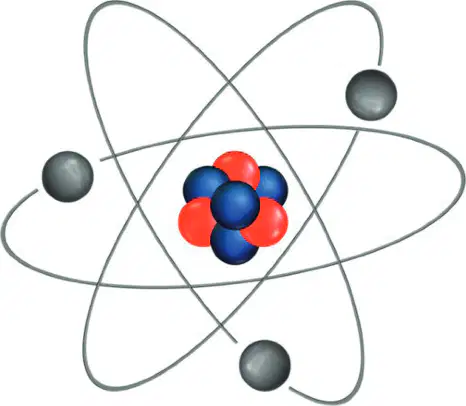
Imagine you’re building an element in a game. Which part decides the element’s identity, like its "name tag"?
The number of protons
The number of neutrons
The number of electrons
The total weight of the atom
In a baking experiment, your cake batter doesn’t weigh more after it’s baked. What scientific rule explains this?
A) Mass is created in reactions.
B) Mass is destroyed in reactions.
C) Mass is conserved during reactions.
D) Mass changes forms in reactions.
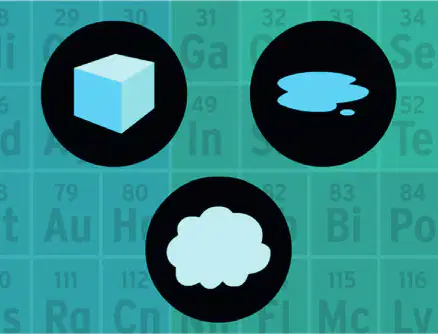
Think of ice melting on a hot day. What happens to the particles inside the ice as it turns into water?
A) They stop moving.
B) They move closer together.
C) They move apart and slide around more.
D) They form fixed shapes.
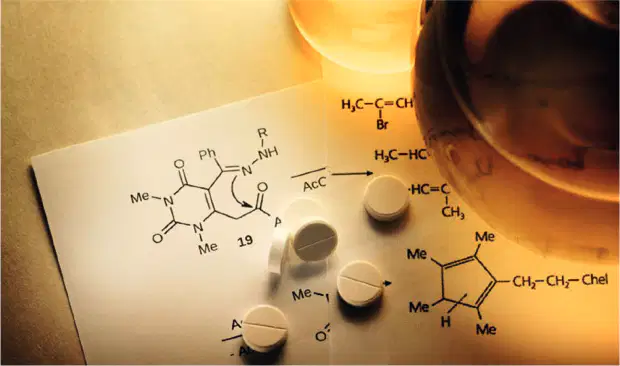
If you’re looking for molecules that are mostly made of carbon and hydrogen, which group would you check?
Organic compounds
Metals
Acids
Salts
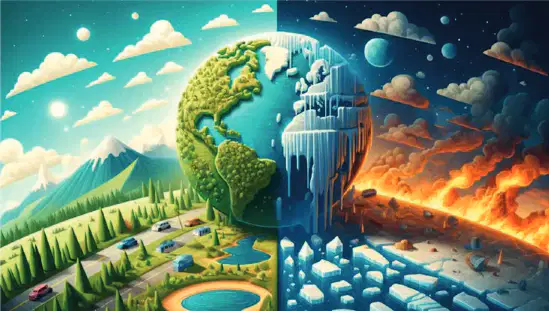
The world is getting warmer, and scientists say it's because of a gas we release. Which gas is causing this?
Oxygen
Carbon dioxide
Ozone
Hydrogen

You light a candle for a birthday party, and the flame produces heat and light as it burns. What type of chemical reaction is creating the glowing flame?
Neutralization
Combustion
Decomposition
Gas-producing reaction
You are a tiny explorer inside a plant cell placed in salt water. What would you see happening to the cell?
It swells up like a balloon.
It shrinks and looks squeezed.
It stays the same.
It splits into two.
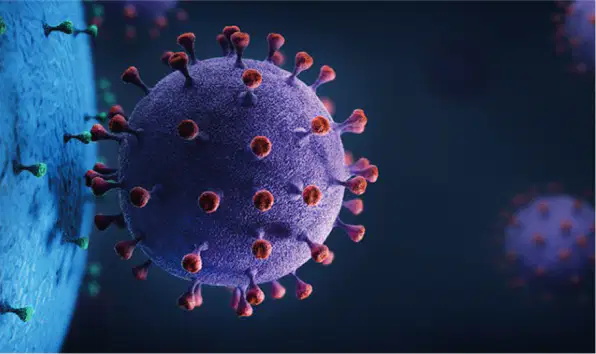
Imagine you're designing a special medicine to stop viruses in human cells. Where should the medicine target?
Mitochondria – the cell's power station
Lysosomes – the trash processors
Nucleus – the control center
Ribosomes – the protein builders
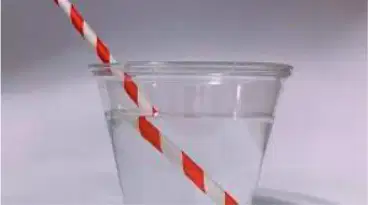
Why do objects appear distorted when viewed through water?
A) Light travels slower in water, bending the light rays.
B) Water absorbs the light completely.
C) Light reflects more in water.
D) Water blocks certain colors of light.
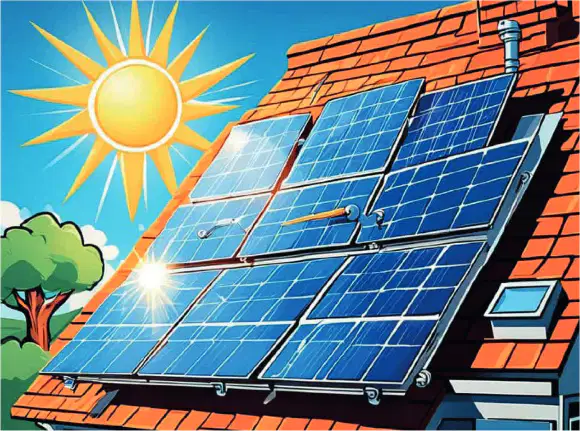
Why do solar panels produce electricity when sunlight hits them?
Heat from the Sun creates electricity.
Photons in sunlight knock electrons free in the panels.
The Sun’s rays reflect energy onto the panels.
The panels absorb sound waves from sunlight.
A radioactive isotope used in medical scans has a half-life of 2 hours. How much of a 16 g sample remains after 6 hours?
2 g
4 g
6 g
8 g
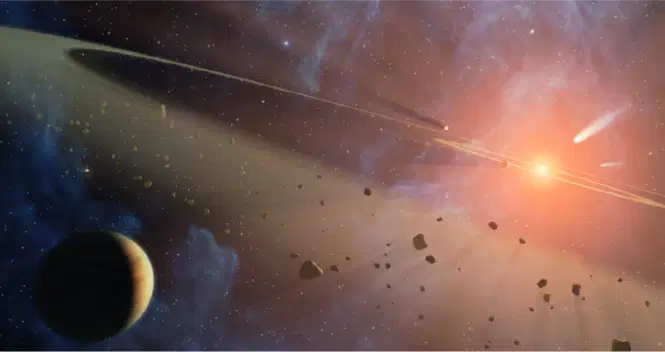
You see a star that is 10 light-years away. What does this mean?
The light took 10 years to reach Earth.
The star is 10 times bigger than the Sun.
The star will disappear in 10 years.
The star moves closer every 10 years.
The image of an object in front of a mirror is upright and larger than the object itself. Which of the following statements are correct? I. The mirror could be a concave mirror. II. The image could be a real image. III. The mirror could be a plane mirror.
I
II
III
I and II
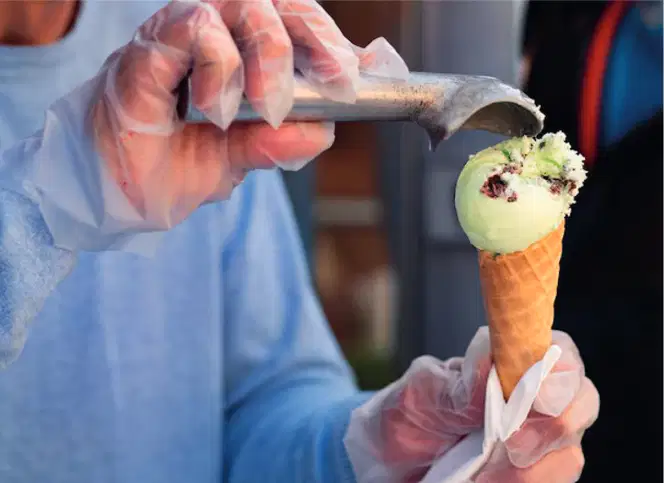
An ice cream vendor uses a spoon to place scoops of ice cream into a cone. After placing each scoop, the vendor dips the spoon into a container filled with water. Which of the following statements are correct? I. The adhesion between the spoon and the ice cream is greater than the adhesion between the water and the ice cream. II. The cohesion within the ice cream is greater than the adhesion between the spoon and the ice cream. III. The adhesion between the spoon and the ice cream increases with the help of water.
A) I
B) II
C) I and II
D) I and III
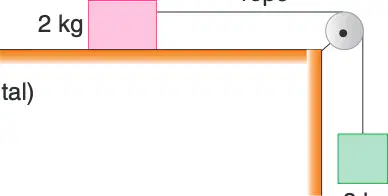
In the frictionless system shown, the mass of object K is 2 kg, and the mass of object L is 3 kg. What is the acceleration of object K as it moves toward the pulley after being released? (Take g=10 m/s²)
0 m/s²
5 m/s²
6 m/s²
8 m/s²
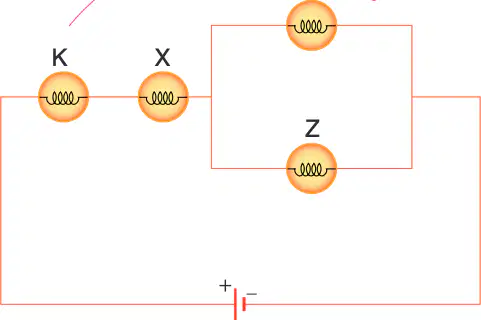
How does the brightness of the X, Y, and Z bulbs change as a result of Jason's modification?
Bulb X: Increases, Bulb Y: Decreases, Bulb Z: Increases
Bulb X: Unchanged, Bulb Y: Increases, Bulb Z: Unchanged
Bulb X: Increases, Bulb Y: Unchanged, Bulb Z: Increases
Bulb X: Decreases, Bulb Y: Decreases, Bulb Z: Increases
A photon has a wavelength of 500 nm. What is its energy? (h= 6¨.63×10−34 , c= 3¨×108 )
3.98×10^{-19} J
6.63×10^{-34} J
1.24×10^-19 J
7.35×10^-18 J
What is the cosmic microwave background radiation?
Light emitted by stars in the galaxy
Remnant heat radiation from the early universe
Electromagnetic waves produced by black holes
Solar radiation reflected by planets
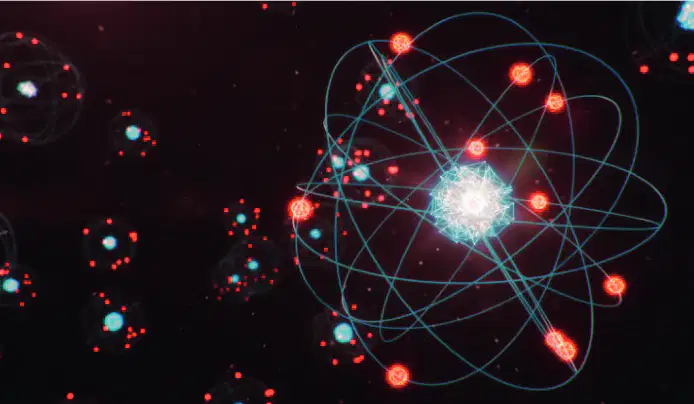
Imagine you are designing a new element for a science fiction movie. It has 15 protons, 15 neutrons, and 15 electrons. Based on its atomic number, how would its electron configuration determine its chemical reactivity?
A) It has 2 electrons in the outermost shell and is unreactive.
B) It has 5 electrons in the outermost shell and forms covalent bonds easily.
C) It has 7 electrons in the outermost shell and is highly reactive.
D) It has a full outer shell and does not react.
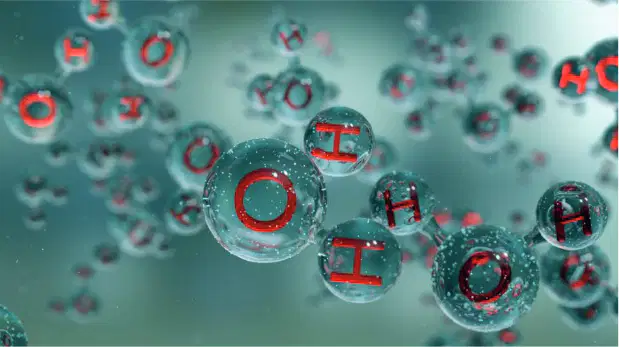
Water (H₂O) has a bent molecular structure due to polar covalent bonds. How does the structure of water affect its physical properties, such as surface tension?
It weakens surface tension because of hydrogen bonding.
It increases surface tension due to the attraction between polar molecules.
It decreases surface tension by reducing molecular attraction.
It has no effect on surface tension.
A factory is producing ammonia using the reaction N₂ + 3H₂ ↔ 2NH₃. If the factory owner wants to increase ammonia production, which action would best shift the equilibrium?
Decrease the temperature.
Reduce the pressure.
Increase the pressure.
Add more nitrogen.
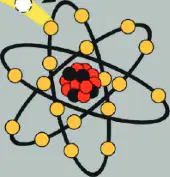
During the reaction 2H₂ + O₂ → 2H₂O, hydrogen is oxidized and oxygen is reduced. How does the transfer of electrons explain the energy released in this reaction?
A) Electrons are gained by hydrogen, increasing potential energy.
B) Electrons are transferred to oxygen, releasing energy stored in bonds.
C) Electrons are lost by oxygen, reducing energy release.
D) Electrons stay in the same state, conserving energy.
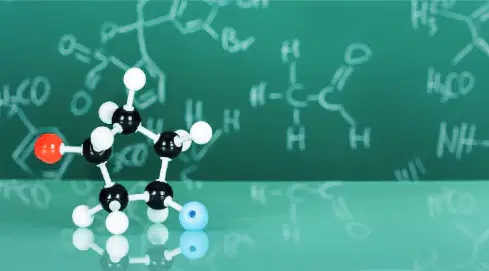
Ethanol (CH₃-CH₂-OH) is used as a fuel additive. How does its molecular structure contribute to its use in combustion engines?
A) Its oxygen atom prevents complete combustion.
B) Its carbon-hydrogen bonds release energy when burned.
C) Its hydroxyl group makes it non-flammable.
D) Its high boiling point makes it ideal for evaporation.
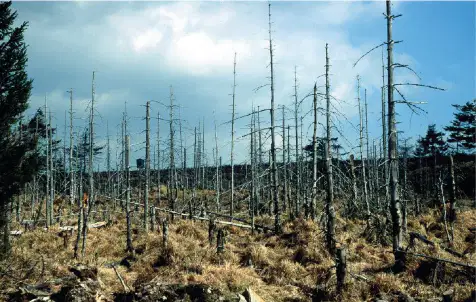
Acid rain damages ecosystems. What would be the most effective solution to reduce its impact?
Increase industrial use of fossil fuels.
Install scrubbers to capture sulfur dioxide in factories.
Reduce water vapor emissions into the atmosphere.
Use fertilizers to neutralize soil acidity.
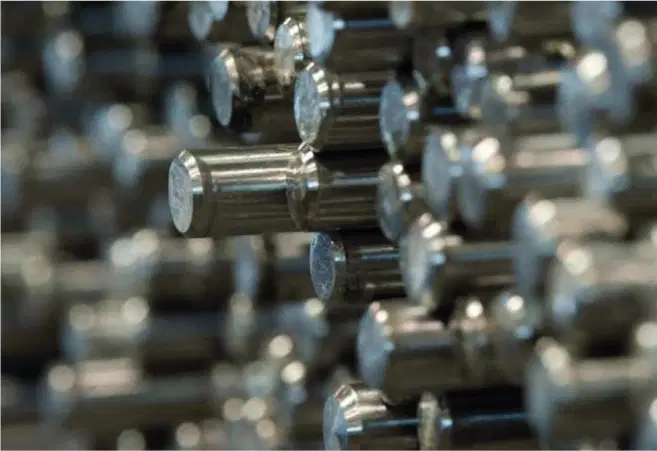
You are searching for a shiny metal to build a new tool. Based on their atomic numbers, which element would you pick as a metal?
Selenium (Se), atomic number = 34
Cobalt (Co), atomic number = 27
Carbon (C), atomic number = 6
Bromine (Br), atomic number = 35
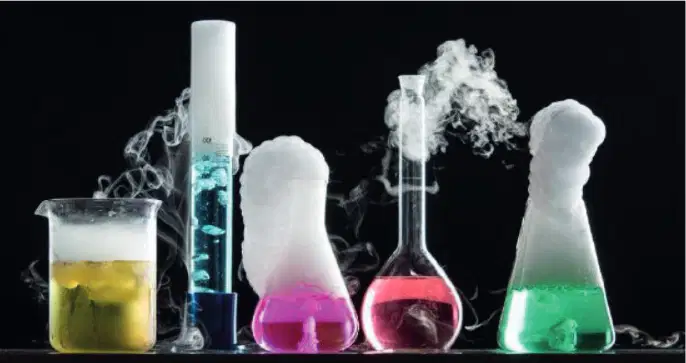
Imagine you’re fueling a rocket with hydrogen gas (H₂), and it reacts with oxygen to form water. Using the equation 2H₂(g) + O₂(g) → 2H₂O(l), how much water (in grams) is produced when 9.00 moles of H₂ react completely? (The molar mass of H₂O is 18.0 g/mol.)
18.0 g
36.0 g
81.0 g
162.0 g
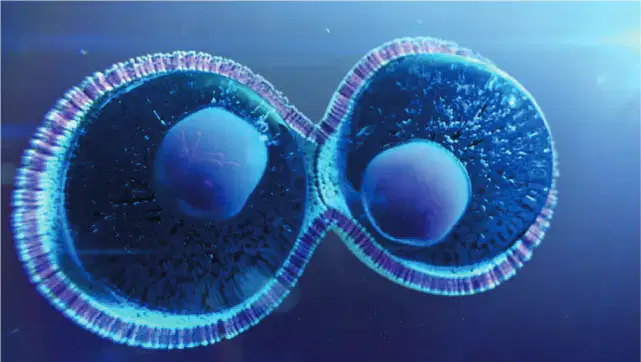
During the final moments of mitosis, something crucial happens before the cell divides completely. Can you figure out what happens LAST?
Microtubules emerge from the centrosomes.
Sister chromatids separate.
Sister chromatids align on the metaphase plate.
The spindles start to pull on the kinetochores of sister chromatids.

In a garden experiment, crossing red (RR) and white (rr) flowers results in pink offspring due to incomplete dominance. What would the flower color ratio look like in the F2 generation?
One red: two pink: one white
Two red: one pink: one white
All pink
Three red: one white
At what point does the baseball have ALL gravitational potential energy?
The (a) energy of an object increases with its height.
potential
kinetic
thermal
mechanical

In order to increase the gravitational potential energy of a roller coaster car, you could...
increase the car's height
decrease the car's height
increase the car's velocity
decrease the car's mass

A girl throws a ball up into the air and watches it fall back down to the ground. At what point does the ball have the most GPE?
A
B
C
The ball has the same GPE at all points.

This is an example of ___________.
alpha decay
fission
fusion

Which of the following is an example of chemical change?
A chunk of metal being hammered flat
a piece of chalk being crushed into powder
a solid rock melting into magma
an iron bridge turning brownish over the years
Select all that apply. Which of the following are examples of radiation?
microwave
fire
sunlight
touching a piece of hot metal
According to the Second Law of Thermodynamics, in which direction does heat flow spontaneously?
From colder to hotter objects
From hotter to colder objects
Heat does not flow spontaneously
In prokaryotic cells, which part stores genetic material?
nucleus
ribosome
nucleoid region
nucleolus

In eukaryotic cells, which organelle secretes waste?
golgi apparatus
smooth endoplasmic reticulum
vacuole
ribosome

Which part(s) is found in all prokaryotic and eukaryotic cells?
cytoplasm
ribosome
cell membrane
DNA
nucleus

Label the parts of the enzyme model
Match the following
Binds to active site to slow reaction
Competitive
Binds at a different spot on enzyme to change shape
Allosteric
Binds to active site
Substrate
Speeds up a chemical reaction without being used up
Catalyst
Part of enzyme where reactants bind to
Active Site


What are three major disaccharides?
Maltose, Lactose, & Sucrase
Maltase, Lactose, & Sucrose
Maltose, Lactose, & Sucrose
Maltose, Lactase, & Sucrose


Cellular respiration is the process by which ____________ is consumed and _______________ is produced.
Carbon, Oxygen
Oxygen, Carbon dioxide
H20, oxygen
Carbon, H2O