wayground logo

Free Printable Worksheets

Font size

S
M
L
XL
Worksheets

2nd Review of Stage 9 Chemistry

Total questions: 60

Worksheet time: 2hrs 54mins
Name
Class
Date
1.
Frank has an eraser. It has a mass of 4g, and a volume of 2cm3. What is its density?
a)
8 g/cm3
b)
2 g/cm3
c)
1/2 g/cm3
d)
24 g/cm3
2.
A crayon has a mass of 10g and volume of 5 mL. What is the density?
a)
30 g/mL
b)
15 g/mL
c)
1 g/mL
d)
2 g/mL
3.
Frank has an eraser. It has a mass of 4 g, and a volume of 2 cm3. What is its density?
a)
8 g/cm3
b)
2 g/cm3
c)
1/2 g/cm3
d)
24 g/cm3
4.
An object with which of the following densities will float on water?
a)
0.7 g/cm3
b)
1.2 g/cm3
c)
3.5 g/cm3
d)
11.4 g/cm3
5.
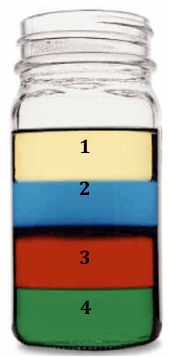
Put the liquids in order from most dense to least dense?
a)
4, 3, 2, 1
b)
1, 2, 3, 4
c)
3, 4, 2, 1, 
d)
4, 3, 1, 2
6.

Which box has a higher density?

a)

A

b)

B

c)

They are the same

7.
Frank has a paper clip. It has a mass of 9g and a volume of 3cm3. What is its density?
a)
3 g/cm3
b)
1/3 g/cm3
c)
27 g/cm3
d)
39 g/cm3
8.

Calculate the density in the following question: A flower pot has a mass of 95 g and a volume of 92 mL.

a)

1.03 g/mL

b)

0.97 g/mL

c)

1.01 g/mL

d)

0.99 g/mL

9.
In the picture, the mass of the block is 200 g, the dimensions of the block are 6 cm by 4 cm by 5 cm.  What is its density?
a)
1.67g/cm3
b)
13.33 g/cm3
c)
0.60 g/cm3
d)
 24000 g/cm3
10.
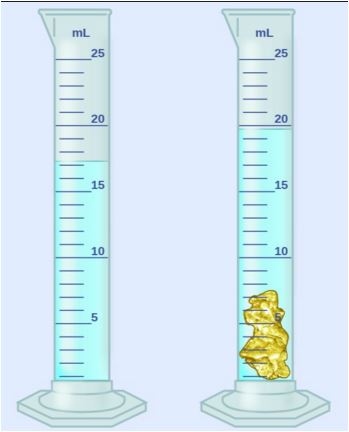
An irregularly shaped piece of gold was lowered into a graduated cylinder holding a volume of water equal to 17 ml. The height of the water rose to 20 ml. If the mass of the gold was 27 g, what was its density?
a)
9 g/mL
b)
10.5 g/mL
c)
6.5 g/mL
d)
8 g/mL
11.
An irregularly shaped rock was lowered into a graduated cylinder holding a volume of water equal to 50 ml. The height of the water rose to 75 ml. If the mass of the stone was 250 g, what was its density?
a)
15 g/mL
b)
5 g/mL
c)
10 g/mL
d)
20 g/mL
12.

The volume of the water is 40 mL. An object was placed inside the graduated cylinder and it now reads 65 mL. The mass of the object is 125 g. What is the DENSITY of the object?

a)
40 mL
b)
65 mL
c)

25 mL

d)

5 mL

13.
What is the volume of 150 grams of lead if it has a density of 11.3 g/cm3?
a)
13.3 g
b)
13.3 cm3
c)
.075 g
d)
1695 cm3
14.

The density of a material is 2 g/cm3. The volume is 24 cm3 . What is the mass?

a)
12 grams
b)
48 grams
c)
12 g/cm3
d)
48 g/cm3
15.
A displacement reaction will occur when...
a)
a more reactive metal displaces a less reactive metal from its compound.
b)
A less reactive metal displaces a more reactive metal from its compound
c)
Displacement only occurs when two of the same metals are reacted 
d)
Displacement reactions will only occur in metals above iron in the reactivity series
16.

Iron + copper oxide ----

a)

Iron + copper oxide

b)

Iron oxide + copper oxide

c)

Iron oxide + copper

d)

No reaction

17.

Which of the following is more reactive?

a)

Calcium

b)

Magnesium

c)

Zinc

d)

copper

18.

What will the products of this reaction be?

calcium + zinc nitrate --------->

a)

Calcium + zinc nitrate

b)

Zinc + calcium nitrate

c)

there will be no reaction

d)

Zinc + calcium chloride

19.
What will be the result of :  Zn + AuCl2->
a)
ZnCl2 +Au
b)
ZnAu + Cl2
c)
no reaction
d)
ClAu + Zn
20.

Which of the following metals is the most reactive?

a)

Copper

b)

Iron

c)

Zinc

d)

Magnesium

21.

Which metal will not react with iron sulfate?

a)

Iron

b)

Magnesium

c)

Copper

d)

Zinc

22.

What is the word equation for the reaction between magnesium and copper sulfate?

a)

Magnesium + Copper sulfate → Copper + Magnesium sulfate

b)

Copper + Magnesium sulfate → Copper sulfate + Magnesium

c)

Magnesium + Copper sulfate → Magnesium + Copper sulfate

d)

Copper + Magnesium sulfate → Magnesium + Copper sulfate

23.

What is the reactivity series used for?

a)

To predict displacement reactions

b)

To measure the temperature of reactions

c)

To determine the color of metals

d)

To identify the density of metals

24.

Which of the following metals will not react with air and water?

a)

Gold

b)

Zinc

c)

Iron

d)

Magnesium

25.

What are the products of the reaction between iron oxide and aluminium?

a)

Aluminium and iron sulfate

b)

Iron and aluminium oxide

c)

Aluminium and iron oxide

d)

Iron and aluminium sulfate

26.
Ionic bonds form between two ions that have...
a)
ionic compounds
b)
negative charges
c)
positive charges
d)
opposite charges
27.
Which is most likely to form a negative ion...
a)
an element from Group 17
b)
a metal
c)
an element from Group 1
d)
an element with atoms that have eight valence electrons
28.
Which of the following is the correct name for MgCl2....
a)
Magnesium Clorine
b)
Magnesium Dicholorine
c)
Magnesium Cloride
d)
Magnesium Dichloride
29.
A(n) _____________ is an atom or group of atoms that has an electric charge. 
a)
ion
b)
electron
30.

Cl2

a)

Covalent Bond

b)

Ionic Bond

31.

Valence electrons are found

a)

in the innermost energy level of an atom

b)

in the middle energy levels of an atom

c)

in the outermost energy levels of an atom

32.

How do covalent bonds form?

a)

By donating and receiving valence electrons between atoms.

b)

Scientists still aren't sure.

c)

Opposite slight charges attract each atom in the compound.

d)

Sharing valence electrons between atoms

33.
Covalent bonds are between...
a)
Metal and Non-metal
b)
Non-metal and Non-metal
c)
Metal and Metal
34.
How are ionic bonds formed?
a)
Transfer of electrons
b)
Sharing of electrons
35.
What is the charge on a Hydrogen ion?
a)
+1
b)
1
c)
2
36.

What kind of bond will form between Hydrogen and Oxygen?

a)

ionic

b)

covalent

c)

metallic

d)

no bond

37.
In an electron dot diagram, two pairs of shared electrons represents a ...
a)
single bond
b)
double bond
c)
triple bond
d)
quadruple bond
38.
A Nitrogen molecule (N2) has one triple bond. How many electrons do the nitrogen atoms share?
a)
1
1
b)
3
c)
4
d)
6
39.
Compared to ionic compounds, molecular compounds generally have...
a)
good conductivity
b)
greater densities
c)
more chemical bonds
d)
a low boiling point
40.
Compared to ionic compounds, molecular compounds generally have...
a)
stronger chemical bonds
b)
poor conductivity
c)
a high melting point
d)
lower densities
41.

What is the correct Lewis Dot Structure for ammonia NH3

a)
b)
c)
d)
42.

Which is the correct molecular structure for carbon dioxide?

a)
b)
c)
d)
43.

Which Lewis Dot Model drawing correctly shows an O2 molecule?

a)
b)
c)
d)
44.

dinitrogen pentoxide

a)

N2O5

b)

NO5

c)

N5O2

d)

N2O6

45.

hydrochloric acid + calcium carbonate ---> .......... + water + carbon dioxide

a)

calcium sulfate

b)

calcium chloride

c)

calcium hydroxide

d)

calcium nitrate

46.

Which gas is produced when metal reacts with acid?

a)

Hydrogen

b)

Oxygen

c)

Carbon dioxide

d)

Nitrogen

47.

Which gas is produced when metal carbonates reacts with acid?

a)

Hydrogen

b)

Oxygen

c)

Carbon dioxide

d)

Nitrogen

48.

What is the name of the method described in the picture to get solid salt from the solution?

a)

Evaporation

b)

Distillation

c)

Filtration

d)

Extraction

49.

The method described in the picture is ........

a)

Evaporation

b)

Distillation

c)

Filtration

d)

Extraction

50.

What is the pH of a neutral salt?

a)

<7

b)

7

c)

>7

d)

0

51.
A salt is formed when nitric acid combines with sodium hydroxide. What is the name of the salt?
a)
Sodium chloride
b)
Sodium nitrate
c)
Hydrogen Nitrate
d)
Nirate
52.

Which method of preparation can be used to make a sample of sample of copper carbonate?

a)

Metal and acid

b)

Acid and base

c)

precipitation

53.

Ionic precipitation involves what type of reaction?

a)

Neutralization

b)

Double displacement

54.

An indicator is?

a)

A lab manual or guide

b)

Something like litmus paper that can tell you if a substance is acidic or basic

c)

A PS4 game where you pretend to direct traffic

d)

Something only scientists in a lab can use

55.

Do acids and bases conduct electricity?

a)

Only acids conduct electricity

b)

Only bases conduct electricity

c)

Bases and acids conduct electricity

d)

Neither conduct electricity

56.

When you neutralize acid with a base you create

a)

a Salt and water

b)

You can not neutralize acid with a base

c)

You create carbon dioxide

d)

A moderate sized explosion

57.

A substance with a ph of higher that 7.5 is a?

a)

Home dog doggity

b)

Base

c)

Acid

d)

Salt

58.

A substance with a ph of lower than 7 is a

a)

Acid

b)

True OG

c)

Base

d)

Salt

59.

Metal + Steam yields ___________

a)

Metal Oxide + Hydrogen

b)

Metal Hydroxide + Hydrogen

c)

A + B

d)

Metal Oxide

60.

Acid + Carbonate yields _____________________

a)

Salt + Hydrogen

b)

Salt + Water + Carbon Dioxide

c)

Salt + Water

d)

Salt + Alkali