
Font size
 Worksheets
Electricity and Magnetism
Total questions: 69
Worksheet time: 2hrs 16mins
1-10.
Answer the questions below after watching the video
Which metals are primarily known to have magnetic properties?
Lead, Tin, and Mercury
Gold, Silver, and Platinum
Copper, Aluminum, and Zinc
Iron, Nickel, and Cobalt
What happens when you bring similar magnetic poles together?
They repel each other
They neutralize each other's magnetic field
They attract each other
Nothing happens
Why do opposite magnetic poles attract each other?
Due to gravitational force
Because of the alignment of their atoms
Because of static electricity
Due to the magnetic field interaction
How do magnetic field lines illustrate the strength of a magnetic field?
The farther they are, the stronger the field
They do not indicate strength
The closer they are, the weaker the field
The closer they are, the stronger the field
What is the primary function of a compass?
To measure the intensity of magnetic fields
To align with Earth's magnetic field
To show the direction of the wind
To detect electric fields
How can you visualize a magnetic field?
Through a glass of water
By using a flashlight
With iron filings
Using a bar magnet
What creates an electromagnet?
Permanent magnets
Electrical current flowing through a wire
Rubbing a piece of iron against a magnet
Placing a metal in a strong magnetic field
What happens to the magnetic field of an electromagnet when it is disconnected from electricity?
It remains unchanged
It reverses direction
It disappears
It becomes a permanent magnetic field
What demonstrates the relationship between electricity and magnetism?
A compass needle moving in sunlight
A magnet moving near a copper coil
Two magnets attracting each other
A battery and a wire creating a magnetic field
Which of the following is not a use of electromagnets?
In non-electric heaters
In speakers
In doorbells
In motors
11-25.
Answer the questions below after watching the video
What analogy is used to explain the concept of current in electrical circuits?
Water flowing through a pipe
Cars on a highway
Air moving through an atmosphere
Sound waves through a medium
What remains constant throughout a wire even when obstructed by resistors?
Resistance
Voltage
Current
Power
Which factor does NOT affect the resistance of a material?
Temperature
Color
Cross-sectional area
Material type
Which component is likened to friction in explaining resistance?
Transformer
Inductor
Capacitor
Resistor
What does voltage in a circuit primarily do?
Decreases current
Increases resistance
Reduces power output
Pushes electrons through
In a series circuit, how is the total resistance calculated?
Subtracting the resistances
Adding the resistances
Multiplying the resistances
Dividing the resistances
How does the voltage drop across each resistor in a series?
It varies depending on the resistance
It increases
It remains constant
It decreases
What does the term 'voltage drop' refer to in a circuit?
A reduction in current
An increase in power
A decrease in resistance
A decrease in voltage across a component
How do you calculate the voltage drop across a resistor in a series circuit?
Add the resistances of all resistors
Divide the total voltage by the number of resistors
Subtract the resistance from the total current
Multiply the current by the resistance of the resistor
What happens to the total resistance in a parallel circuit when more resistors are added?
It increases
It becomes zero
It decreases
It remains the same
In a parallel circuit, how does the current behave?
It only flows through the path with highest resistance
It stops flowing
It varies depending on the resistance of each path
It is the same through each path
In a parallel circuit, if one path has a lower resistance, how does the current behave?
Equal current flows through all paths
Current stops flowing through the lower resistance
No current flows through the lower resistance
More current flows through the lower resistance
What is the effect of adding more resistors in parallel on the total resistance?
Makes the resistance infinite
Has no effect on the resistance
Decreases the resistance
Increases the resistance
What is the first step in solving a complex circuit with both series and parallel resistors?
Replace all resistors with a single equivalent resistor
Identify and solve series and parallel sections separately
Add all resistances
Calculate the total power
What is the key difference in current flow between series and parallel circuits?
Current stops in series when a resistor is added
Current is constant in series and variable in parallel
Current doubles in parallel circuits
Current is variable in series and constant in parallel

A Circuit is the pathway through which electricity flows.
True
False

Insulator

power source

conductor

load

Switch
Which Image has an electrical current flowing through (closed Circuit) ?


The energy being used is __________ and it is producing _______ energy.
Electrical energy to sound energy.
Electrical energy to mechanical energy.
Sound energy to electrical energy.
Sound energy to light energy.

The energy being used is __________ and it is producing _______ energy.
Electrical energy to sound energy.
Electrical energy to mechanical energy.
Electrical energy to Light energy.
Electrical energy to light and thermal energy.

How dependent are we on electricity?
Extremely dependent.
Sort of dependent.
I can live without it.
Fill in the blank:
Ohm’s law explains the relationship between ……………. in a circuit.
Voltage ,Current and Power
Voltage ,Current and Resistance
Voltage and Current
Only Voltage
How can Ohm's law be written?
R=I/V
V=I×R
V=I/R
What does water need in order for it to flow?
More of it
Different temperature
Ice
A high and low part
If you want water to go from low potential energy to high you would need to add...
A pump
a boat
a diving board
A ramp
What could the cause of the potential difference (voltage) in our circuit be? (like the water pump)
What is the potential difference (voltage) between a 1.5V and a 9v battery?
1.5 has a larger potential difference
9 has a larger potential difference
The number only describes the size of the battery
The number only describes how long the battery will last
What causes a light bulb to be brighter
Current
Voltage
Resistance
Ohm's Law describes how Voltage, Current, and Resistance are related by the equation I = V/R. Which equation would help us find resistance?
R = V x I
R = I / V
R = V / I
Ohm's Law describes how Voltage, Current, and Resistance are related by the equation I = V/R. Which equation would help us find voltage?
V = I x R
V = I / R
V = R / I


The picture shows an electrical circuit. This circuit is a series circuit because:
It has 3 light bulbs.
The same current flows through all three light bulbs.
It uses a single battery.
The electrical current has more than one path to flow through
What is the total voltage of the battery if its 5 resistors produce the follwoing drops: 8V, 2V, 5V, 1.5V and 1.5V?
4.5 V.
9 V.
18 V.
36 V.
The following type of circuit has the same voltage throughout the entire circuit.
series
parallel
What is current?
the amount of push the electrical source supplies to the circuit
how much a given device resists the flow of electric current
flow of electric charge
none of the above
The current is the same throughout this type of circuit
series
parallel

A parallel circuit has 6 ohm, 10 ohm, 12 ohm and 15 ohm resistors. Which resistor will have the highest amount of current flowing through it?
15
12
10
6
If we added a 4th lightbulb...
the bulbs would get brighter
the bulbs would turn off
the bulbs would all get dimmer
the bulbs would each have a different brightness

What is the total resistance of a series circuit with values of 5, 9, and 17 ohms?
31
765
17
3
Skip question. What is the current of a series circuit with values of 5, 9, 17 ohms, with a battery of 12V
0.3871
3870.0
372.0
4.4395
Three resistors, RA=10 Ω , RB =20 Ω , and RC = 25 Ω , are connected in PARALLEL. The total resistance of this setup is equal to _____.
0.19 Ω
5.26 Ω
18.33 Ω
55 Ω
Three resistors, RA=10 Ω , RB =20 Ω , and RC = 25 Ω , are connected in SERIES. The total resistance of this setup is equal to _____.
0.19 Ω
5.26 Ω
18.33 Ω
55 Ω

The total resistance in this type of circuit is always smaller than any of its single resistor.
series
parallel
In a parallel circuit, when one light goes out, the others stay on. Now that there are less paths for the electrons, is there more or less total resistance?
more (more backed up electrons, since there are less options for them to go)
less
the same
In a parallel circuit, when one light goes out, the others stay on. Would they get brighter or dimmer?
brighter
dimmer
stay the same

Battery

Bulb

Switch

Resistor
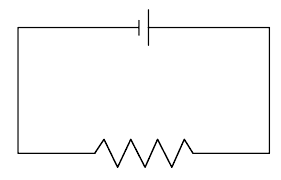
3 Amps
192 Amps
2 Amps
4 Amps
A light circuit is operating at 75 Volts. What is the circuit's current if the resistance is 5 Ohms?
375 Amps
50 Amps
15 Amps
0.07 Amps
How many Volts would we need to produce a current of 8 Amps through a 6 Ohm resistor?
1.33 volts
24 volts
0.75
48 volts
What is the voltage if a resistance of 25 Ω produces a current of 250 amperes
6250V
10V
0.1 V
625 V
What is the current produced by a voltage of 240 V through a resistance of 0.2 Ω
1200 Amps
48 amps
0.0008 Amps
480 Amps
Increase
Decrease
Stay the same
X
Increase
Decrease
Stay the same
X
Ohm's Law describes how Voltage, Current, and Resistance are related by the equation I = V/R. Which equation would help us find resistance?
R = V x I
R = I / V
R = V / I
Ohm's Law describes how Voltage, Current, and Resistance are related by the equation I = V/R. Which equation would help us find voltage?
V = I x R
V = I / R
V = R / I
The picture shows an electrical circuit. This circuit is a series circuit because:
It has 3 light bulbs.
The same current flows through all three light bulbs.
It uses a single battery.
The electrical current has more than one path to flow through
What is the total voltage of the battery if its 5 resistors produce the follwoing drops: 8V, 2V, 5V, 1.5V and 1.5V?
4.5 V.
9 V.
18 V.
36 V.
The following type of circuit has the same voltage throughout the entire circuit.
series
parallel
What is current?
the amount of push the electrical source supplies to the circuit
how much a given device resists the flow of electric current
flow of electric charge
none of the above
The current is the same throughout this type of circuit
series
parallel
A parallel circuit has 6 ohm, 10 ohm, 12 ohm and 15 ohm resistors. Which resistor will have the highest amount of current flowing through it?
15
12
10
6
If we added a 4th lightbulb...
the bulbs would get brighter
the bulbs would turn off
the bulbs would all get dimmer
the bulbs would each have a different brightness
What is the total resistance of a series circuit with values of 5, 9, and 17 ohms?
31
765
17
3
What is the current of a series circuit with values of 5, 9, 17 ohms, with a battery of 12V
0.3871
3870.0
372.0
4.4395
Three resistors, RA=10 Ω , RB =20 Ω , and RC = 25 Ω , are connected in PARALLEL. The total resistance of this setup is equal to _____.
0.19 Ω
5.26 Ω
18.33 Ω
55 Ω
Three resistors, RA=10 Ω , RB =20 Ω , and RC = 25 Ω , are connected in SERIES. The total resistance of this setup is equal to _____.
0.19 Ω
5.26 Ω
18.33 Ω
55 Ω
The total resistance in this type of circuit is always smaller than any of its single resistor.
series
parallel
In a parallel circuit, when one light goes out, the others stay on. Now that there are less paths for the electrons, is there more or less total resistance?
more (more backed up electrons, since there are less options for them to go)
less
the same
In a parallel circuit, when one light goes out, the others stay on. Would they get brighter or dimmer?
brighter
dimmer
stay the same

