
 Worksheets
Matter Test Review
Total questions: 73
Worksheet time: 6hrs 5mins
Match the following
Pure Substance
One element or one compound.
Mixture
Two or more substances not bonded.
Element
Contains only one kind of atom.
Compound
Contains two or more kinds of atoms.
True or False: elements AND compounds are pure substances.
True
False

Which sample shows a mixture?


Each substance keeps its own properties in this type of matter:
element
compound
mixture
pure substance
Which sample shows a pure substance?


Which of the following is a mixture?
Glucose (C6H12O6)
Salt Water (NaCl + H2O)
Iron (Fe)
Gold (Au)


element
compound
heterogeneous mixture
homogeneous mixture
Salt (NaCl)
Element
Compound
Mixture
H2SO4
NaCl + H2O
Kool-aid
Distilled Water
Match the following
H2
Ni
H2O
SrO

Use the Image to answer the question.
II is a (a)
III is a (b)
IV is a (c)
Match the following
Colloid
Medium Particle Size
Solution
Small Particle Size
Suspension
Large Particle Size
Match the following
Suspension
Forms Layers Quickly
Solution
Never Forms Layers
Colloid
Forms Layers Overtime

In the context of saltwater, what is the solvent?
Salt
Sugar
Water
Vinegar

In the context of hot tea, what is the solute?
Water
Tea
Sugar
Milk
Which of the following is an example of a colloid that separates into layers over time?
Organic Peanut Butter
Sand mixed in water
Saltwater
Italian salad dressing
How quickly do ingredients in a suspension settle into layers?
Very slowly
Moderately
Very quickly
Not at all
Which of the following is an example of a suspension?
Salt and water
Sand and water
Sugar and water
Vinegar and water
Which of the following is NOT an example of a suspension?
Orange juice with pulp
Salad dressing
Snow globe
Saltwater
What are physical properties of a pure substance?
Properties that change the material permanently
Properties that can be observed without changing the material permanently
Properties that involve breaking molecular bonds
Properties that require chemical reactions
What happens to bonds during a physical change?
Old bonds are broken between atoms and new bonds form between new atom combinations.
Old bonds are not broken or formed.
This is the physical property observed when an object can be hit with a hammer and flattens without breaking.
Hardness
Malleability
Ductility
pH
This is the physical property observed when an object can be heated and pulled into a wire.
Hardness
Malleability
Ductility
pH
An object is found to have a pH of 6.5
Would this be considered acidic, basic, or neutral?
acidic
basic
neutral
An object is found to have a pH of 12.5
Would this be considered acidic, basic, or neutral?
acidic
basic
neutral
An object is found to have a pH of 7.0
Would this be considered acidic, basic, or neutral?
acidic
basic
neutral
How can a Pure Substance Element exist in nature? Choose all that apply
as a single atom
as a molecule
How can a Pure Substance Compound exist in nature? Choose all that apply
as a single atom
as a molecule
What are the 3 ways to increase the rate of a solute dissolving in a solvent? Choose all that apply
Increase the amount of surface area of the solute.
Decrease the amount of surface area of the solute.
Increase the temperature of the solvent.
Decrease the temperature of the solvent.
Increase the amount of stirring of the solution.
In which mixture can you see all of the parts?
homogeneous
heterogeneous
Identify which images are HETEROGENEOUS MIXTURES! (Check all that apply)


Solutions are ___________ mixtures.
Solid
Homogenous
Heterogeneous
Gas
A material with a particular chemical makeup
mixture
pure substance
hetogeneous
homogeneous
Substances in a mixture can be separated by physical methods.
TRUE
FALSE

This technique is based on the differences of the boiling point of the substance in the mixture.
decantation
distillation
filtration
chromatography

It is a technique in which an insoluble solid is separated from a liquid.
Filtration
Sieving
Decantation
Use of Magnets

It involves separating a mixture based on different sizes of components.
Decantation
Sieving
Use of Magnets
Filtration

Vinegar
Solution
Suspension
Colloid
Hydrogen gas
Element
Compound
Mixture
2 or more different substances that are physically together is called...
element
compound
mixture
solute
Which of the following a correct way to separate a compound?
A reaction must occur to break the bonds
Distillation using boiling points
Filtering using paper to hold the solid from the liquid
Magnetic Attraction to separate metals from non-metals
Which of the following a correct way to separate a mixture?
A reaction must occur to break the bonds
Distillation using boiling points
Mixtures cannot be separated
Combustion of some kind
All phases changes are considered...
physical and therefore relate to mixtures.
chemical and therefore relate to compounds.
physical and therefore relate to elements.
chemical and therefore relate to molecules.
All the separation techniques we learned about are
chemical means of separating matter.
physical means of separating matter.
reactive means of separating matter.
unclear means of separating matter.

Ink can be separated by a method of -----------------------------------------------
distillation
filtration
chromatography
sedimentation
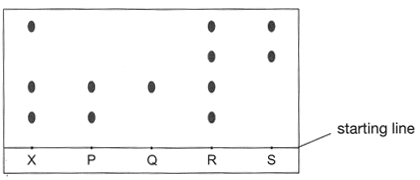
A substance is soluble if it can be dissolved.
In paper chromatography, the most soluble solute _____________________ .
does not move from the start point
stays closest to the start point
travels furthest away from the start point
can be found in the middle of the chromatogram
Which mixture can be separated using a filter?
sand and iron filings
saltwater
sand and water
none of the above
Match the following
Sieving
Separate large solids from small solids
Filtration
Separate insoluble solid from a liquid
Evaporation
Separate a soluble solid from a liquid
Distillation
Separates mixtures of liquids by boiling
Chromatography
Separate mixtures by solubility
Match the following
Separating sand from water
Filtration
Separating oil from water
Decantation
Separating different size pebbles
Sieving
Separate salt from salt water
Evaporation
How can I increase the surface area of a solute I want to dissolve?
Break it into smaller pieces
Stir faster
Increase the temperature


What is a physical property of these strawberries?
Red
Rotten
Flammable

Determine if the following is a physical or chemical property
Solubility
Ductility
Density
Tarnish
Oxidation
Combustion
pH
Determine if the following is a physical or chemical change.
A paper is ripped in half
Salt is dissolved in water
A silver chain tarnishes
Vinegar reacts with baking soda.
A metal pan rusts

The pictures shows a (a) of (b) It is (c) .

The picture is of a (a) . It is made of (b) .
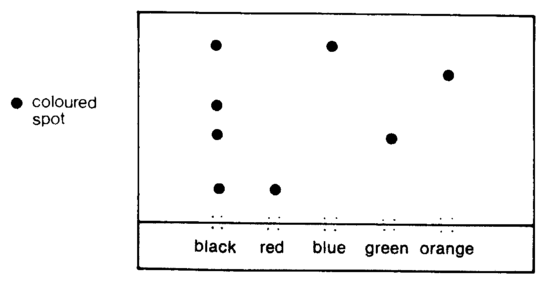

Here is chromatography of markers with the paper placed in water. What is true.
Blue dissolves best in water.
Yellow dissolves best in water.
Green dissolves best in water.
Pink dissolves best in water

