wayground logo

Free Printable Worksheets

Font size

S
M
L
XL
Worksheets

TOS Recap

Total questions: 59

Worksheet time: 47mins

Name
Class
Date
1.

What is the main difference between a physical change and a chemical change?

a)

A. Physical changes are permanent while chemical changes are temporary

b)

B. Physical changes form new substances while chemical changes do not

c)

C. Chemical changes form new substances while physical changes do not

d)

D. There is no difference between physical and chemical changes

2.

Which of the following is NOT a characteristic of chemical reactions?

a)

Evolution of gas

b)

Change of color

c)

Change of temperature

d)

Change of shape only

3.

When sodium chloride reacts with silver nitrate in solution, what is formed?

a)

A. A yellow precipitate

b)

B. A white precipitate

c)

C. A green gas

d)

D. A blue solution

4.

What type of reaction releases heat energy?

a)

Endothermic reaction

b)

Exothermic reaction

c)

Neutral reaction

d)

Catalytic reaction

5.

In the Haber process for manufacturing ammonia, what conditions are required?

a)

Low temperature and low pressure

b)

High temperature and low pressure

c)

Low temperature and high pressure

d)

High temperature and high pressure

6.

Which condition is necessary for photosynthesis to occur?

a)

High pressure

b)

Light

c)

Electricity

d)

Catalyst

7.

What happens when electric current is passed through acidulated water?

a)

Water turns into steam

b)

Water forms ice

c)

Water decomposes into hydrogen and oxygen

d)

Water becomes acidic

8.

In a synthesis reaction, what happens?

a)

One compound breaks into multiple substances

b)

Two or more substances combine to form one product

c)

Two compounds exchange ions

d)

One element replaces another in a compound

9.

The decomposition of mercuric oxide produces which products?

a)

Mercury and hydrogen

b)

Mercury and oxygen

c)

Oxygen and hydrogen

d)

Mercury and water

10.

What determines if one metal can displace another in a single displacement reaction?

a)

The color of the metals

b)

The size of the metals

c)

The reactivity series of metals

d)

The temperature of the reaction

11.

In a double displacement reaction, what happens?

a)

One element is replaced

b)

The positive ions switch places

c)

Three compounds are formed

d)

Only gases are produced

12.

Which equation represents a precipitation reaction?

a)

HCl + NaOH → NaCl + H₂O

b)

Na₂S + 2HCl → 2NaCl + H₂S

c)

Na₂SO₄ + BaCl₂ → BaSO₄ + 2NaCl

d)

4K + O₂ → 2K₂O

13.

What happens during a combustion reaction?

a)

A. A substance combines with nitrogen

b)

B. A substance combines with oxygen

c)

C. A substance combines with hydrogen

d)

D. A substance combines with carbon

14.

Which is required for sodium to react with water?

a)

Heat

b)

Light

c)

Physical contact

d)

Electricity

15.

What happens in a redox reaction?

a)

Only oxidation occurs

b)

Only reduction occurs

c)

Both oxidation and reduction occur simultaneously

d)

Neither oxidation nor reduction occurs

16.

When iron and sulfur react to form iron sulfide, what condition is necessary?

a)

Presence of water

b)

Presence of light

c)

Application of heat

d)

Application of pressure

17.

Which of these is an example of a gas evolution reaction?

a)

Formation of rust

b)

Burning of magnesium

c)

Formation of Hydrogen sulphide

d)

Formation of silver chloride

18.

In the reaction Fe + S → FeS, this is classified as what type of reaction?

a)

Decomposition

b)

Single displacement

c)

Double displacement

d)

Synthesis

19.

What happens during a neutralization reaction?

a)

Two gases combine

b)

An acid reacts with a base

c)

A metal displaces another metal

d)

A compound breaks down

20.

What is the correct answer?

a)

Option 1

b)

Option 2

c)

Option 3

d)

Option 4

21.
What type of chemical reaction takes place when fluorine reacts with sodium bromide?
a)
single replacement 
b)
double replacement 
c)
combustion
d)
synthesis 
22.
What are the correct coefficients when this equation is balanced?
KClO3  --> KCl  +  O2
a)
2,2,2
b)
2,2,3
c)
1,2,3
d)
3,3,3
23.
A metal is reacted with an acid to produce a salt and a hydrogen gas. What type of reaction has occurred? 
a)
neutralization 
b)
double replacement 
c)
single replacement 
d)
synthesis 
24.
Predict the products of the following equation: Mg + AgCl →
a)
No reaction
b)
MgAg + Cl2
c)
products are unpredictable
d)
MgCl2 + Ag
25.
Predict the products of the following reaction: Pb(NO3)2 + 2KI → 
a)
PbI+ K(NO3)
b)
PbK + I(NO3)
c)
no reaction
d)
PbK(NO3) + I
26.
Which type of reaction requires the activity series?
a)
synthesis
b)
decomposition
c)
single replacement
d)
double replacement and single replacement
27.
Balance this equation:  H2 + N2 → NH3
a)
 H2 + 4N2 → NH3
b)
 H2 + 3N2 → 2NH3
c)
 3H2 + N2 → 2NH3
d)
 2H2 + 2N2 → 2NH3
28.
If the reactants on the left side of a chemical equation are C₃H₈ + 5O₂, the products in a balanced equation could be
a)
4CO₂ + 3H₂O
b)
3CO₂ + 4H₂O
c)
2CO₂ + 3H₂O
d)
3CO + 4H₂O
29.

metal hydroxide (+ heat) → ____________ + _________

a)

metal carbonate + water

b)

metal oxide + carbon dioxide

c)

carbon dioxide + water

d)

metal oxide + water

30.

______________ (+ heat) → zinc oxide + carbon dioxide

a)

zinc carbonate

b)

zinc oxide

c)

zinc dioxide

d)

zinc hydrogen carbonate

31.

What type of reaction is this?

Al(OH)3 → Al2O3 + H2O

a)

Combination

b)

Decomposition

c)

Single Replacement

d)

Double Replacement

32.

Predict the products for the following reaction:

Ca + P →

a)

CaP

b)

Ca2P3

c)

Ca3P2

d)

CaP + Ca3P2

33.

Identify the reaction type:

2H2O --> 2H2 + O2

a)

Thermal decomposition

b)

Photolytic decomposition

c)

Electrolytic decomposition

d)

Thermal dissociation

34.

How many Oxygens are on the product side of this chemical equation?

a)

1

b)

2

c)

3

d)

4

35.

Why are chemical equations always balanced? Select ALL that apply.

a)

Matter cannot be created.

b)

Matter cannot be destroyed.

c)

Matter can only be rearranged/conserved.

d)

Matter doesn't matter.

36.

In an exothermic reaction, the products have more stored energ than the reactants

a)

True

b)

False

37.
Translate the following word equation: 
Liquid nitrogen and oxygen gas combine to form nitrogen monoxide gas. 
a)
N + O → NO
b)
N2 + O2 → N2O2
c)
N2(l) + O2(g) → NO(g)
d)
N(l)O2(g) → NO(g)
38.

6 CO2+ 6 H2O + Energy  C6H12O6 + 6 O26\ CO_2+\ 6\ H_2O\ +\ Energy\ \rightarrow\ C_6H_{12}O_6\ +\ 6\ O_2

a)

endothermic reaction

b)

exothermic reaction

39.
A chemical reaction is...
a)
when a substance is mixed with another substance
b)
when a substance undergoes a change to form a new substance
c)
when a substance is dissolved into another substance
d)
when a substance is heated or exposed to another substance
40.
A student places a piece of a potato into a container of hydrogen peroxide. One observation the student makes is that bubbles form around the potato. The presence of bubbles might indicate the formation of a new substance because bubbles - 
a)
could show that a gas is forming.
b)
always rise to the top of a liquid. 
c)
are almost always perfectly spherical.
d)
usually burst after a few minutes.
41.
Four students performed four different investigations by combining different substances. Which of the observations is most indicative of a chemical reaction?
a)
investigation 1
b)
investigation 2
c)
investigation 3
d)
investigation 4
42.
Which of the following is an example that includes evidence of a chemical reaction?
a)
A sample of zinc is placed in water and it settles to the bottom
b)
A solid block of ice is heated and it completely melts into a liquid. 
c)
Sugar that is burned gives off an odor and turns brown and then black.
d)
A tomato is placed into a blender and chopped up into smaller pieces.
43.
A clear liquid from a flask is poured into another clear liquid in a beaker. Which of the following results of this procedure would indicate a new substance was formed?
a)
The level of the substance in the beaker is higher after the other liquid is added.
b)
A yellow solid forms and then settles to the bottom of the beaker.
c)
Small white crystals are left behind in the flask that held the first liquid.
d)
The mass of the combined liquids is greater than either original liquid.
44.
You know you a chemical reaction has occurred if 
a)
there is a precipitate.
b)
there is a color change.
c)
there is a temperature change.
d)
All of these answers are evidence.
45.
Which of the following describes a precipitate?
a)
a liquid forms when a block of metal is heated
b)
a solid forms when one liquid is poured into another
c)
a gas forms when a solid is placed in a liquid
d)
bubbles form when an acid is poured on a rock
46.
A molecule is________
a)
a glob of gelatinous goo
b)
smaller than an atom
c)
filled with raisons
d)
more than one atom bonded together
47.
What are the PRODUCTS of the chemical reaction pictured?
a)
CH4 and CO2
b)
CH4 and O2
c)
CO2 and H2O
d)
O2 and H2O
48.
CaCO3 represents a chemical
a)
Symbol
b)
Formula
c)
Subscript
d)
Reaction
49.
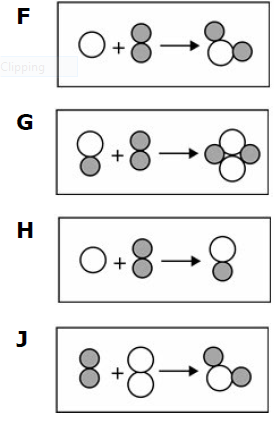
Which of the following models best demonstrates a balanced chemical equation?
a)
F
b)
G
c)
H
d)
J
50.
Si + S8 →Si2S4
a)
Synthesis (combination)
b)
Decomposition
c)
Single replacement
d)
Double replacement
51.
Ca + AlCl3→ CaCl2 + Al
a)
Synthesis (combination)
b)
Decomposition
c)
Single replacement
d)
Double replacement
52.
KOH + H3PO4 → K3PO4 + H2O
a)
Synthesis (combination)
b)
Decomposition
c)
Single replacement
d)
Double replacement
53.
Pb(NO3)2 →PbO + NO2 + O2
a)
Synthesis (combination)
b)
Decomposition
c)
Single replacement
d)
Combustion
54.
NO2 →N2 + O2
a)
Synthesis (combination)
b)
Decomposition
c)
Single replacement
d)
Combustion
55.
A + BC →B + AC
a)
Single Replacement
b)
Decomposition
c)
Double Replacement
d)
Synthesis
56.
 C + O→ CO2
a)
Synthesis Reaction
b)
Decomposition Reaction
c)
Single Displacement Reaction
d)
Double Displacement Reaction
57.
Ca3(PO4)2 + 3 H2SO4 + 3 CaSO4 + 2 H3(PO4)
a)
Synthesis Reaction
b)
Decomposition Reaction
c)
Single Displacement Reaction
d)
Double Displacement Reaction
58.
In a cold pack, which type of reaction draws heat from the surroundings?
a)
exothermic
b)
endothermic
c)
exergonic
59.

In a chemical reaction, the ___________ and _____________ are represented by chemical formulas.

(a)